BRICS countries unable to reach common ground on Iran, format loses influence, diplomat says
This opinion was expressed by Andriy Veselovsky, Ambassador Extraordinary and Plenipotentiary, advisor to the director of the National Institute for Strategic Studies, in a comment to Ukrinform.
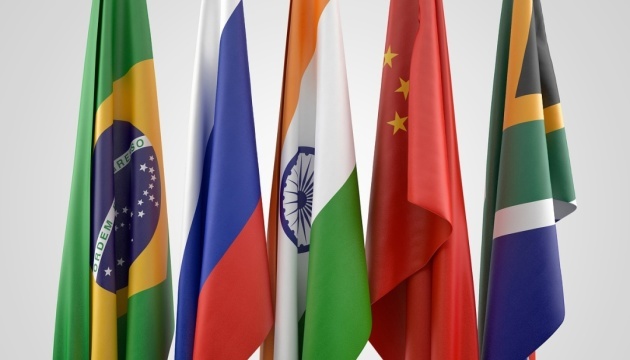
The diplomat noted that the BRICS format is quite diverse, and the countries are distant from each other. He also recalled that initially, this association included five states: Brazil, the Russian Federation, India, China, and, a little later, the Republic of South Africa.
"The first four countries are indeed influential global and regional players that maintain political and economic dialogue with each other—it is not even possible to talk about interaction. Therefore, the BRICS constitute the ‘big four’ in terms of coordinating certain positions. But in the current situation [against the backdrop of events in Iran], these positions cannot be coordinated," Veselovsky said.
In this context, he noted that, for example, Iran's nuclear weapons plans are dangerous for India because it already has two nuclear powers on its doorstep—China and Pakistan. Therefore, in this regard, India supports the United States' policy. At the same time, for Brazil, a major oil producer and exporter, the current situation surrounding Iran is beneficial, as oil prices have risen.
"For all four of these major powers, the very fact of a US attack on Iran is dangerous in terms of, so to speak, a theoretical future: What if they do the same to us? But they cannot create a joint military bloc due to geographical and political differences. They also cannot create a joint economic bloc because regional interests outweigh global ones," the diplomat stated.
According to him, the recent expansion of BRICS was most likely a “theatrical move”: The new countries (Egypt, Iran, the UAE, Indonesia, and Ethiopia) diluted the original “anti-imperialist” essence of this alliance, but did not add either their economic weight or political influence.
“Therefore, I do not see any common strong position. We have not heard of any plans by the BRICS to urgently convene a council and issue a statement [regarding the war in Iran]. And even if we did, it would not look convincing,” Veselovsky believes.
He explained that Brazil and Russia sell oil, while India and China buy it, so, for example, the rise in oil prices due to the war in the Middle East is perceived in each country through its own economic interests.
“But, in essence, I would say that BRICS has not ceased to exist in this new reality, but has largely been ‘sidelined’ as a phenomenon,” the diplomat believes.
As reported by Ukrinform, the Will for Peace naval exercises were held in early January off the coast of South Africa, with Russia and Iran participating under the auspices of the BRICS. Ships from China, South Africa, and the United Arab Emirates also took part in the exercises. Indonesia, Brazil, Egypt, and Ethiopia sent observers.
On February 28, the US and Israel launched joint strikes on Iranian regime targets. Iran then attacked US bases in Kuwait, the UAE, Qatar, Bahrain, and Jordan.
Photo: pixabay