Police: Remote mining of residential areas increasing in Kherson
Andrii Kovany, head of the communications department at the Main Directorate of the National Police in the Kherson region, told Ukrinform about this.
“Yes, we are currently observing an increase in the intensity of remote mining of residential neighborhoods. Over the past two weeks, there has been a significant rise in such incidents. This type of mining is specifically targeted at civilians, just like the shelling of the city and drone attacks,” said Kovany.
He added that the enemy’s mining of Kherson and the right bank of the Kherson region in general began in the very first days of the occupation. Back then, the Russians mined the territory for their own defense; now, they do so to cause as much harm as possible to those living on the right bank.
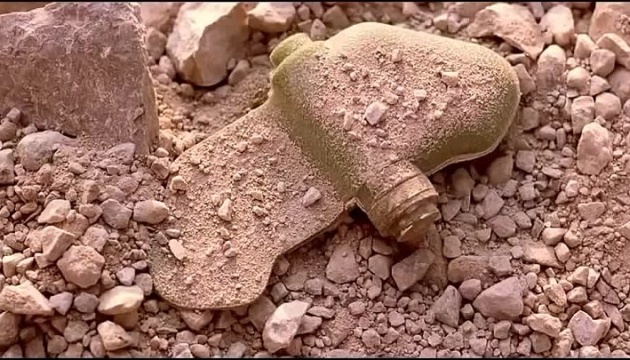
“For remote mining of the city, they mainly use ‘Peliustky’-type anti-personnel mines, specifically the PFM-1 or PFM-1S. How do they differ? The PFM-1S has a self-destruct mechanism. These are Soviet-era munitions,” Kovany clarified.
As he explained, this is a pressure-activated anti-personnel mine, meaning it explodes when a person steps on it. The consequences are serious injuries, including possible limb amputation. And if the victim does not receive medical assistance in time, such injuries can be fatal. Kovany points out that these mines are also dangerous because they are quite unstable and can explode even from high temperatures when pressure rises.
The police constantly urge local residents not to take any action regarding the mines themselves, but to report such dangerous finds to rescue workers or the police.
“These mines are small in size and inconspicuous. In addition, the Russians often camouflage them further. They may coat them in glue and then in dust for camouflage; they paint them in various colors; depending on the season, different methods of camouflaging such munitions are used. But often they are simply discarded without any camouflage,” noted Kovany.
He says that in addition to “Peliustky,” “Prianyk” anti-personnel mines have recently been detected in the city.
“This isn’t exactly new either, but they’ve been detected in the Kherson region relatively recently—over the past few months. It’s an anti-personnel mine that’s essentially homemade—not factory-produced ammunition. It has a plastic casing made using 3D printing, with an explosive charge and a pressure-activated detonator inside. Any type of detonator can be placed there. But what we’ve seen so far is specifically the pressure-activated type,” says the head of the communications department.
He also notes that the “Prianyk” contains more explosive material than the “Peliustky,” which is why the injuries can be more severe.
Kovany emphasizes that there are many types of munitions designed for mining, but these two types of mines are predominant in Kherson.
Another danger comes from the remnants of cluster munitions used by the Russians to shell the city—when they hit the ground, they don’t always explode immediately; there is a fairly high rate of misfires. “They look like little bells. People don’t always realize what they are. People might pick them up, and then the munition explodes. Unfortunately, there have been reports of both injuries and civilian deaths specifically due to careless handling of these ‘bells,’" says Kovany.
The Russians are mining the city’s territory from the occupied left bank of the region using drones. Kovany notes that the mines are dropped from FPV drones, “Mavics,” and “Molniia”-type drones. The drones can also drop metal spikes to damage vehicles.
The head of the communications department noted that in the region, bomb disposal experts are working to quickly clear areas where mines have been detected. From the beginning of the year through April 1, bomb disposal experts from the Kherson Regional Police alone responded to 751 reports of explosive devices, and 595 of them were neutralized.
Kovany emphasizes that the enemy is deliberately terrorizing the civilian population, as mines are being dropped on residential areas, where they could be stumbled upon by a child or an elderly person. In fact, such mines pose a danger even to professionals—two police bomb disposal experts were injured by “Petal” mines, in particular, and are now, after receiving prosthetics, continuing their service.
According to information provided to the agency by the Regional Military Administration, from November 11, 2022, to April 14, 2026, a total of 323 civilians were affected by explosions from mines and other explosive devices in the region; 76 of them died, including two children, and 247 people were injured, including 16 children.
As reported by Ukrinform, “Prianyk” (“Pliushka”) anti-personnel mines were discovered on the road bridge across the Koshova River in Kherson.
Photo: Armyinform