Ukraine’s reconstruction needs rise 12.2% over year — Economy Ministry
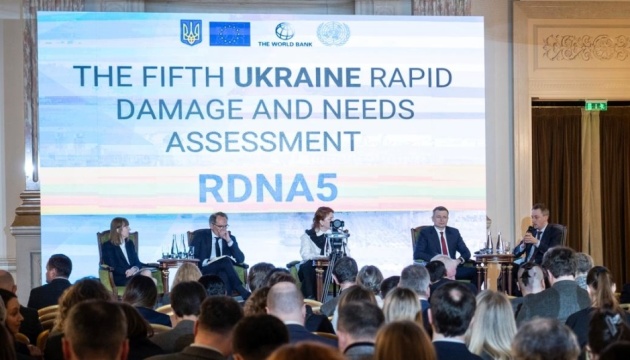
Minister of Economy, Environment and Agriculture Oleksii Sobolev announced the figures during the presentation of the Fifth Rapid Damage and Needs Assessment (RDNA5), according to the Ministry of Economy.
“Compared to RDNA4, reconstruction needs have increased by 12.2% in a year, most significantly in Donetsk, Kharkiv, Zaporizhzhia, Kyiv, Luhansk, and Kherson regions. At the same time, at least USD 20.3 billion — 3.5% of total needs — has already been financed, primarily in housing, education, transport, business, and agriculture,” Sobolev said.
According to RDNA5, as of December 31, 2025, Ukraine’s reconstruction and recovery needs for the next decade amount to over USD 587.7 billion. Direct damages are estimated at USD 195.1 billion, while economic and social losses total USD 666.7 billion.
The largest reconstruction needs are concentrated in the transport sector (USD 96.3 billion, 16.4%), energy (USD 90.6 billion, 15.4%), housing (USD 89.8 billion, 15.3%), and trade and industry (USD 63.3 billion, 10.8%).
Sobolev stressed that post-war recovery does not mean returning to the pre-war economic model. “Together with the World Bank, we developed the Economy of the Future model, which envisions doubling GDP within ten years. This means new jobs, the return of displaced people, rising incomes, and a tax base capable of sustaining a modern army and state without constant reliance on donors. It is not only our economic goal but also a security strategy against renewed aggression,” he added.
He also highlighted Ukraine’s role for Europe in security, energy, and critical minerals. Ukraine has the largest armed forces in Europe, a strong defense-industrial base, and one of the most advanced drone production ecosystems.
The country also holds significant potential in solar and wind energy, as well as reserves of critical minerals vital for Europe’s resource security.
As a reminder, RDNA5 is conducted jointly by the World Bank, the Government of Ukraine, the European Union, and the United Nations. The report builds on previous assessments and incorporates additional analytical studies. It applies the “Build Back Better” (BBB) approach and principles of green, resilient, and inclusive reconstruction, analyzing the war’s impact on vulnerable groups (displaced persons, veterans, people with disabilities) and setting short-term recovery priorities for 2026.
Photo credit: Ministry of Economy