Chornobyl: Fourteen Seconds That Shook an Empire
The prolonged and immoral concealment of the Chornobyl disaster and its consequences became one of the factors that accelerated the collapse of the Soviet Union.
April 26 marks forty years since the disaster—the largest man-made catastrophe in human history.
For years, the authorities withheld from their own citizens the truth about what had happened on that April night in 1986 at the Chornobyl Nuclear Power Plant, in the relatively prosperous, by Soviet standards, town of Pripyat. It is also possible that the system itself never fully comprehended the scale of the catastrophe. Nearly three years passed before its causes and consequences began to be discussed openly.
THE FIRST DAYS AFTER THE DISASTER: DESPAIR, FEAR, BLACK HUMOR, AND RUMORS
When Yevgeny Velikhov, a physicist and vice president of the USSR Academy of Sciences, arrived in Kyiv on May 8, 1986—accompanying a distinguished guest, the Director General of the International Atomic Energy Agency, the Swede Hans Blix—he was greeted with a freshly coined joke:
“In heaven, a Chornobyl victim and a Kyiv resident meet. ‘What brought you here?’ asks the Kyiv resident. ‘Radiation,’ replies the Chornobyl victim. ‘And you?’ ‘Information,’ says the Kyiv resident.”
The anecdote suggests that within a week of the disaster, people had regained a degree of composure and were already able—albeit grimly—to joke, as society’s psychological defense mechanisms took hold. Yet despair, anger, and fear persisted, driven above all by a chronic lack of reliable information.
Ukrainian literary scholar and translator Mykhailyna Kotsiubynska described the situation as an “information noose” imposed by the Soviet authorities, while poet Iryna Zhylenko wrote in her diary: “The government maintains a vile and senseless silence, or brazenly lying…”
In the first days after the accident at the Chornobyl Nuclear Power Plant, rumors became the only source of information: “They say, they say… And that ‘they say’ is the only source of information. The government pretends that nothing worth attention has happened…”
Pavel Palazhchenko, interpreter to Mikhail Gorbachev, later recalled that Moscow was “on the verge of panic”:
“Rumors spread throughout the city. Few trusted the official version… State media—out of both habit and fear of causing panic—downplayed the consequences of the disaster. The mood in Moscow was gloomy and often angry. In short, it was a mood of deep distrust toward the authorities.”
THE TRADITION OF CONCEALMENT
In the Soviet Union, accidents at nuclear power plants were not uncommon, yet they were systematically classified. The authorities and the KGB concealed information from both the public and specialists.
For example, in late 1982, an accident occurred at the Armenian nuclear power plant near the city of Metsamor. A generator exploded, and the turbine hall burned out completely. To contain the damage, an emergency crew had to be urgently flown in from the Kola Peninsula, beyond the Arctic Circle.
Soon afterward, during the startup of a reactor at the Balakovo nuclear power plant, a relief valve exploded. Superheated steam at 300 degrees Celsius filled the circular space surrounding the reactor vessel, and fourteen workers were killed—effectively boiled alive. Yet no meaningful information about the incident appeared in the media—only brief, perfunctory notices in Pravda and, once again, rumors.
THE FIRST 14 SECONDS OF TRUTH
For two full days after the disaster at the Chornobyl NPP, the media remained completely silent. Only on the evening of April 28—the third day after the accident—did the central Moscow television program Vremya air a terse, 14-second statement.
In reality, the announcement was made under mounting international pressure. As radiation levels rose, the global community began demanding explanations. Sweden was among the first to raise the alarm: on April 27, elevated radiation levels were detected on its territory. After checking readings at the Forsmark Nuclear Power Plant, north of Stockholm, and confirming the source lay elsewhere, Swedish authorities sought clarification through diplomatic channels— —but to no avail: the Soviet leadership remained stubbornly silent.
Only after Sweden threatened to take the matter to the International Atomic Energy Agency did the Soviet Union finally acknowledge that an accident had occurred.
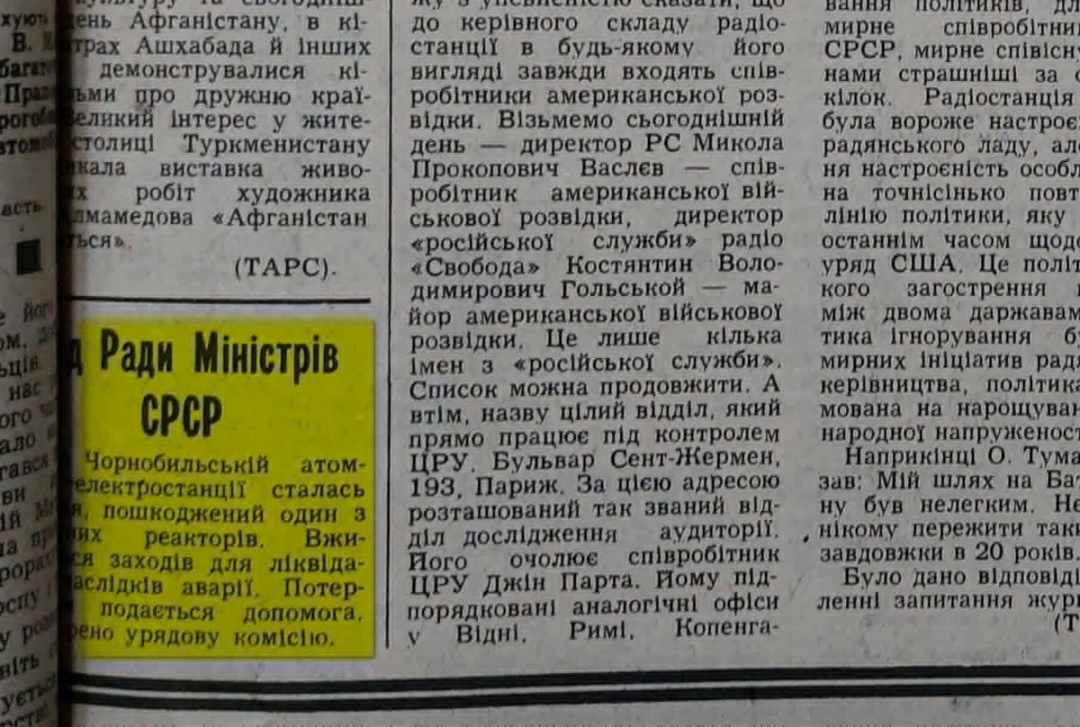
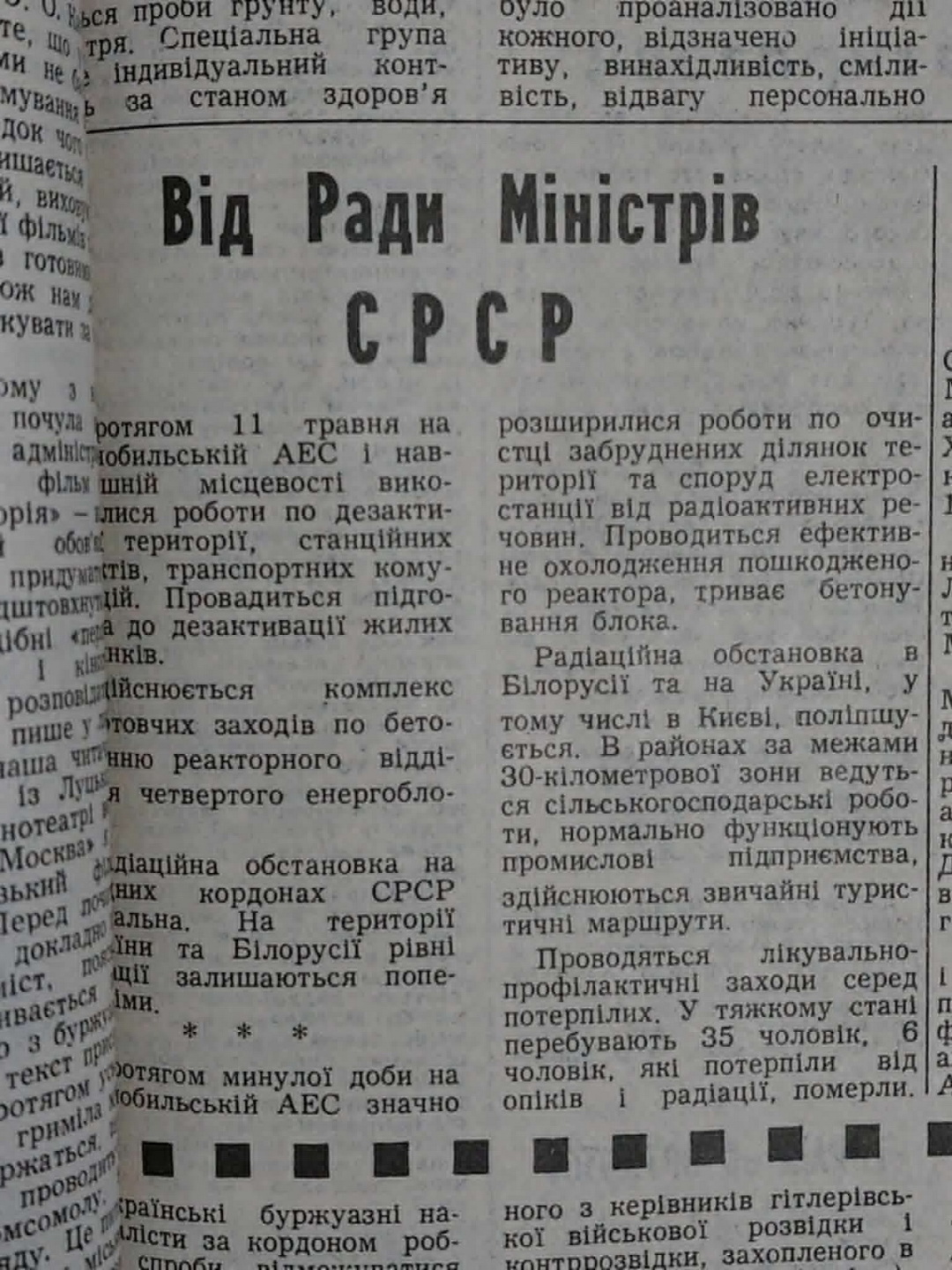
“On April 29, with authorization from Moscow, news of the accident was published in nearly all Ukrainian newspapers—reduced to just three lines tucked beneath the sports news:
“From the Council of Ministers of the Soviet Union. An accident has occurred at the Chornobyl Nuclear Power Plant; one of the nuclear reactors has been damaged. Measures are being taken to eliminate the consequences of the accident. Assistance is being provided to those affected. A government commission has been established.”
WESTERN MEDIA REPORT 2,000 DEAD
Western media immediately sought access to all available sources of information but ran into an impenetrable wall of Soviet bureaucracy. Gaining entry to Ukraine was virtually impossible; information had to be pieced together fragment by fragment.
American journalist Luther Whittington, a Moscow-based correspondent for United Press International, had shortly before the accident met a Ukrainian woman in Red Square who, he believed, had connections with the relevant state authorities.” When the catastrophe occurred, he contacted her and, based on their conversation, concluded that 80 people had died instantly in the explosion and another 2,000 on the way to hospitals.
Some of Whittington’s colleagues questioned these figures, suggesting he may have misunderstood the Kyiv resident due to his limited command of the language. Others suspected a possible provocation by the KGB intended to discredit Western journalists.
Nevertheless, the unverified but sensational report from behind the Iron Curtain spread rapidly worldwide. On April 29, headlines were striking. The New York Post ran: “2,000 dead in nuclear nightmare; Soviets ask for help—atomic plant out of control.” The London-based Daily Mail went further: “2,000 dead in atomic horror movie.” In the United States, reports of 2,000 deaths became the leading television story.
A Pentagon official, speaking to NBC, noted that available satellite imagery showed significant destruction at the Chornobyl NPP, making such casualty estimates appear plausible.
THE SOVIET “MIRACLE”: QUESTIONS ALLOWED AT A PRESS CONFERENCE
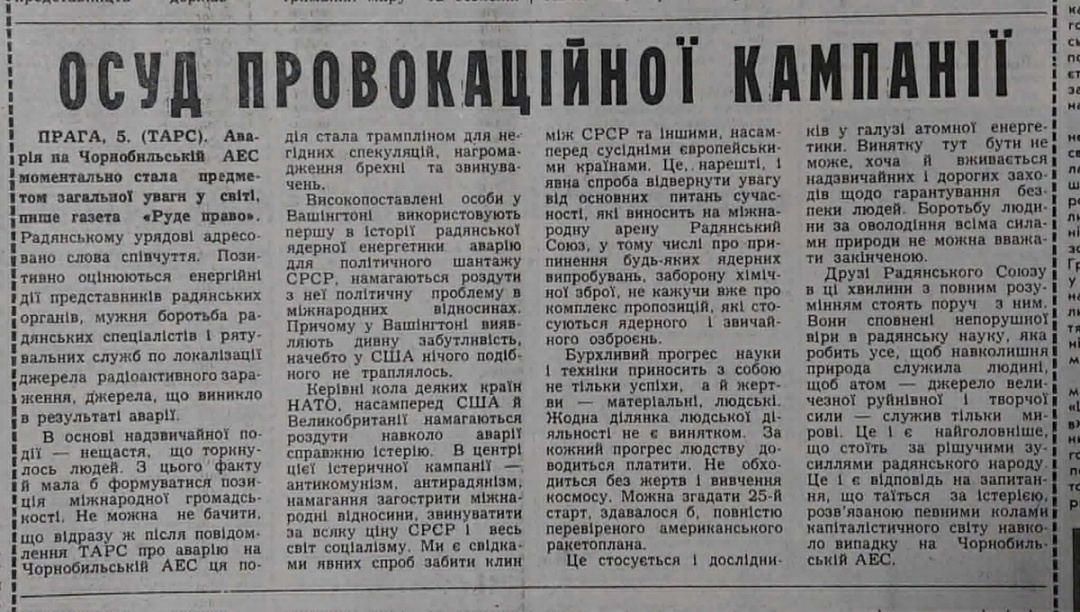
The intense attention and swift response of Western media were characterized in the Soviet Union as a “campaign of mass hysteria.” The state news agency TASS issued a statement:
“Unfortunately, certain groups, against the general background of sympathy and understanding, are attempting to exploit what has happened for dishonest political purposes. Rumors and speculation have nothing in common with basic moral standards and are being spread as propaganda. An example is the unfounded exaggeration regarding thousands of deaths and panic among the population.”
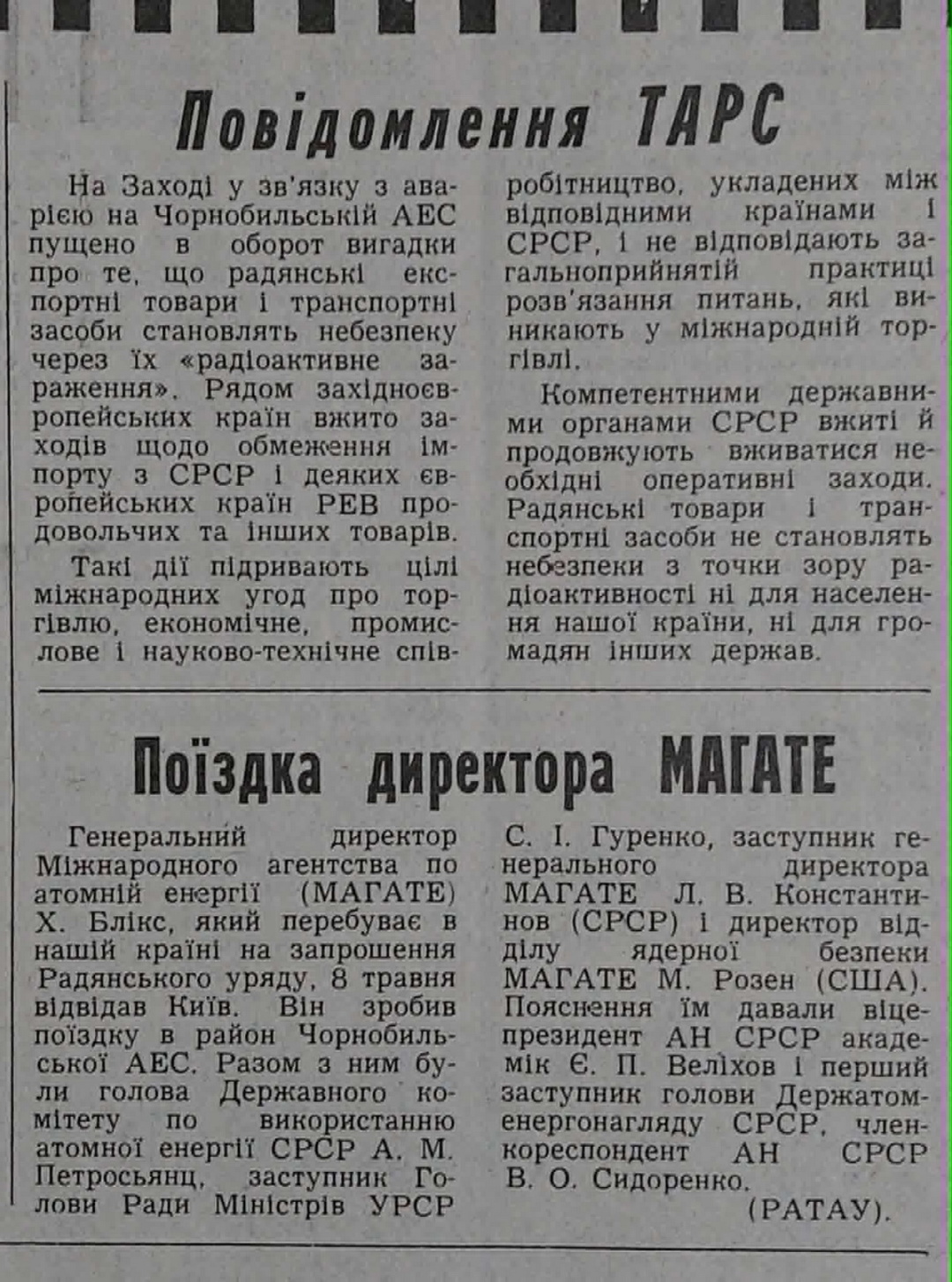
However, foreign media effectively forced the Soviet Union leadership to stop concealing the high levels of radiation. The authorities ultimately agreed to allow a limited group of Western journalists to visit Kyiv and the disaster site.
On May 6, 1986, as dosimeter readings began to decline, the Soviet Ministry of Foreign Affairs convened a press conference. There, Boris Shcherbina, chairman of the government commission responsible for Chornobyl NPP disaster relief, acknowledged that the evacuation of civilians had been delayed due to underestimated radiation levels.
For the first time, Soviet journalists—as well as their counterparts from the “socialist bloc”—were permitted to ask questions. Western correspondents, however, had to submit their questions in writing in advance. Even so, this marked a notable breach in the USSR’s tightly controlled information regime.
Following this belated admission, the flow of information gradually increased. That same day, Pravda published an article explaining for the first time that the April 26 explosion at the Chornobyl NPP had triggered a massive fire. The state agency TASS cautiously reported that radioactive materials had spread beyond the restricted zone into Ukraine and Belarus.
The newspaper Literaturna Ukraina struck an optimistic tone, claiming that the atom had “temporarily slipped out of control,” but that Soviet scientists were “firmly keeping their hand on everything happening inside and around the reactor.” Residents of evacuated areas, it suggested, would soon be able to return home once decontamination was complete.
ONE-THIRD OF THE COVERAGE WAS DEVOTED TO CRITICIZING THE WEST
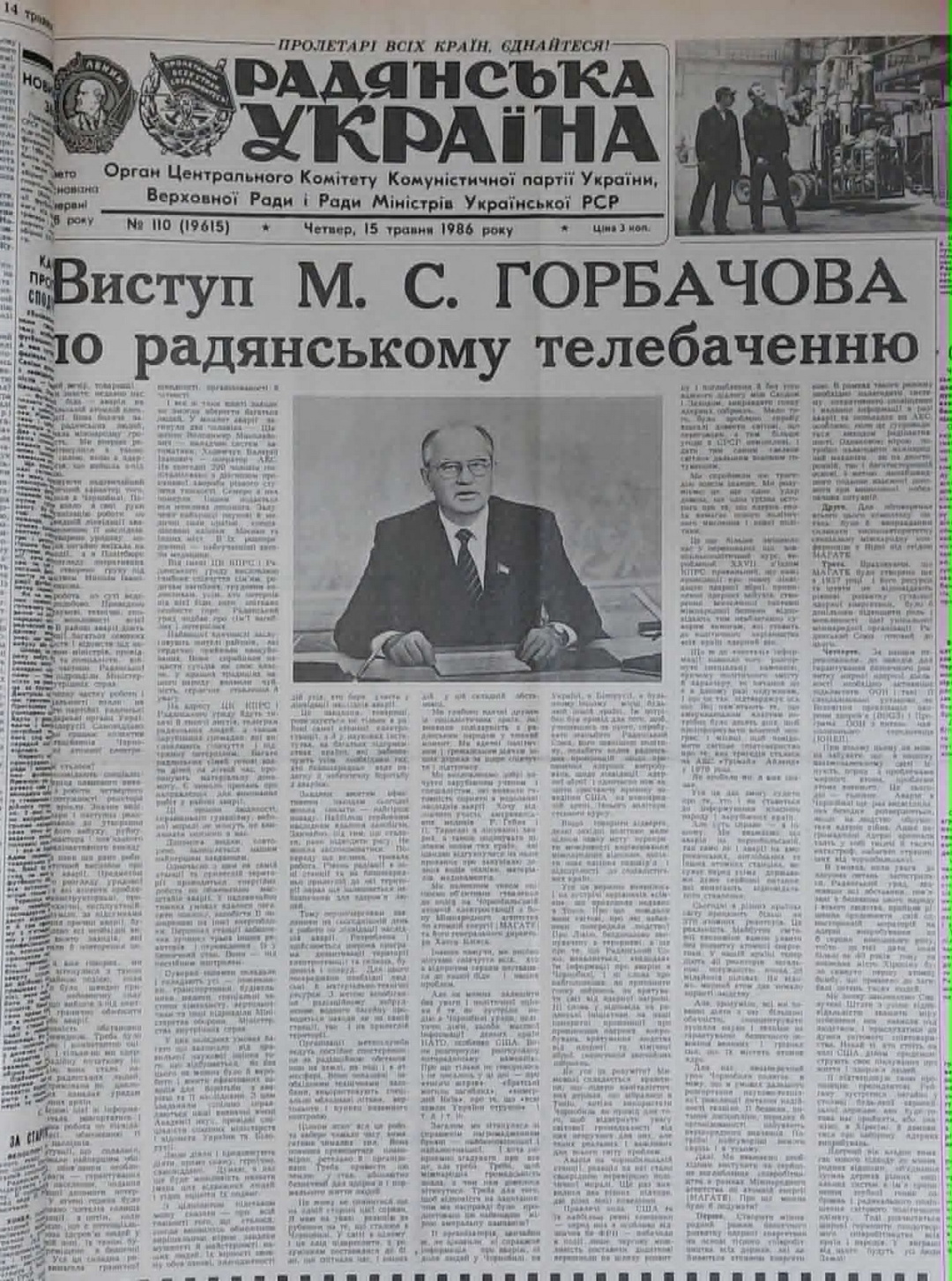
Mikhail Gorbachev addressed a broad audience on May 14—eighteen days after the catastrophe at Unit 4. In his speech, broadcast live on the American network CNN, he downplayed the severity of the situation and stressed the need to “rebuff the fabrications of bourgeois propaganda.”
As noted by Serhii Plokhy in his book Chornobyl: The History of a Nuclear Catastrophe:
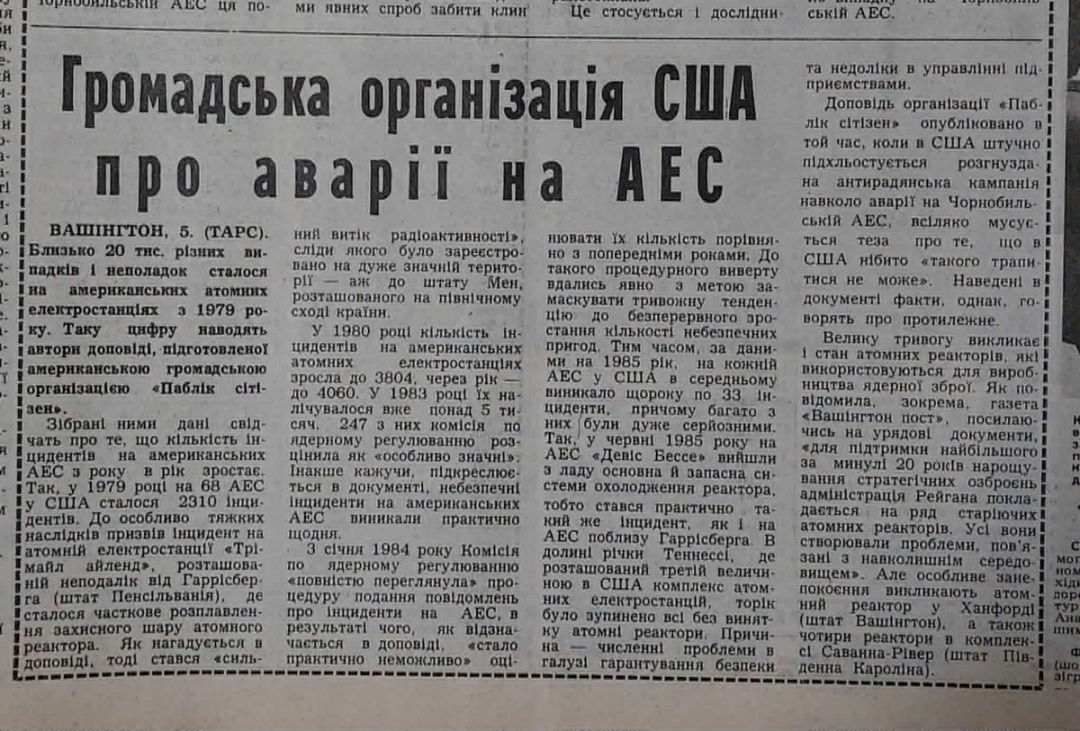
“During the first month after the accident, roughly one-third of Soviet media coverage of the situation at the Chornobyl Nuclear Power Plant was devoted to criticism of the West.” Soviet propagandists eagerly seized on inaccuracies and exaggerations in early foreign reports—distortions that were themselves largely a product of the information blackout imposed by the Soviet Union.
Mikhail Gorbachev would not visit the Chornobyl NPP until 1989, after the withdrawal of Soviet troops from Afghanistan, against the backdrop of a sharp economic downturn. Accompanied by his wife, Raisa Gorbacheva, he toured Reactor No. 2 and the newly built city of Slavutych—the youngest and final city constructed in the USSR.
In Kyiv, the General Secretary addressed the local party leadership, outlining ambitious environmental initiatives and promising referendums on major industrial projects likely to provoke public concern. He urged citizens to be patient with chronic shortages and warned that the Soviet republics contemplating secession were “playing with fire.”
During a planned stop at the intersection of Khreshchatyk and Taras Shevchenko Boulevard, Gorbachev stepped out to speak with residents. The exchange quickly veered off script. Locals showed little interest in perestroika, focusing instead on immediate fears.
“People are afraid,” one woman told him. As he attempted to respond, another interrupted, pointedly asking about plans to construct two new nuclear reactors in Crimea.
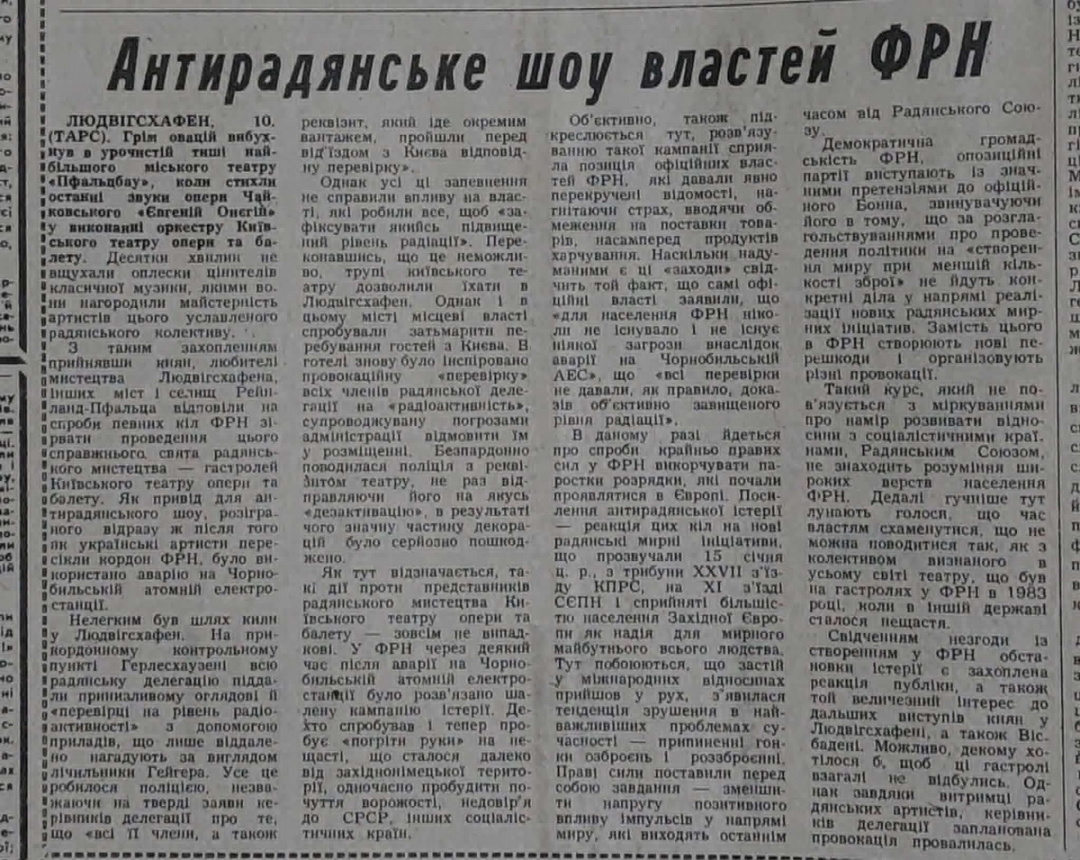
According to the report, the performers were allegedly stopped and screened with detectors—an incident framed by Soviet media as evidence of exaggerated fears and Western “hysteria” in the wake of the Chornobyl disaster.
Such stories formed part of a broader counterpropaganda strategy within the Soviet Union—portraying Western reactions as irrational and alarmist, while diverting attention from domestic criticism and the persistent lack of transparency about the true scale and consequences of the disaster at the Chornobyl Nuclear Power Plant.
THE KEY WAS TO STRIKE THE “RIGHT TONE”
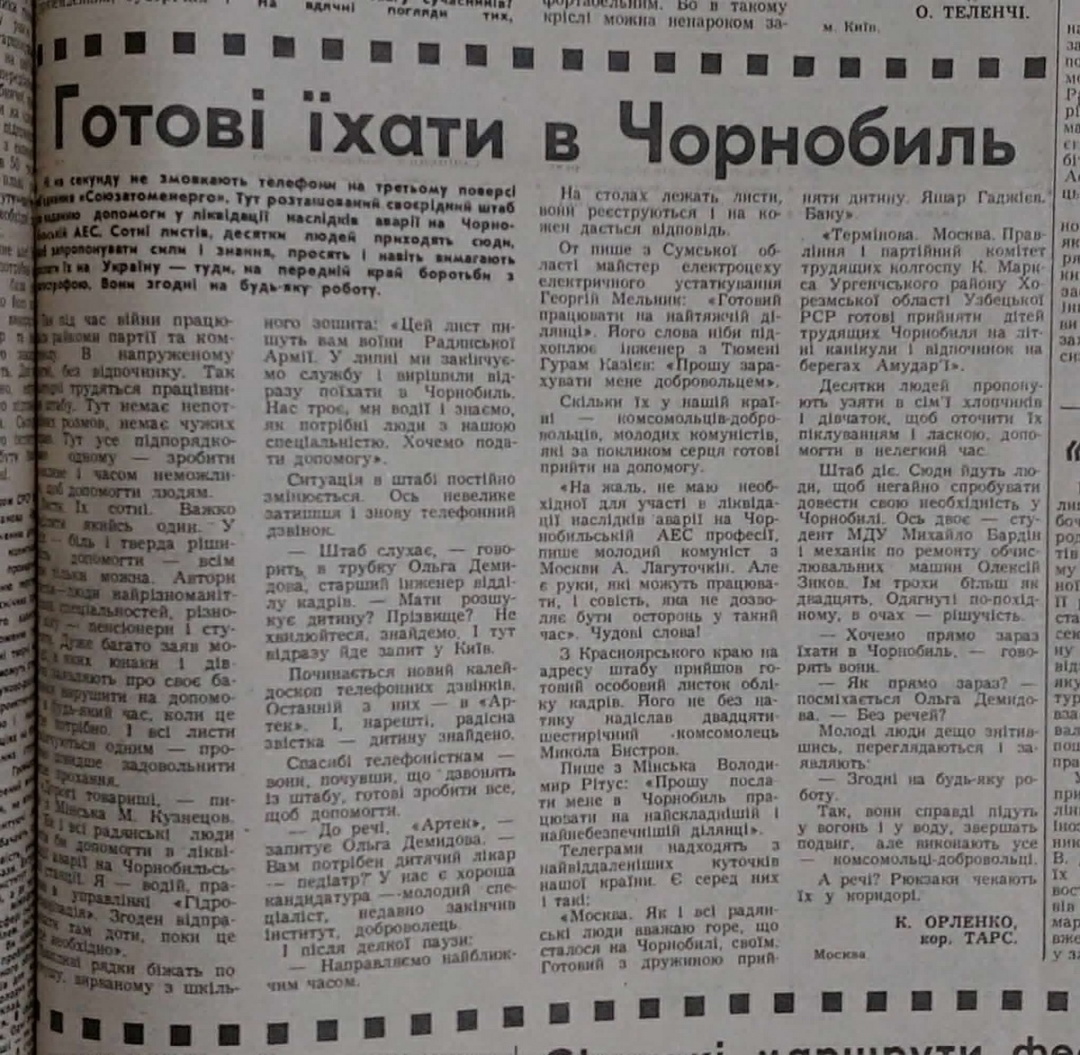
It took the authorities considerable time to comprehend what had actually occurred—and then to calibrate the “right” tone for communicating it to society. That tone was set, above all, by Pravda and Izvestia.
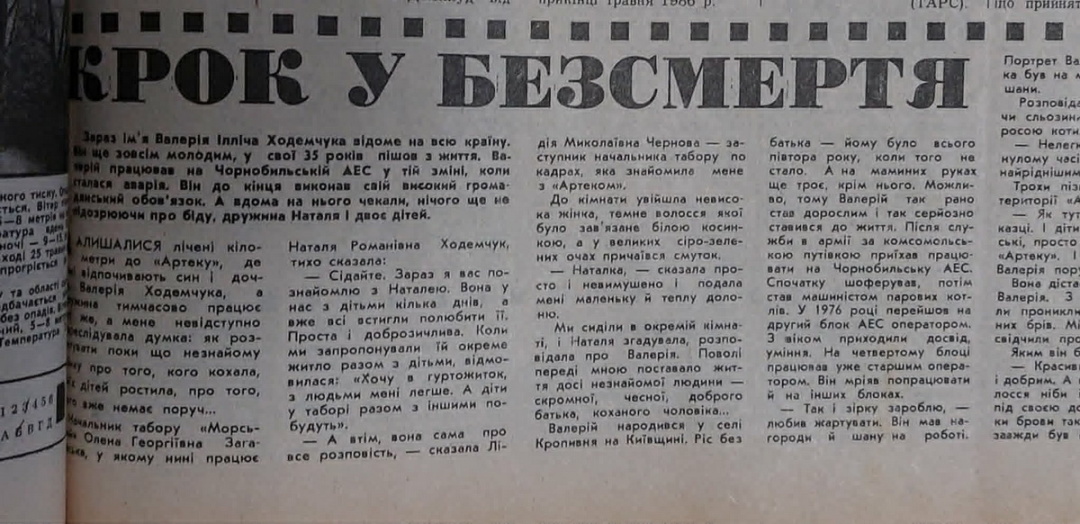
By mid-May 1986, both papers were publishing vivid accounts of the quiet self-sacrifice of ordinary men—Chornobyl firefighters, miners, and metro builders—cast as modern-day Prometheuses who rushed without hesitation to save the motherland. These were often genuinely powerful, human stories. They even acknowledged the dangers of radiation, creating the impression that the wall of silence had been breached and that a current of glasnost was finally beginning to flow.
Yet the underlying purpose of these narratives was different: to construct another “pantheon of glory” and redirect public attention away from radiation risks, contaminated territories, evacuation, housing shortages, and other systemic failures—toward a familiar heroic script. Courage and sacrifice were foregrounded; the true scale of the danger was not. The dominant message was clear: the crisis was under control and nearing resolution.
THE BITTER TRUTH BEHIND THE FAÇADE OF OPTIMISM
Despite the triumphant, reassuring tone of the headlines, reality told a different story.
Here is just one example. By the autumn of 1986, tens of thousands of “partisans”—middle-aged reservists—had been mobilized across the Soviet Union and dispatched to the most heavily contaminated zones, where they worked until reaching a cumulative dose of 25 rem. These men carried out the dirtiest and most hazardous tasks. They were later reassigned to decontamination work and demobilized—only after signing non-disclosure agreements.
Some were decorated before departure and offered a choice of gifts—a cassette recorder or a wristwatch. Meanwhile, the press worked to craft the image of fearless, flawless builders of communism. Yet the reality—often harsh and, at times, terrifying—of what these Chornobyl “partisans” actually endured spread across the Soviet Union.
Fewer and fewer people were willing to risk their health. Upon receiving summonses for “special training,” reservists increasingly understood what awaited them. So some turned to a well-known, time-tested method—bribing the draft office. It was rumored that avoiding deployment to the Soviet–Afghan War cost around 1,000 rubles, while evading Chornobyl duty could be arranged for roughly half that amount.
Unrest occasionally broke out in tent camps around the perimeter of the zone. In one instance, two hundred Estonian “partisans,” informed that their term of service would be extended from two to six months, flatly refused to report for work.
THE THAWING OF THE INFORMATION ICE
The ice of silence, half-truths, and secrecy did not begin to crack until around 1988. That year, the first international conference on the medical consequences of the disaster was held in Kyiv. For the first time, Soviet scientists acknowledged that 17.5 million people had been living in the most contaminated areas of Ukraine, Belarus, and Russia at the time of the accident—including 2.5 million children under the age of seven.
Yet resistance persisted. On the final day of the conference, the head of the Institute of Biophysics sharply rebuked colleagues who warned of future cancer cases:
“We never speak about the number of those who fall ill. That is immoral.”
The newspaper Pravda Ukrainy began publishing weekly radiation reports in 1988 for the three largest cities closest to the Chornobyl NPP.
In February 1989—nearly three years after the Chornobyl disaster—Soviet television aired its first report openly acknowledging that the true scale of radioactive contamination beyond the thirty-kilometer exclusion zone had been concealed, and that the total affected area was, in fact, even larger than the zone itself.
“Still, glasnost is prevailing—that is how we might begin this story,” the correspondent said, standing before maps showing the most heavily contaminated areas up to 300 kilometers from the plant—already on the territory of Belarus, in the Gomel Region and Mogilev Region—where in April and May 1986 people had witnessed black rain.
The land was so severely contaminated that nearly 100,000 more people would have had to be evacuated.
WHAT CHORNOBYL REVEALED
The Chornobyl disaster marked a turning point in the evolution of Soviet media—and significantly accelerated the collapse of the Soviet Union.
Dr. Jonathan Sanders, who later spent several years as a CBS correspondent in Moscow, observed:
“Coverage of the Chornobyl disaster marked a watershed in the history of Soviet communications. Television broadcasting, for the first time… began to meet the public’s demand for ‘unpleasant’ news, abandoning the practice of suppressing facts about national catastrophes.”
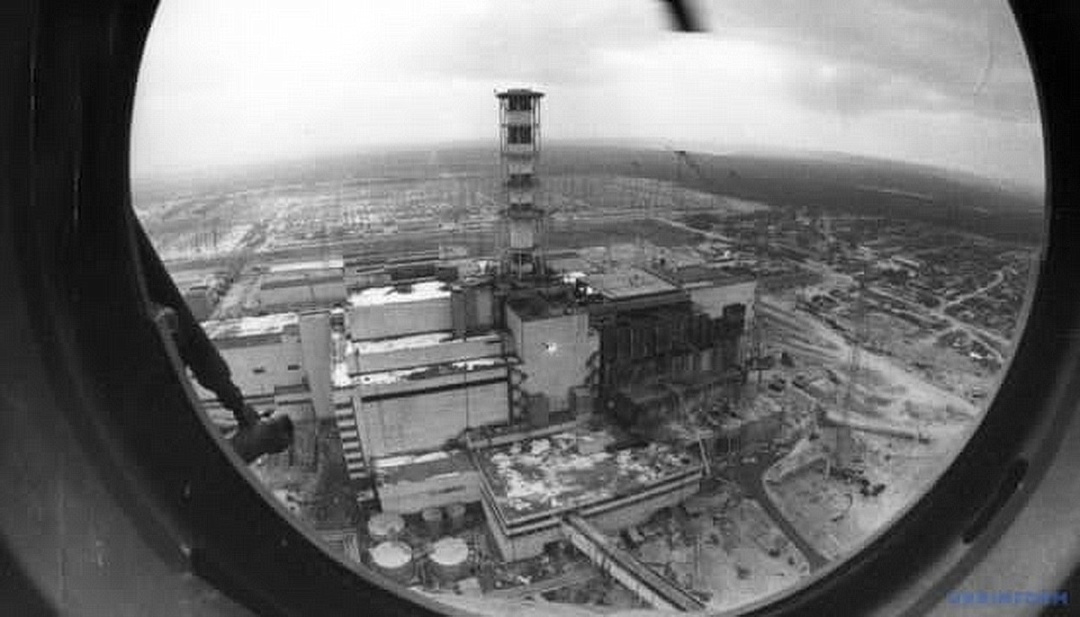
Once the Party loosened its iron grip, it became clear that the previous level of control over information could no longer be restored. Gradually, reporting in newspapers, magazines, and on television grew more candid and direct. Articles, features, TV reports, and interviews with participants and eyewitnesses pushed the media toward greater openness, frank discussion, and public debate—hallmarks of a democratic society.
The ray of Chornobyl’s glasnost significantly expanded the space for truth. The media began to address other sensitive issues as well—the Soviet–Afghan War, the epidemic of abortions (many women feared childbirth at the time), drug abuse, and the horrors of Stalinism. Society seemed to awaken from a kind of lethargic sleep.
As the full extent of deception and concealment became apparent, even some of the most loyal supporters of the Soviet Union were deeply shaken. Chornobyl poisoned not only the land—it poisoned trust. And from this invisible radiation, the Soviet Union never recovered.
Svitlana Shevtsova, Kyiv
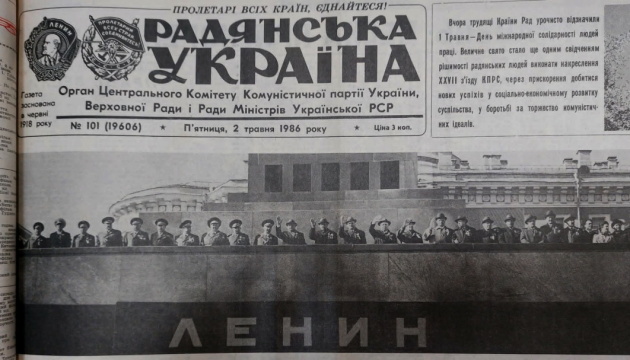
The headline photo shows representatives of the Soviet establishment on the tribune of Lenin's Mausoleum during the 1986 May Day parade. Newspaper Sovietska Ukraina.
All photos via Author