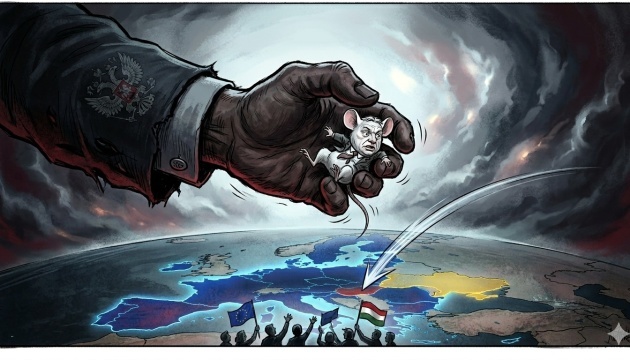
The Fall of the Kremlin’s “Tame Mouse” in Europe
“There is no risk of war in Europe, because Russia is not even capable of defeating Ukraine—a country fully entitled to self-defense and exercising that right with remarkable resilience. Russians understand only the language of force, and Europe must be strong.”
Surprisingly, these words were pronounced by Hungarian Prime Minister Viktor Orbán. He made the statement in June of last year, attempting to appeal to pro-Ukrainian voters at home. The maneuver failed. Europe’s most emblematic “political animal” miscalculated—and suffered a decisive electoral defeat.
Ancient Greek Motifs in Orbán’s Downfall
The term “political animal” is not an insult, but a classical concept (Greek: zōon politikon) introduced by Aristotle. He argued that human beings are not merely social creatures (like ants), but inherently political ones—capable of realizing their full potential only within the polis, or city-state. Those who exist outside it are “either beasts or gods.” Over time, the term has come to describe individuals deeply absorbed in the pursuit of power and political maneuvering.
Orbán’s attempt to stand apart from the European community, coupled with a cultivated sense of personal “divinity” after 16 years in power, put him at odds with the Hungarian “polis”—and proved politically fatal.
The rupture proved decisive. So wide became the gap between ruler and electorate that even the prospect of contesting the results never seriously emerged.
The outcome was unequivocal: the Tisza party secured a constitutional majority, granting it the ability to form a government independently, without the need for coalition partners.
In the story of the “god” of Budapest—as Orbán may have imagined himself—another ancient Greek motif emerges. Bloomberg recently leaked a recording of a phone call between Orbán and Putin dated October 17 of last year. In it, the Hungarian prime minister declares: “Our friendship has risen to a level where I can help you in any way… Wherever you need my assistance, I am at your service.” He invoked Aesop’s fable of the mouse and the lion: the lion once spared the mouse after it had the misfortune of running across him. Later, captured and bound to a tree, the lion struggled and roared—until the mouse returned, gnawed through the ropes, and freed him.
The allegory is revealing. It raises an obvious question: when, exactly, did Putin “spare” Orbán—and at what price? Speculation is widespread. Some reports point to potential Kremlin leverage in the form of compromising material, including persistent stories about a “suitcase” linked to Russian criminal networks. Whatever the mechanism, the political outcome is clearer: Orbán has effectively acted as Putin’s “tame mouse.” What future “ropes” he may have been expected to gnaw through for this “lion” remains an open—and troubling—question.
Szijjártó Will Shine Only in Moscow
The decisive turn in Orbán’s pivot toward Russia came in 2014, when he approved a massive Russian loan to expand Hungary’s Paks II nuclear power plant. This was not merely an economic arrangement; it signaled a deeper ideological convergence with Putin’s model of governance. Shortly thereafter, Orbán openly articulated his ambition to build an “illiberal state based on national and traditional Christian values,” explicitly citing Russia as a model.
Since February 2022, the rhetoric of Orbán and his inner circle—particularly Foreign Minister Péter Szijjártó—has shifted into openly discrediting territory. They have stated that they “do not consider Putin a war criminal,” accepted Russia’s “Order of Friendship” in Moscow, and have been accused of leaking confidential EU information to the Kremlin. At the same time, they have actively lobbied for the removal of both personal sanctions—targeting figures from Patriarch Kirill to Kremlin-aligned oligarchs and ministers—and broader sectoral restrictions imposed by the European Union.
Equally significant has been their consistent obstruction of EU assistance to Ukraine, including the most recent €90 billion package—positioning Budapest as a recurrent spoiler within the bloc at a moment of acute strategic strain.
Budapest has increasingly taken on the characteristics of a hub for Russian influence operations. According to Agentstvo, 15 of the 47 staff members at the Russian embassy in Hungary are linked to intelligence services, with another six suspected of similar affiliations. Meanwhile, Vsquare -- an independent investigative journalism project bringing together journalists from the Visegrád Group: Hungary, Poland, the Czech Republic, and Slovakia—reported that three GRU operatives entered Hungary under diplomatic cover with the aim of influencing the elections and securing Orbán’s victory. In early April, additional reports indicated that Vladislav Surkov, a former Kremlin strategist, had relocated to Budapest, where he assumed an informal advisory role to Orbán on constructing a model of “sovereign democracy.”
Parallel to these developments, a study by the analytical firm Vox Harbor—based on the analysis of more than 628,000 messages—identified a coordinated media effort designed to amplify fear among Hungarian voters regarding the consequences of Orbán’s defeat. Yet this reliance on fear was hardly new. In 2018, during his campaign for a third consecutive term, Orbán’s Fidesz party systematically mobilized anti-migrant sentiment. In 2022, with elections held just five weeks after Russia’s full-scale invasion of Ukraine, he advanced claims that the opposition would drag Hungary into the war.
This time, however, the strategy proved far less effective. The use of deepfakes to discredit opponents, combined with more traditional manipulations such as gerrymandering, appears to have backfired—alienating even segments of Orbán’s previously loyal electorate.
Further underscoring the depth of this alignment, it emerged that as early as December Orbán’s government had concluded a non-public agreement with Russia to expand cooperation across economic, trade, energy, and cultural dimensions. The provisions reportedly included expanding Russian-language instruction—bringing in teachers from Russia—mutual recognition of academic diplomas, postgraduate exchange programs, and collaboration in fields as varied as sports and circus arts.
Taken together, these developments suggest that the Kremlin had made a substantial investment in its Hungarian partner. What additional pro-Russian “performances” this arrangement might have produced within Europe remains, at this stage, a matter of speculation.
That trajectory, however, was abruptly interrupted. The election winner, Magyar, in one of his first post-vote statements, called on the entire Orbán government—as well as other members of the current administration—to step down early. In this new political reality, Szijjártó may find himself “shining” only in Moscow, perhaps alongside his former Austrian counterpart, Karin Kneissl.
Orbán’s Anti-Ukrainian Playbook: From Scarf to Pipeline
A distinct and persistent vector of Viktor Orbán’s politics has been anti-Ukrainian rhetoric—often personalized in attacks on President Volodymyr Zelensky. This has manifested not only in statements but in concrete actions by Hungary’s “mouse king” and his inner circle. As early as April 2022, Orbán shifted responsibility for the invasion of Ukraine away from Putin and onto the European Union—going so far as to demand “proof” that the atrocities in Bucha had not been staged by Kyiv. These claims, later normalized within his discourse, were delivered with conspicuous timing—immediately after Szijjártó’s visit to Moscow, where he secured “special conditions” for Hungary’s gas supplies.
At the same time, Budapest argued it could not supply weapons to Kyiv, claiming that such a move would expose Transcarpathia—home to a Hungarian minority—to potential Russian strikes. This logic of selective vulnerability provoked outrage from Tibor Tompa, head of the Hungarian community in Kyiv: “By Szijjártó’s reasoning, it follows that I—as a Ukrainian of Hungarian origin living not in Transcarpathia but in Kyiv—and members of our community across Ukraine are effectively acceptable targets.”
In April 2023, similar narratives were advanced by Deputy Speaker of Parliament Dóra Dúró. In an interview with the Russian outlet Izvestia, she justified Hungary’s opposition to Ukraine’s EU and NATO integration by citing Kyiv’s policies toward the Hungarian minority in Transcarpathia. She further suggested that Ukraine should grant territorial autonomy to the region—rhetoric closely aligned with familiar Kremlin framing. Europe, however, has already seen the consequences of such narratives when framed in terms of “protection” and “autonomy.”
Symbolism reinforced this messaging. On November 22, 2022, Orbán appeared in a video wearing a football scarf depicting “Greater Hungary”—a reference to the Kingdom of Hungary’s pre-1920 borders, encompassing territories now part of Romania, Ukraine, Slovakia, Croatia, Serbia, and Austria. Given that Hungary formally renounced these claims under the Treaty of Trianon, the gesture triggered sharp and immediate reactions from neighboring states, including Ukraine, Romania, and Croatia.
Against this backdrop, Orbán framed the elections as a binary choice between “war and peace.” His closing argument centered on an alleged “explosives incident” near the Serbian border, purportedly targeting the TurkStream gas pipeline. He directly linked the episode to Kyiv, claiming that “only his government” could protect Hungarians from terrorism and energy deprivation. He convened a defense council and staged a video appearance with Hungarian troops ostensibly deployed to “protect” the pipeline.
The narrative was reinforced through apocalyptic imagery: a Hungary freezing and under siege, supposedly being “brought to its knees” by Ukraine and unnamed external enemies. Kremlin spokesperson Dmitry Peskov echoed this framing, underscoring the broader informational alignment between Budapest and Moscow.
However, the director of Serbia’s Military Security Agency, Đuro Jovanić, stated unequivocally that “claims that Ukrainians attempted to organize this plot are not true.” Péter Magyar went further, suggesting that Orbán “may be conducting a false-flag operation involving Serbian and Russian actors amid collapsing support for his party.”
What had been presented as a geopolitical thriller quickly unraveled into farce. For Orbán, the episode became a final “black swan”: the anticipated rally ’round the flag effect failed to materialize. The alleged Ukrainian connection to the TurkStream incident marked a tipping point—beyond it, Orbán’s increasingly crude and high-risk political engineering slid into self-inflicted damage.
The defeat is notable for its paradox. Losing while benefiting—at least tacitly—from signals of support from both Moscow and Washington is no small feat, yet Orbán managed it. External backing did not offset his vulnerability; it intensified it, reinforcing his image as politically toxic among Hungarian voters.
For Russia, the result represents one of its most consequential electoral setbacks in Europe. In February 2025, its aligned forces lost ground in Germany; in May, Moscow’s influence receded in Romania; in September, in Moldova. Orbán’s defeat adds to this trajectory: Putinism has failed to establish durable traction across the European political landscape.
The Kremlin, in effect, has been left without a trump card in its rigged game with the European Union. The era of its Hungarian “tame mouse” has come to a close.
Max Meltzer