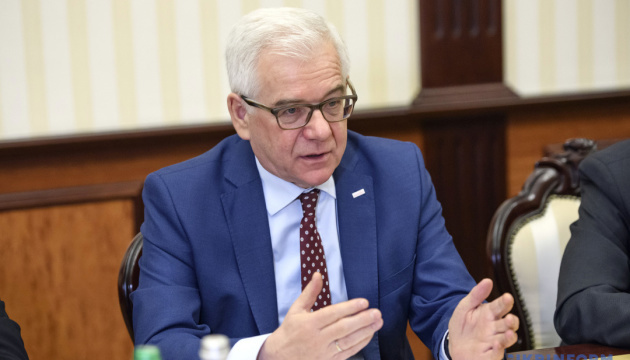
Logistics alone not suffice: former Polish FM criticizes Warsaw’s refusal to join Ukraine mission
This view was expressed in a comment to Ukrinform by former Polish Foreign Minister Jacek Czaputowicz, commenting on a statement by Polish Prime Minister Donald Tusk that Warsaw would play a key role in providing logistical support to Kyiv and to countries operating in Ukraine.
“From the very beginning, I have believed that Poland must do more, take a more active part, and not opt out of participation in a military mission, although of course not in a leading role there,” Czaputowicz said.
In his view, Poland’s declaration that it will limit its involvement to a logistics mission on Polish territory is “mistaken.”
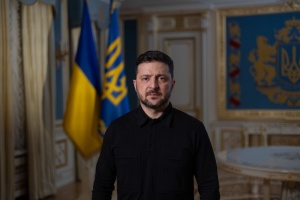
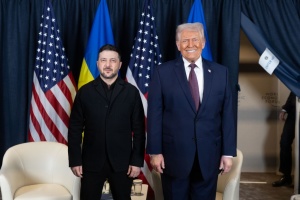
In this context, he drew attention to remarks by Ukrainian President Volodymyr Zelensky, who said that after the signing of peace agreements, U.S. President Donald Trump could fly directly to Kyiv to demonstrate that security is genuinely guaranteed.
“If peace is achieved, Ukrainian airports will be open, and Ukraine will receive direct support for the troops stationed there. Without a doubt, the hub in Rzeszów will continue to play a transit role, but logistics will be provided on the ground. That is why I believe the Polish side does not understand the situation,” Czaputowicz noted.
According to him, after peace is reached, Ukraine will prefer to resolve issues related to supplying troops with weapons and food, their deployment, and medical treatment directly – this being the essence of logistics.
“After peace is achieved, will it make sense to transport everything through the Rzeszów–Jasionka hub if it can be delivered directly, for example, to Kyiv or to airports near the locations where troops are deployed?” the former minister asked.
Czaputowicz believes that Warsaw’s current position stems from fears within Polish society regarding military involvement in Ukraine, hence a “mood of a certain retreat.”
The former Polish foreign minister noted that this position can be understood to some extent, as Poland borders Russia and is subject to significant Russian propaganda and disinformation attacks. In this light, the deployment of Polish troops in Ukraine would be perceived very negatively in Russia, which could respond by increasing sabotage and various provocative actions in Poland.
“However, since we believe that this would pose too great a risk for us, we should state this clearly and allow others, especially France and the United Kingdom, to act, which is also in Poland’s interests. When the security situation stabilizes, public attitudes may also change, and Poland may join the multinational mission. Without this, our role in logistics will be limited to escorting aid across Polish territory and handing it over to the Ukrainian side at the border,” Czaputowicz stressed.
According to the former head of Polish diplomacy, it was a mistake for the government to exclude even symbolic participation by Poland in a multinational mission, “because it is necessary to be present in Ukraine, and therefore necessary to assume these risks.”
“Then we would take part in all negotiations and be a useful ally for Ukraine and for those countries participating there,” Czaputowicz added.
Commenting on opinion polls in Poland that indicate public reluctance to send a contingent to Ukraine, the expert said it is the task of the Polish authorities to explain to society that a Polish contingent would go there only after peace is achieved and would not take part in combat operations.
“And this has not been explained to Polish society,” the former foreign minister concluded.
As reported by Ukrinform, after the meeting of the leaders of the Coalition of the Willing in Paris, Prime Minister Donald Tusk said that Poland would not send its troops to Ukraine but would play a key role in providing logistical support to Kyiv and to countries operating in Ukraine.
According to a poll conducted at the beginning of 2025, 22% of respondents in Poland supported sending units of the Polish army to take part in a possible stabilization mission in Ukraine, while 63% opposed.
Photo: archive