How Minsk’s Plant SVT Services Russia’s Military-Industrial Complex
The Belarusian company Plant SVT provides maintenance and repair services for Russia’s strategic missile systems. This is confirmed by documents obtained by the Belarusian opposition organization BELPOL and reviewed by Ukrinform.
The state-owned enterprise Plant SVT is part of OJSC Amkodor-Belvar, which belongs to the Amkodor holding — officially a manufacturer of construction, road, and special-purpose machinery, operating under the direct control of Alexander Lukashenko's regime. Although the company formally produces radio-electronic equipment, a significant portion of its activities is linked to military-industrial programs — both Belarusian and Russian.
Belarusian Plant Servicing Russia’s Deadliest Weapons
According to BELPOL, Plant SVT has been involved in developing the Swislоch-SVT drone system and the Vartavy artillery fire-control system. Another line of work concerns fulfilling contracts under Russia’s state defense orders.
BELPOL obtained a report on “work completed in 2023” by Russian Major М. Porokhnyavy, head of Group 1281 of the Russian Defense Ministry’s military representative office, which oversees product quality control at Plant SVT. According to the report, the Minsk enterprise executed at least five inter-factory contracts under Russia’s state defense order in 2023.
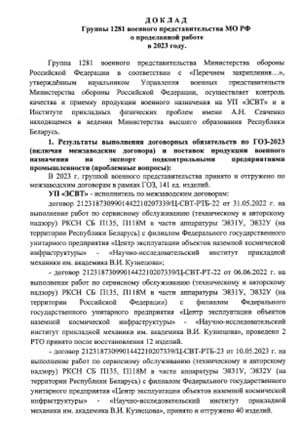
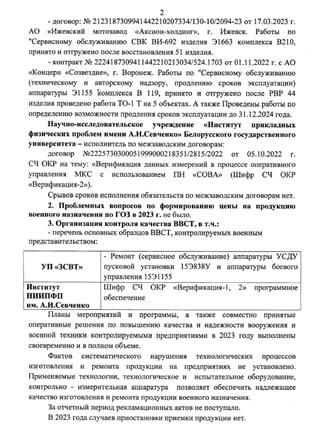
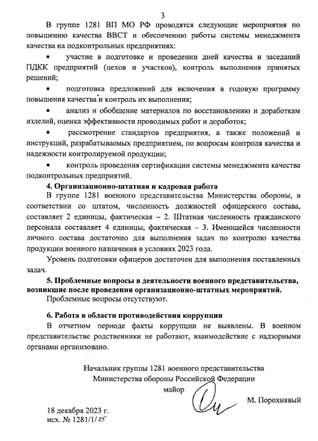
Specifically, the Belarusian plant carried out technical supervision and servicing of electronic equipment used in silo-based missile systems P-135 and P-118M.
The P-118M complex (also designated 15P118M) is a silo-based intercontinental ballistic missile system carrying the R-36M UTTKh (“Satan”). The P-135 (15P135) system refers to a liquid-fueled intercontinental missile used as the launch platform for the Avangard hypersonic glide vehicle.
Maintenance of the electronic systems for these deadly Russian complexes was performed both at the Minsk facility and on Russian territory. The customer and coordinator of the work was the Academician V.I. Kuznetsov Research Institute of Applied Mechanics, a branch of Roscosmos’s Center for Ground Space Infrastructure Operations. The institute is one of Russia’s leading developers of gyroscopic systems, control, and targeting equipment for both the Strategic Missile Forces and the space program.
In addition, Porokhnyavy’s report states that Plant SVT serviced electronic equipment for the B210 and B119 complexes. These designations do not appear in open sources and are likely classified identifiers used in Russia’s defense procurement system, referring to command-and-control systems (B119) and remote missile launch control systems (B210) used in silo-based strategic missile complexes.
Servicing of the B210 complex was carried out under contract with Izhmash-Aksion Holding JSC, a leading Russian defense electronics manufacturer that also produces ground-based control systems for strategic missile forces.
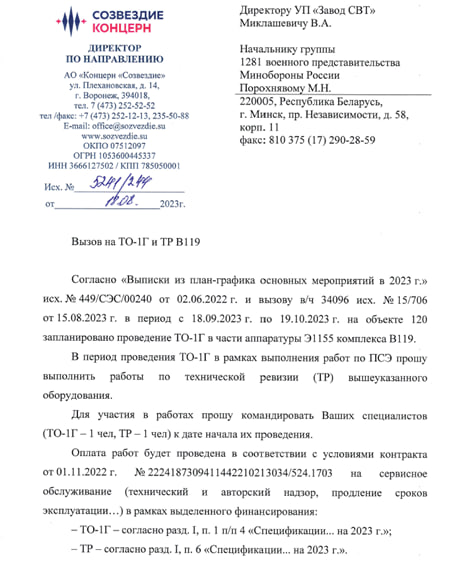
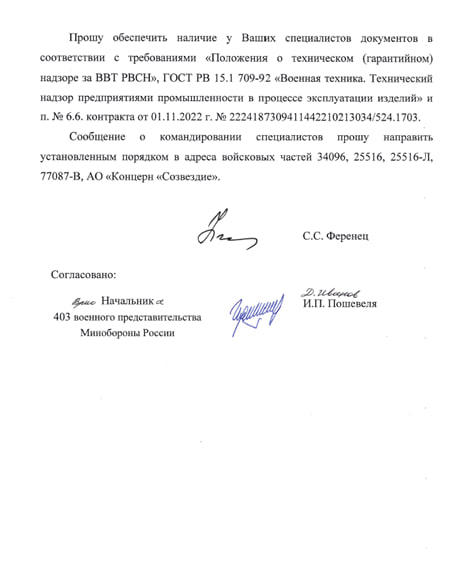
Another contract — for technical and design supervision and extending the service life of the B119 complex’s electronic systems — was signed with the Sozvezdie Concern in Voronezh. Sozvezdie is one of the key Russian developers and producers of combat control and radio-electronic systems for the armed forces, including the Strategic Missile Forces.
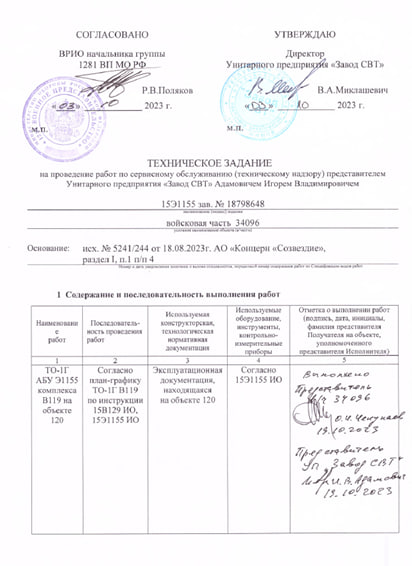
The B119 complex is deployed at Facility No. 120, which belongs to military unit 34096, the 14th Missile Division of Russia’s Strategic Missile Forces. According to a letter dated August 18, 2023, from Sozvezdie to Plant SVT, Belarusian specialists were requested to come there to perform a technical inspection of the equipment. The letter also listed three other Strategic Missile Forces units — 25516, 25516-L, and 77087-V — that had to be notified of their arrival. All work was carried out under a contract signed on November 1, 2022.
Classified Cargo from Minsk to Russia
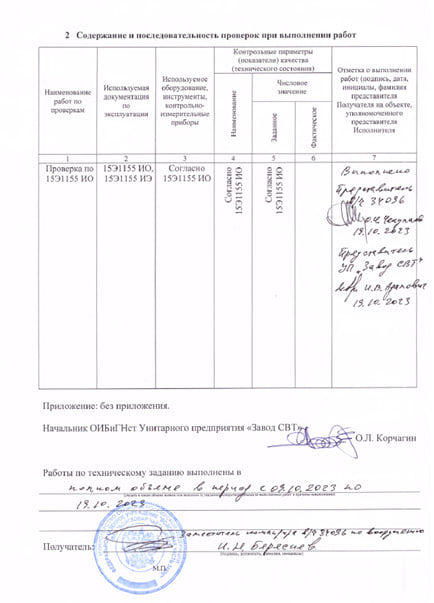
Less than two months later, on October 3, a technical assignment was issued, signed by Plant SVT director V. Miklashevich and approved by R. Polyakov, acting head of Group 1281 of the Russian Defense Ministry. Between October 9 and 19, 2023, Plant SVT engineer Ihor Adamovich completed full maintenance of the B119 command-and-control system at the same site. The work was formally accepted by Russian officers — military unit 34096 deputy commander for armaments I. Beresnev and unit representative O. Chekunaev.
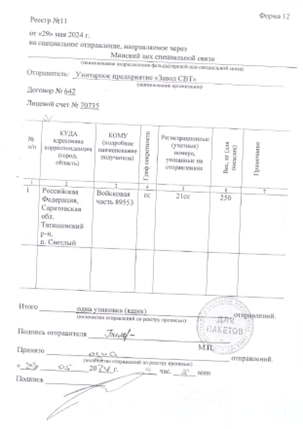
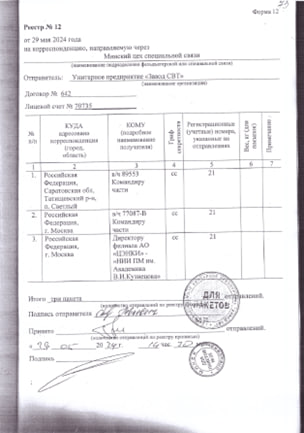
Other documents obtained by Ukrinform show that transportation of components, equipment, and documentation to Russian military facilities was carried out through the state enterprise “Specsvyaz” (Minsk Special Communications Branch). At the same time, Plant SVT continued supporting Russia’s strategic missile capabilities in 2024.
On May 29, 2024, a classified 250-kilogram shipment was sent via Specsvyaz to military unit 89553 — the 60th Missile Division, part of the 27th Missile Army located in the closed military town of Svetly, Saratov region.
Another parcel, marked “Top Secret,” was sent to military unit 77087-V in Moscow, a structure within the command of Russia’s Strategic Missile Forces.
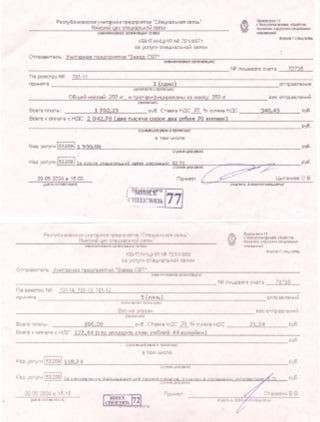
“The Republican Unitary Enterprise Specsvyaz has previously appeared in BELPOL’s investigations as part of schemes to circumvent sanctions during Russian diamond exports. This further confirms the involvement of Belarusian state institutions in supporting Russia’s military logistics,” said Vladimir Zhigar, public representative of the Belarusian opposition organization BELPOL, in a comment to Ukrinform.
Zhigar now coordinates investigations into Belarusian companies working for the Russian defense industry. According to him, there may be over 500 such enterprises, both state-owned and private.
“The militarization of Belarus’s economy is a deliberate and institutionalized policy aimed at strengthening the internal authoritarian regime, ensuring economic support from Russia, and facilitating the Kremlin’s military and geopolitical goals — including the war against Ukraine,” Zhigar said.
BELPOL has already compiled full evidence dossiers on about 150 of these companies and passed the materials to international partners.
As reported by Ukrinform, previously published BELPOL documents confirm that Russia imports Japanese and Thai components for weapons and combat vehicles through a Belarusian company registered in China.
Vasyl Korotkyi, Vienna
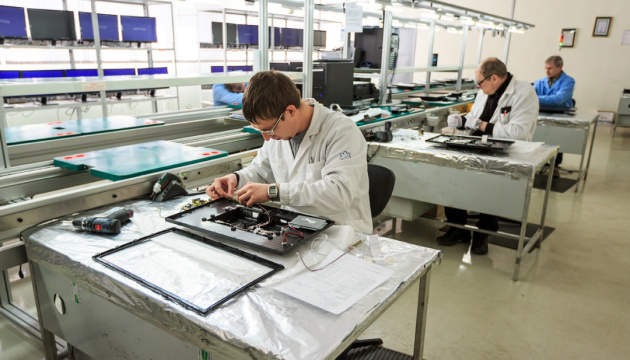
First photo: Plant SVT (for illustration purposes)