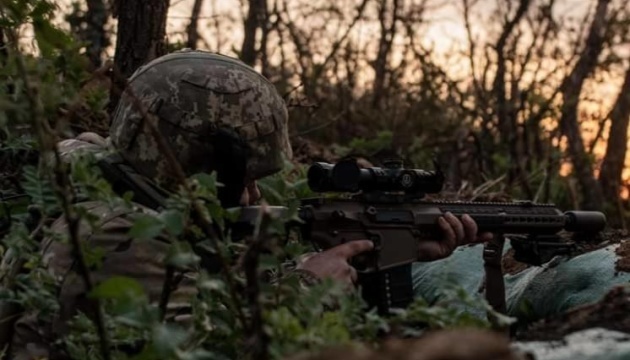
Russian forces shift assault tactics in Pokrovsk sector – National Guard
Ruslan Muzychuk, a spokesperson for the National Guard of Ukraine, stated this on a TV broadcast, according to Ukrinform’s correspondent.
“Currently, the enemy is not relying on massed assaults with the use of armored vehicles [in the Pokrovsk sector], meaning they are not forming ‘breaking’ assaults or offensives in open terrain aimed at rapid or sudden advances or breaching the defensive line,” the spokesperson said.
Muzychuk explained that although the enemy actively employs aviation and artillery to weaken Ukrainian defenses, drones enable the detection of these assaults in time.
“Even over the recent autumn months, large-scale assaults involving armored vehicles have been relatively few compared not only to 2022 but also to 2024. We are now speaking about the concept of a ‘kill zone’, which functions on both sides of the line of contact,” he noted.
According to the spokesperson, a “kill zone” is a section of the front where the enemy is effectively unable to advance with large infantry groups. As a result, Russian forces use small infantry groups.
“The same applies to the use of armored vehicles, because within a depth of 15–20 kilometers on each side of the line of engagement, there is a ‘kill zone’ where drones of various types are actively used, including long-range strike drones like the Lancet. We now see cheaper analogues such as the Molniya,” Muzychuk said.
As reported by Ukrinform, as of 8:00 a.m. on November 28, Ukrainian defenders in the Pokrovsk sector repelled 59 assault actions by the aggressor in the areas of Shakhove, Nove Shakhove, Zatyshok, Chervonyi Lyman, Rodynske, Myrnohrad, Novoekonomichne, Pishchane, Zvirove, Kotlyne, Udachne, Molodetske, Novomykolaivka, Dachne, and in the directions of Hryshyne and Novopavlivka.
Ukrinform’s photos are available for purchase here.