Amsterdam hosts discussion on Russian propaganda influence in Netherlands
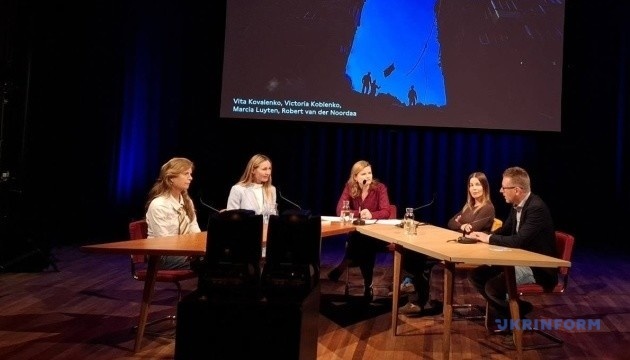
According to a Ukrinform correspondent in The Hague, participants in the discussion addressed the mechanisms of disinformation dissemination, the role of social media in shaping public opinion, and ways to counter manipulation and fake Russian narratives.
"One of the key objectives of Russian propaganda in the Netherlands is to worsen attitudes toward Ukraine in order to weaken public and state support for Ukrainians. Russia systematically attempts to undermine public opinion and uses every opportunity to do so,“ said Ukrainian activist and city council member of the Dutch city of Dordrecht, Vita Kovalenko, in a comment to Ukrinform after the event. She is also the author of the book ”The Truth Under Fire" in Dutch, which covers the war in Ukraine and Russian propaganda.
During the event, participants discussed the miniseries Onze man bij de vijand [“Our Man Among the Enemy”], filmed by Dutch journalist Thomas Erdbrink and director Roelof van Bokhoven, who, in violation of Ukrainian law, illegally visited Russian-occupied territories of Ukraine, including Mariupol.
"This project is having a significant impact on public opinion in the Netherlands. Through such content, Russian narratives are gradually taking hold—namely, that Ukraine should supposedly cede part of its territory if there is a Russian-speaking population living there. However, the fact remains unchanged: Russia has grossly violated international law, carried out an unprovoked invasion of a sovereign state, and occupied part of its territory. There is no justification for this. At the same time, articles about so-called Nazis in Ukraine can still be found in the Dutch media. Russian propaganda is particularly active in exploiting the topic of the “Azov” regiment, using it to discredit Ukraine and its struggle for independence,” said Kovalenko.
She also emphasized that one of the key Russian narratives is to present the war as a conflict between two equal sides.
“This approach can shift the public’s focus away from the main fact that Russia is the aggressor. If the war is presented as a dispute between two sides, then the false impression arises that other states should not intervene or help Ukraine. Similar rhetoric can be heard from representatives of the Dutch party Forum voor Democratie (FvD), which has so far avoided clearly acknowledging Russian aggression. These narratives are actively spread through social media, where disinformation often reaches a wide audience," noted the Dordrecht city council member.
Kovalenko also noted that “this is precisely why the idea arose to write the book ‘Truth Under Fire,’ to show that propaganda is not a thing of the past, but one of the most powerful tools of our time. Propagandists skillfully exploit freedom of speech and the openness of democratic societies to gain access to the public sphere, spread their messages, and influence public opinion. They often try to do this through the media as well. Two members of the Dutch parliament were present at the event, and it was important for them to hear this discussion. After all, wars do not begin with bullets. They begin with words.”
In turn, the well-known Dutch actress of Ukrainian origin, Viktoria Koblenko, emphasized that Russian propaganda is not a new phenomenon. According to her, it is a well-established system whose roots date back to Soviet times and which, over decades, has shaped a distorted perception of Ukraine among both Russians and those outside Russia.
“The propaganda machine has been operating for hundreds of years. It has shaped the image of Ukrainians as ‘younger brothers,’ an inferior nation, while the Ukrainian language and culture were often portrayed as secondary. Such narratives have been passed down through generations,” Koblenko noted.
The actress noted that many Russians support the war precisely because they have heard the same myths and false stories about Ukraine for years.
According to Koblenko, modern Russian disinformation actively employs the tactic of creating informational chaos—where a large number of claims, most of which are false, are simultaneously released into the information space: “As a result, society doesn’t have time to verify all the facts, and some of the disinformation begins to be perceived as the truth.”
Dutch researcher and journalist Robert van der Noordaa is one of those studying Russian propaganda and the activities of Russian organizations in the Netherlands, their influence, the spread of disinformation, and the distortion of facts. According to him, Russia has allocated over 9 billion euros for propaganda this year worldwide.
"The budget Russia has allocated for information operations this year amounts to about 9 billion euros. This applies not only to Russia Today but also to so-called troll farms and other tools of influence. With that kind of money, you can create a colossal propaganda machine," he said.
Dutch researcher and journalist Robert van der Noordaa has also spent many years investigating the downing of Flight MH17 and emphasized that modern technologies make it possible to track the spread of disinformation campaigns and identify their key narratives.
According to him, following the MH17 crash, the Russian propaganda machine launched hundreds of alternative accounts of the tragedy, designed to divert attention from Russia’s responsibility.
“We analyzed massive amounts of data and saw that the narratives being spread almost completely matched the content of Russian state-run media. Regardless of the topic, the mechanism works the same way: create as many versions as possible so that people stop understanding what the truth is,” he said.
Dutch journalist Marcia Luyten emphasized that if disinformation enters the media space, journalists must respond promptly, correct errors, and help one another counter the spread of false information. According to her, in the Netherlands, freedom of speech is increasingly being used as a kind of shield for spreading manipulation and disinformation.
“Freedom of speech does not exempt one from responsibility. Journalists must be accountable for their words and for the information they disseminate,” Luyten emphasized.
As reported by Ukrinform, Putin uses his own version of history as a weapon to justify the war against Ukraine.