The United States Has Made Clear Where Russia’s Borders End
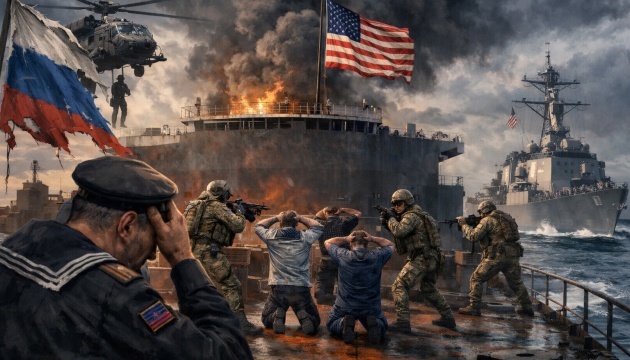
Russia was shaken not only by the American “special operation” that resulted in the arrest of Venezuelan dictator Nicolás Maduro, but also by the second phase of that operation—which directly affected Moscow itself. This involved the seizure by U.S. special forces of two “shadow fleet” tankers, Marinera and Sophia.
The story unfolded almost in real time. The United States has been pursuing the tanker Marinera since mid-December, after it abruptly changed course while sailing from Iran to Venezuela in an apparent attempt to evade detention by the U.S. Coast Guard. At the time, Washington emphasized that Marinera had violated the maritime blockade imposed on Venezuela, which applies to sanctioned vessels. The Marinera has been under sanctions since 2024.
Washington Was Unimpressed by the ‘Sochi’ Marinera
“An operation to seize Marinera could begin as early as this week,” two U.S. officials told CBS and CNN on January 6. After the U.S. Department of Justice issued a warrant for the tanker’s arrest, American forces attempted to board the vessel. In response, the crew painted a Russian flag on the hull and claimed the tanker was under Russian protection. Moscow immediately sent a diplomatic note to Washington demanding that the pursuit be halted.
However, U.S. authorities concluded that a formal, last-minute claim of Russian jurisdiction did not grant the vessel any immunity. At the time of the initial contact with the U.S. Coast Guard, the tanker was not sailing under the Russian flag, and therefore could not retroactively invoke its protection.
There was, incidentally, another factor at play. Two U.S. intelligence sources told CBS that Venezuelan authorities—prior to the tanker’s seizure—had considered deploying armed military personnel aboard the vessel disguised as civilians, potentially equipped with man-portable air-defense systems (MANPADS). The broadcaster suggested that Washington intended to seize the ship rather than destroy it, while also acknowledging that such an operation carried the risk of triggering a direct escalation between the United States and Russia.
Inside Russia, officials had already explained on January 1 why the tanker was renamed and reflagged. According to Moscow, “the vessel officially changed its name to Marinera and was entered into the Russian ship registry with the port of registry listed as Sochi. This complicates the situation for the Americans from the standpoint of maritime law. Under the relevant UN Convention, a vessel may be detained and inspected if it lacks registration or if such registration is falsified. But now the ship has Russian registration, meaning the United States no longer has the right to detain it.”
Subsequent events, however, demonstrated that Moscow’s assumptions were misplaced. As reported by international media, Russia even dispatched naval vessels and a submarine to “protect” the Marinera. At one point, speculation emerged about a possible replay of the 1962 Cuban Missile Crisis. Yet, according to Reuters, “the Russian fleet remained near the tanker and simply watched as U.S. forces seized it.”
After the operation concluded, Russia’s Foreign Ministry issued a statement demanding that the United States ensure “humane treatment of the Russians aboard the tanker, respect for their rights and freedoms, and offer no obstruction to their return home.” That was the extent of Moscow’s response.
The reasons behind this notably restrained reaction—set against the backdrop of a globally televised humiliation—are explained mainly by pro-Kremlin commentators. Some of them, however, simultaneously place the blame squarely on the Kremlin itself.
“All the hype, hysteria, and, in some cases, tragedy surrounding this tanker was created by us ourselves. Had Russia not granted it its flag, the Foreign Ministry would not have had to express concern over its fate—thereby drawing the world’s attention to its very existence. Until December 25 (the day the flag was changed), no one cared about this tanker. Hardly anyone even knew it existed, although it had already been trying to evade the Americans for several weeks. Where this might ultimately have led is anyone’s guess. Perhaps by issuing the flag, we assumed that the ‘stupid Americans’ would not dare kidnap Maduro and would be afraid to touch a vessel flying the Russian flag. But they, ‘quite surprisingly’, were not afraid.”
Moscow now finds itself in a genuine strategic bind. As it turns out, the hybrid practice of distributing Russian flags to “ghost” tankers—or, for that matter, granting Russian citizenship in currently occupied Ukrainian territories—means very little in practice. It neither impresses nor intimidates anyone. Vladimir Putin may insist as much as he likes that “Russia’s borders end nowhere,” but realities on the ground—and now at sea—tell a different story.
This likely explains why no comment has come from Putin himself. Over a quarter century in power, observers have grown accustomed to his pattern during extraordinary crises—dating back at least to the sinking of the nuclear submarine Kursk—of simply disappearing from public view.
Wagner mercenaries won’t save the tankers
Russian war correspondent Yuri Kotenok, reacting to what he called Russia’s “naval shadow-fleet humiliation,” wrote the following:
“If we set aside the tears and lamentations, there is a simple fact: for the first time in modern history, the United States has made a public, humiliating gesture toward us by seizing two Russian tankers. For the first time. Nothing like this happened even during the slippery Yeltsin years. As for the USSR, it’s not even worth comparing—despite all the system’s rigidity, we always tried to respond to American insolence. Today, we are demonstrating weakness. This is an alarming and bad sign. Weakness never leads to success. Unfortunately, this day will go down in history. We are standing on the threshold of major trials—greater than those of 2022.”
Meanwhile, Russia’s Ministry of Defense has remained conspicuously silent—failing even to explain why Russian warships sailed to the area only to observe the seizure of the tanker without intervening.
In this vacuum, some Russian “war correspondents” are already suggesting recruiting private military companies (PMCs) armed with small arms, drones, and man-portable air defense systems (MANPADS) to protect the shadow fleet. Others, however, point out the futility of such suggestions.
As one commentator noted, such measures might offer protection against pirates, but they would be meaningless in a direct confrontation with the world’s most powerful navy. First, there is the question of whether anyone would even dare to open fire while being pursued by a U.S. frigate preparing a boarding operation. Second, once a PMC fires on an American warship, the frigate could simply respond with its main gun—against which a tanker has no defense whatsoever. Any clash between a tanker and a warship would be heroic, perhaps, but ultimately pointless.
The debate itself underscores a broader reality: Russia’s improvised, hybrid responses offer little protection when confronted with overwhelming conventional military power.
Thus, the Kremlin has no tangible levers—military, legal, or geopolitical (the very tools it had counted on)—to counter actions of this kind. The practice of handing out Russian flags to “hybrid” or shadow fleet tankers (a practice that is far from isolated) and the assumption that the United States would hesitate to interfere have proven ineffective. More importantly, this episode has demonstrated—to Europeans as well—that Russia is not something to be feared.
Why 7 January 2025 Resembles 24 February 2022
The same war correspondent Kotenok is, in fact, right when he says that “7 January 2025 will go down in history” and that “Russia stands on the threshold of major trials—greater than those of 2022.” After Ukrainians, on 24 February 2022, famously sent the cruiser Moskva “in a known direction,” the United States has now done something similar. Washington’s forced change of course for a Russian vessel is likely to lead Moscow into consequences no less severe.
Donald Trump has reportedly given the green light to a bipartisan bill—introduced as far back as April last year—that would allow the United States to impose 500 percent tariffs on countries purchasing Russian oil, gas, uranium, and other products. This was announced on 8 January by Senator Lindsey Graham, who said that “passing this legislation now would be timely, as Ukraine is making concessions for the sake of peace, while Putin only talks and continues killing innocent people… I expect a vote on the bill in Congress as early as next week.”
Taken together, these developments suggest that symbolic gestures and hybrid tactics are no longer sufficient to shield Moscow from escalating economic and political pressure—and that January 2025 may mark the beginning of a far more consequential phase of confrontation for the Kremlin.
Thus, over the course of just two days, the United States has demonstrated in unmistakable terms that Vladimir Putin’s strategy of simultaneously evading sanctions while continuing the war against Ukraine will carry consequences. Ultimately, he will be forced to pay a price. And judging by current developments, that price will not be limited to Russia’s grey market oil exports alone.
Max Meltzer