Is the UN capable of reforming itself?
Politicians and diplomats have been talking about the need for the United Nations reform almost every year for almost 80 years of its existence, although few seem to believe it ever happening. In October, the UN celebrated its 80th anniversary in a state of serious crisis, caused by both internal and external factors.
The UN structure built after World War II to “maintain peace and security” and not current geopolitical realities turned out unable to prevent the largest war in Europe in eighty years, which Russia unleashed against Ukraine, or to stop a number of other conflicts. Despite loud statements about reform, the UN remains archaic and too slow to respond adequately to the challenges of the 21st century.
UN Photo
LACK OF FUNDING AS THE MAIN DRIVER
Secretary-General António Guterres, whose term ends in 2026, launched the UN80 initiative, a sweeping reform agenda to streamline operations, cut costs, and refocus the UN on its core mission. The goal is to make the United Nations more efficient, effective, and responsive to modern global challenges in a context of tightening resources and complex crises.
The UN80 Initiative is focused on three main areas:
1) Efficiency and effectiveness: Identifying immediate improvements in the way the UN operates. This includes streamlining processes, reducing duplication, and potentially relocating some administrative functions to lower-cost locations (primarily to Kenya).
2) Mandate implementation review: Examining the thousands of mandates—tasks and responsibilities assigned by member states—that the UN has accumulated over decades. The review aims to identify overlapping or outdated mandates to help the organization prioritize more effectively.
3) Structural changes: Conducting a strategic review of deeper, more structural changes and program realignment across the entire UN system. This aims to ensure the UN's architecture is fit for the future.
However, even the authors themselves admit that these steps are more of a technical “clean-up” than a real renewal.
The organization’s problems are much deeper. In 80 years, the UN has never managed to create a mechanism capable of containing aggression by a permanent UN Security Council member. Since the beginning of the full-scale Russian invasion of Ukraine, the institution designed to guarantee international security has been effectively paralyzed by Moscow’s veto. And the resolutions of the larger body, the General Assembly, condemning Russian aggression remain declarative documents only.
UN reports emphasize the “successful examples” of the organization’s activities – the creation of the World Health Organization, the Children’s Fund UNICEF, and agreements on nuclear non-proliferation. But even today, those achievements are overshadowed by the reluctance of individual countries, primarily the largest UN donor, the United States, to finance some of these areas, as well as humanitarian programs – from protecting women in crisis areas to combating HIV.
Under-Secretary-General Guy Ryder, the head of the UN80 Task Force, which was established by the UN Secretary-General to reform the United Nations system, said that the initiative aims to enhance the organization's ability to adapt and deliver a bigger impact. But in reality, it is the lack of funds and political support that is forcing the UN to “optimize” its operations.
The organization promises to make the reform “inclusive” – involving young people and “marginalized votes”. But even the most inclusive discussion cannot fix the structural problem: a system in which five countries are empowered to block any significant decision can be neither fair nor effective.
At the same time, everyone sees the UN reform in their own way. They talk about the need to reduce costs and the apparatus and simplify internal procedures, or about expanding Security Council by adding six new permanent members and four non-permanent members, including from Africa, which holds no permanent seats despite hosting nearly half of all UN peacekeeping missions. And even Germany and Japan suggest proposals aimed to limit or circumvent veto power of the five permanent members. The "Veto Initiative," adopted in 2022, requires the General Assembly to automatically debate any matter on which a P5 member casts a veto. Some proposals call for P5 members to refrain from using the veto in cases of mass atrocities, a "responsibility not to veto." Other ideas suggest requiring a minimum of two P5 members to cast a veto for it to be effective.
The UN is torn between an attempt at self-preservation and the need for drastic restructuring.
UN Photo
A LOOK INTO THE FUTURE FROM THE AGGRESSOR’S PERSPECTIVE
The anniversary milestone, which was supposed to symbolize the restoration of trust in international institutions, has so far only emphasized their helplessness. The Russian presidency of the UN Security Council in October was especially indicative in this regard.
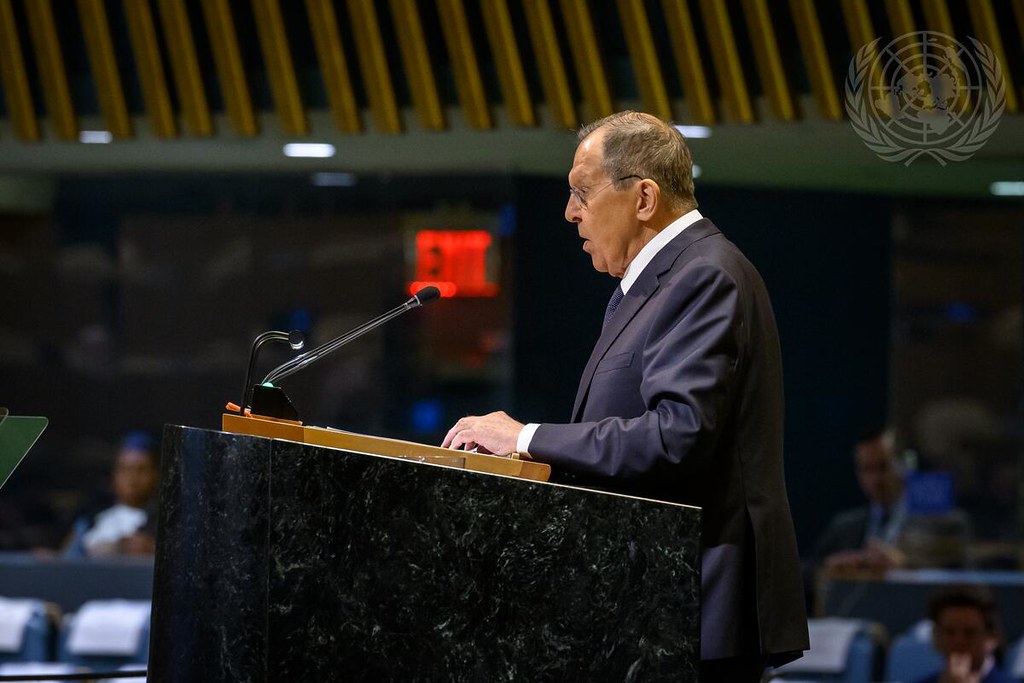
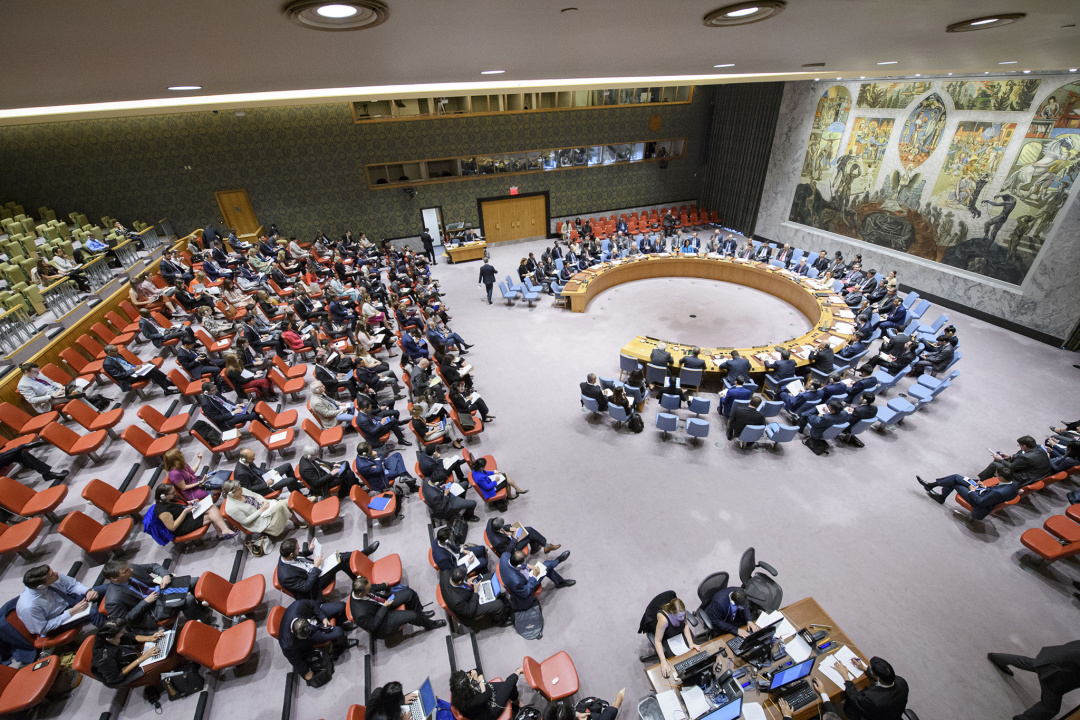
On October 24, the day the UN Charter entered into force eighty years ago, Moscow submitted for an open debate at the Security Council meeting a concept titled “The United Nations Organization: Looking into the Future”. It explores issues such as the implementation of the UN Charter, efforts to promote dialogue and unity (especially in the Security Council), and the long-term vision for the UN in the context of the UN80 initiative.
The members of the Security Council are accustomed to Russian lies, which constantly pour from the mouths of Russian Permanent Representative Vassily Nebenzia at the UNSC, his deputies, and Russia’s top diplomats.
Therefore, accusations against NATO and the West of “violations of the UN Charter and other norms of international law” coming from the mouth of the representative of a state that attacks a neighboring country with bombs, drones and missiles on a daily basis, blocks humanitarian missions, destroys civilian infrastructure, and abducts children, convinced few people.
The Russian representative also stated that the UN Charter “remains on paper only” due to “Western hegemony,” and also reproached democratic countries for “dividing the world into their own and others’.”
Nebenzia’s rhetoric only underscored the absurdity of the situation. The Kremlin, which has destroyed international law, claims to be its guardian. Under the slogan of “fighting double standards,” Moscow promotes its own system of immorality, where aggression is presented as “defense of sovereignty,” and colonial war as “peacemaking.”
The UN, while condemning Moscow’s actions, has failed to find a mechanism to cut the aggressor down to size. Russia, having assumed a permanent position following the dissolution of the Soviet Union in December 1991, retains membership in the Security Council, which is not provided for by either the Charter or any other UN document, and has frequently used its veto to block resolutions, particularly on its invasion of Ukraine.
Ambassador James Kariuki, UK Chargé d'Affaires to the United Nations, speaking at the UN Security Council meeting on the future of the UN, did not hesitate to call things by their rightful names.
“We must highlight the hypocrisy of the Russian Federation positioning itself as a champion of the Charter. It does this while continuing to disrespect the principles of the sovereign equality of States and flagrantly contravening the prohibition on the use of force against the territorial integrity of another State. This makes a mockery of the very platform we have been given in the Security Council to uphold international law and to maintain peace and security. Russia’s invasion of Ukraine, the actions of its shadow fleet, and its malign activity targeting a wide range of States all raise serious concerns about its adherence to the very Charter it seeks to celebrate today.”
Nearly half a hundred states ridiculed Russia’s convening of the Security Council to discuss the future of the Organization while the Kremlin is waging war against Ukraine.
“Russia’s lectures to the world on the future of the United Nations are nothing more than an insult to the UN Charter,” said a joint statement spoken out by Ukraine’s Deputy Permanent Representative, Khrystyna Hayovyshyn, in the presence of signatory countries.
UN Photo
OLEKSANDR MATSUKA, CHIEF OF THE UN SECURITY COUNCIL SECRETARIAT IN 2012-16: UNSC REFORM WILL NEVER TAKE PLACE
The former chief of the UN Security Council Secretariat, Ukrainian diplomat Oleksandr Matsuka shared his opinions regarding the prospects for reforming the UN with Ukrinform’s correspondent in New York:
“The UN remains one of the world’s most universal institutions as it brings together all countries and addresses absolutely everything – from the "triple planetary crisis" of climate change, biodiversity loss, and pollution to human rights, peace and security. A state entity being not a member of the Organization makes it into an inferior country. Membership in the UN is a kind of a state’s birth certificate.
That being said, the United Nations demonstrated its helplessness immediately after its creation. It has failed to prevent wars between a number of Middle East countries and Israel since 1947, the India-Pakistan military conflict (also from 1947), where the oldest UN peacekeeping mission is still present, and the Korean War of 1950–1953.
The problem is inherent in the organization’s foundations laid down in its Charter. It’s just that five countries – the United States, Great Britain, the Soviet Union, the Republic of China, and France – proclaimed themselves permanent members of the Security Council, based on a single criterion: they were the victors in World War II. There’s something Orwellian about this, because the five countries believe that their votes carry more weight than all the others combined.
The Security Council has never been able to pass resolutions on conflicts involving permanent members. This is primarily the case with Russia’s aggression against Ukraine. But there was also Vietnam, Afghanistan…
I consider the “golden age” of the UN to be the period after the fall of the Berlin Wall in 1989, that is, between the end of the Cold War and the early 2000s, when all countries showcased willingness to find solutions to important issues. In 2001, the UN even won the Nobel Peace Prize.
But everything began to change with Putin coming to power in Russia. The last time the Security Council adopted a resolution to end a war conflict was in 2011, when a no-fly zone was established over Libya to protect the civilian population from attacks by Gaddafi’s government forces. The Russians resisted to the end, but the States were able to convince them to agree.
All other decisions on conflicts are, at best, extensions of existing mandates.
When North Korea began supplying weapons to Russia, Moscow did not extend the mandate of the mission to monitor compliance with the sanctions regime. As for Iran, when UN Secretary-General Antonio Guterres intended to dispatch a mission to Ukraine to verify the origin of the Shahed drones (this does not require a decision by the UNSC), Russia threatened to stop all cooperation with the UN, and he had to back down.
Moscow’s position is destroying and breaking the very UN system that was laid down 80 years ago.
The United Nations remains the way the five states want it to be. If they fail to come to terms, then everything remains as is.
I once spoke with the permanent representative of one of these five countries when Ban Ki-moon was being elected Secretary-General. “Can’t you see that he just doesn’t get to that level?” I inquired. “Yes, and that suits us all right,” the diplomat replied, and added, “If the Secretary-General is weak, he will do whatever we want.”
In fact, a lot needs to be changed, including putting pressure on the bureaucracy. Of course, there are people in the secretariat who really work, but there are also those who just write a report once a year that no one reads.
UN Photo
Another problem is that it is impossible to close a topic that has exhausted itself. For example, at Russia's insistence, the 1999 Security Council resolution on the Kosovo peacekeeping mission does not specify the duration of the mission’s mandate. The mission is now unnecessary, it does nothing, but it cannot be closed. The Security Council should vote for it, but Russia opposes this.
Let me give another example. The UN Secretariat includes a Committee on the Exercise of the Inalienable Rights of the Palestinian People, established in 1975. Palestine has long received a much higher status in the UN - it has been an observer state since 2012. But the committee cannot be closed, because Muslim countries in the General Assembly will not vote for it.
All the committee does is hold one or two seminars a year.
The former US ambassador to the United Nations, now world-renowned John Bolton once said: a third of the UN headquarters buildings could be demolished without anyone noticing.
There may be qualitative changes, but there will never be reforms of the Security Council. These five countries will not lose their veto power. Any changes to the United Nations Charter require ratification by all five permanent members of the Security Council, and an amendment must first be adopted by a vote of two-thirds of the members of the UN General Assembly.
They are afraid to even put to vote Russia’s permanent seat on the UN Security Council replacing the USSR, or to remove the long-outdated words “hostile countries” with respect to Germany and Japan from the Charter to avoid opening this Pandora’s box.
It is hard to predict what awaits the UN. At least, I think, we need to create some new organization first before breaking the old one. Other forms of cooperation still exist, so we have to live with what we have.”
Volodymyr Ilchenko, New York
Headline photo via the UN