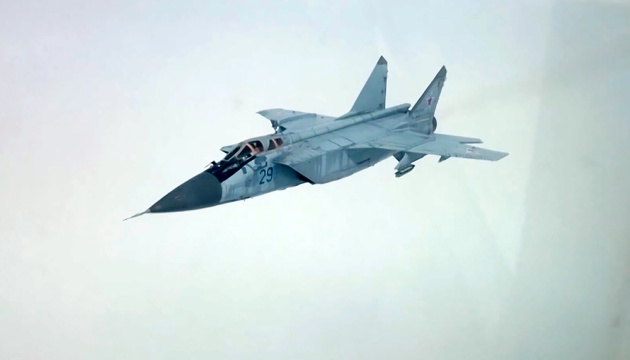
Russia’s violation of Estonia airspace: What made NATO stop short of shooting down Russian MiG-31 jets?
The incident involving Russian fighter jets flying without permission over Estonia have made us recall a 10-year-old Turkish precedent and reflect on what is wrong with the Alliance’s rules of engagement. Three Russian MiG-31 fighter jets entered the airspace of Estonia, a NATO member, without due permission on Friday, September 19, and stayed for a total of 12 minutes before they were forced to withdraw. This incident was not just yet another violation of NATO airspace, but a conscious test of the entire Alliance’s strength and resolve. While Moscow, true to form, denied its jets violated Estonian airspace, saying they flew over neutral waters, the West raised a hot question: why didn’t the Italian F-35s, which had been scrambled to intercept and escort them out of Estonian airspace, didn’t shoot down the violators? This situation involuntarily made everyone recall the events from a decade ago, where Turkey didn’t hesitate to shoot at and send to the ground a Russian Su-24 after it flew above Turkey for just 17 seconds. The contrast between Ankara’s resolve back then and NATO’s restraint now has exposed a profound dilemma facing the Alliance: where to draw the line between avoiding escalation and showing the weakness the Kremlin will inevitably exploit.
Condemnation by words and NATO meeting
The world’s response to the Russian provocation was unanimous and quick in coming, at least at the diplomatic level. Estonia requested consultations under Article 4 of the Washington Treaty after the incident that it described as an "unprecedentedly brazen" incursion. European Commission President Ursula von der Leyen said that Europe “will respond to every provocation with determination while investing in a stronger Eastern flank. As threats escalate, so too will our pressure.” This statement was echoed by the EU's top diplomat Kaja Kallas who accused Moscow of an "extremely dangerous provocation", and by French President Emmanuel Macron, who described this as “a new step in this accumulation of provocations and irresponsible actions by Russia”. Czech President Petr Pavel has warned there is a “significant escalation to European security” and NATO must stay united and must respond decisively to Russian aggression. Pavel said that Russia will “quickly realize” that they have overstepped their bounds, but Europe is on the “brink of conflict.” The Czech President said during an interview with the public broadcaster Czech Television, “In these times, we must act firmly, and if violations occur, we must respond accordingly, including militarily. Russia will very quickly realize it has made a mistake and overstepped its bounds. Unfortunately, this is balancing on the brink of conflict, but giving in to evil is simply impossible,” he said.
NATO said its jets were scrambled to intercept the Russian MiG-41s under the alliance’s new Operation Eastern Sentry, created to protect Eastern Europe, but this did not prevent the violators from staying in Estonian airspace for long 12 minutes. This escalatory event forced the Alliance to seriously consider revising its response rules. On 23 September, the North Atlantic Council met in Brussels at Estonia's request under Article 4 of the Washington Treaty to discuss Russia's dangerous violation of the country's airspace. The key issue on the agenda was to determine whether to use military force against Russian aircraft or drones violating NATO airspace based on real-time intelligence about the level of threat they may pose, and, possibly, to update the NATO “hostile intent” and “hostile act” concepts.
Following the meeting, the NATO press service issued a statement, declaring that Russia’s actions over Estonia were “escalatory, risk miscalculation [and] endanger lives.” The “dangerous” violation last week was “part of a wider pattern of increasingly irresponsible Russian behavior”. The alliance stressed that it would “reinforce our capabilities and strengthen our deterrence and defense posture, including through effective air defense. Russia should be in no doubt: NATO and allies will employ, in accordance with international law, all necessary military and non-military tools to defend ourselves, and deter all threats from all directions. We will continue to respond in the manner, timing, and domain of our choosing. No actions by the Russian Federation will divert the Allies from their unwavering commitment to supporting Ukraine, whose security contributes to ours, in exercising its inalienable right to self-defense against Russia’s brutal and unprovoked military aggression,” the statement reads.
Meanwhile, we have a number of other important news. First, Lithuanian parliament, the Seimas has authorized its army to shoot down drones violating its airspace (Lithuania's army is currently able to target drones only if they are determined to be armed or pose an imminent danger to objects important to the state), and second, Sweden warned it would shoot down Russian fighter jets if its airspace was violated.
For your information: In NATO terminology, the distinction between hostile intent and hostile act is crucial for determining the appropriate military response under the Rules of Engagement (ROE). Unlike the US, which uses these terms to define the right of self-defense, NATO's definitions are more complex and are used to authorize force in situations that do not yet meet the legal threshold for self-defense.
NATO defines hostile intent as a "likely and identifiable threat" based on a target's capability, preparedness, and intention to attack or inflict damage. Intent is often determined based on observed actions. For example, a military aircraft violating a country's airspace and failing to respond to repeated radio calls would be deemed a hostile intent. When hostile intent is detected, NATO follows a "ladder of escalation" that begins with non-lethal responses. For an aerial incursion, this includes radio calls, visual signals, and escorting the aircraft out of the area. The use of armed force is a last resort and requires authorization, but it can be used if the threat is deemed sufficient to warrant it. As NATO Secretary General Mark Rutte explained after the MiG-31 incident in Estonia, the decision to engage depends on "available intelligence regarding the threat posed by the aircraft, including questions we have to answer like intent, armament and potential risk to Allied forces, civilians or infrastructure".
Examples: a massive troop buildup near NATO borders, preparation of electronic warfare equipment for an attack; an attempt to aim missiles at NATO facilities. That is, this is not yet an attack, but a sign that an attack is possible or likely. In such a case, NATO can: increase the level of readiness; relocate troops; demand explanations or use diplomatic demarches.
A hostile act is defined as "any intentional act causing serious prejudice or posing a serious danger to NATO/NATO-led forces or designated forces or Personnel," but one that does not yet constitute an actual attack.
Examples: military aircraft penetrating NATO airspace and refusing to comply with interception instructions, mine-laying operations that restrict the movement of NATO forces, attempting to breach a military installation, an armed attack on NATO territory, forces or facilities, a cyber or subversive attack that causes significant damage (energy grids, military infrastructure).
NATO uses the concept of "hostile act" to permit force in situations that might not rise to the level of an actual attack, allowing for preemptive action to address a dangerous situation before it fully escalates.
17 seconds of Turkish determination
Against the backdrop of NATO’s current restraint, Turkey’s example looks even more striking. On November 24, 2015, two Turkish F-16s shot down a Russian Sukhoi Su-24M bomber that had briefly violated Turkish airspace near the Syrian border. This decision was not spontaneous. It was preceded by clear and consistent policy pursued by Ankara. Back in 2012, after Syria shot down a Turkish reconnaissance plane, President Erdogan announced a change in the rules of engagement, promising to consider any military object approaching from Syria a threat.
After Russia launched a military operation in Syria in 2015, Ankara repeatedly warned Moscow against violating its airspace. The Russians ignored these warnings. On the morning of November 24, two Russian Su-24s approached Turkish airspace over a five-minute period. Turkish air controllers issued 10 warnings over an emergency radio channel, directing the aircraft to change their course. After disregarding these warnings, one of the planes violated Turkish airspace for 17 seconds, flying 2.19 kilometers deep. It was during this violation that a Turkish F-16 fired an air-to-air missile, causing the jet to crash in Syrian territory.
The Kremlin’s reaction was fierce but impotent. Russian President Vladimir Putin condemned the act, calling it a "stab in the back" and stating that the plane was over Syrian territory, 1 kilometer from the border when it was hit. He then responded by imposing an embargo on Turkish tomatoes exports, but most importantly, Russian planes stopped testing Turkish borders. This incident proved that a decisive military response can be more effective than offering endless diplomatic concerns.
Why Estonia is not Turkey: realities and rules of engagement
A direct comparison between Estonia’s and Turkey’s responses would be incorrect from both military and legal points of view, experts emphasize.
First, there is a striking difference in military capabilities. Turkey is the second most powerful army in NATO, with hundreds of its own combat aircraft and a robust air defense capacity. In 2015, it acted independently, using its own fighter jet, which was not under the direct command of the Alliance. Estonia, on the contrary, does not have its own fighter jets, and its air defense capacity is limited, to put it mildly. The country’s air security relies solely on the Baltic Air Policing mission -- a NATO collective defense operation that provides air security for the airspace of Estonia, Latvia, and Lithuania. The three Baltic states joined NATO in 2004 but do not possess the necessary fighter aircraft to patrol their own airspaces.
Anatoliy Khrapchynski, a Ukrainian Air Force officer (ret.) and deputy CEO at an electronic warfare manufacturing company, explains in detail why an immediate armed response was impossible. He says bluntly: "Could Estonia have shot down a Russian fighter jet... like Turkey did in 2015? No, it couldn't. It's inappropriate to compare the capabilities of these two countries. Estonia actually doesn't have its own fighters, and there are as well big problems with air defense systems. Estonia is forced to rely on NATO. And the decision - to shoot down or not - is made by NATO."
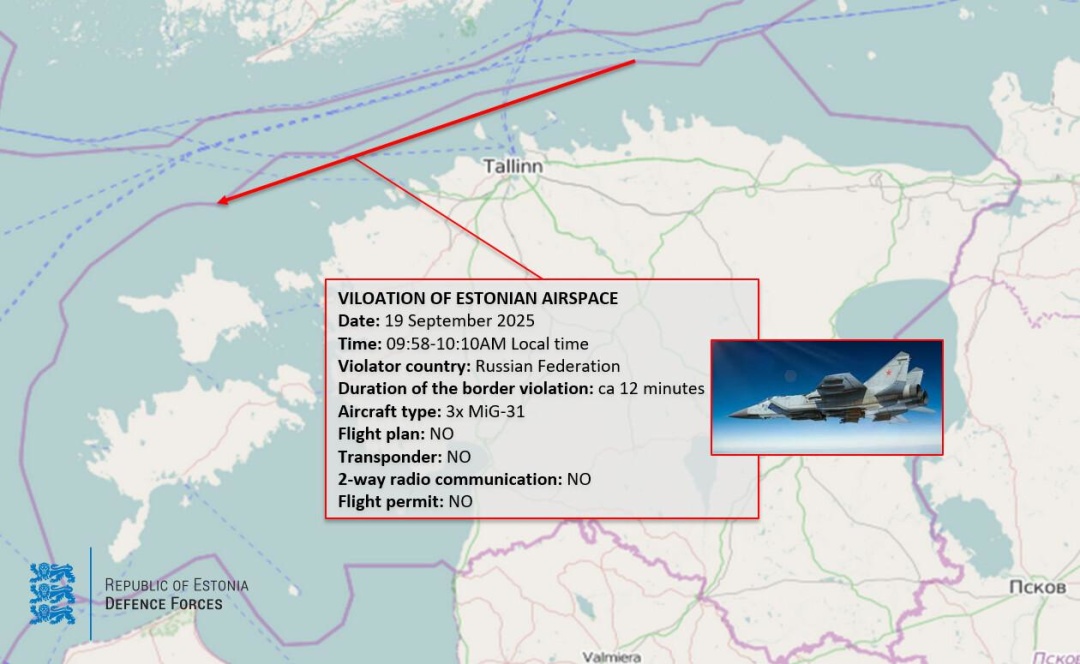
The Estonian Defense Forces have published a map of the flight path of Russian MiG-31 fighter jets that violated Estonian airspace on September 19
Russia uses specific tactics, maneuvering at the very edge of airspace, so that in case of interception its airplanes will already be within international borders, he explains, adding, “Relatively speaking, if an interception occurs, it takes place already in international airspace. This was the case this time: the Russian MiGs were operating at the edge, and due to its characteristics – it is a supersonic aircraft – it could turn on the afterburner and escape. And a shootdown in ‘international’ airspace would have become a precedent that would be beneficial to Russia, which could accuse NATO of ‘aggression’.”
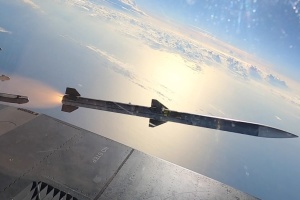
In addition, the Alliance assessed the real level of the threat. On board the MiGs were only R-73 air-to-air missiles, not air-to-ground ones, which indicated the absence of a direct threat to facilities on the ground. “I personally believe that Russian planes should be shot down. But NATO acted according to its standards: threat detection, situation assessment, and, if necessary, interception or escorting. The Russian airplanes were ‘at gun point’. Believe me, the MiG is no competitor to the F-35... In my opinion, NATO acted appropriately. At least in this specific situation. Indeed, the Russian Federation will not stop there, and the West must therefore build up its efforts to counter the aggressor, in particular by strengthening Ukraine's capabilities," Khrapchynski said.
Viktor Taran, head of the Kruk UAV Operator Training Center suggests shifting the focus of the discussion from Tallinn to Brussels. "There can be no complaints against Estonia, because the country has donated a large part of its own weapons to Ukraine, including air defense systems. Therefore, the question should be posed differently: not "why didn't Estonia shoot it down?", but "why don't the protocols of the NATO policing mission, which is currently deployed in Estonia, allow for prompt protection?". In his opinion, it is the outdated protocols of the Alliance and the status of the observation mission that constitute the main problem. “Maybe NATO should finally review its protocols and, in case a similar situation occurs, start actively defending its allies? I am convinced that if the Italian F-35s had shot down the Russian MiGs, Russia would not have done anything in response,” Taran sums up.
Asymmetric responses and raising the stakes: the view of political scientists
Political scientist Ihor Reiterovych believes that the Kremlin is gradually raising the stakes: “At first the Kremlin launched drones, followed by airplanes.” He sees this as a strategy aimed at demonstrating that Putin is not at war with a specific country, but with the Alliance as a whole. In his opinion, NATO’s best response could be an asymmetric action, for example, the creation of a no-fly zone over part of the territory of Ukraine. “It could be controlled by Alliance aircraft and air defense systems. Technically, there will be no NATO troops deployed on the territory of Ukraine, but the no-fly zone will allow us to secure airspace over some of our western cities.” Mr. Reiterovych is convinced that despite the hysterical reaction, Putin will be the first to retreat, because “he does not have the resources to fight NATO.”
Political analyst Oleh Sahakyan also calls on the West to move from symmetrical military responses to asymmetrical actions in other areas that will hit the Kremlin’s most vulnerable spots. He suggests switching “from a policy of deterring Russia to a policy of preventing its aggression.” As an example, he suggests holding a major naval exercise in the Baltic Sea, which would effectively block Russian oil exports, similar to how Russia blocked the Black Sea under the pretext of naval maneuvers. Another option is to use technological superiority: “In the event of a new incursion... the West should launch cyberattacks on the infrastructure that enables the intruding drones to be launched from Russian territory, up to and including disabling power plants.” The arsenal of such actions, he says, is extremely wide and is not limited to military force.
Conclusion
The incident in the Estonian airspace is not just a military provocation, but a political message from Putin: “I will do what I want, as long as you let me.” The example of Turkey proves that the only language understood by Russia is the language of force. The Alliance faces a choice between drawing a new “red line”, thus clearly warning that any violation of its airspace will be stopped by military force, and continuing to watch Russia undermining the security situation in Europe. And while consultations are ongoing in Brussels, it is quite likely that next time the Russian airplanes will linger in the skies of a NATO country a little longer, and the “accidental” drone will fly a little deeper (on the night of September 23, unidentified drones flew into the airspace of Denmark, Norway and Sweden).
Ultimately, the response to Russian audacity lies not only in changing the rules within NATO, but also in more decisive support for Ukraine, which is showing every day in practice how to talk to an aggressor. After all, the security of NATO's eastern flank directly depends on the stability of the Ukrainian front lines.
Myroslav Liskovych. Kyiv