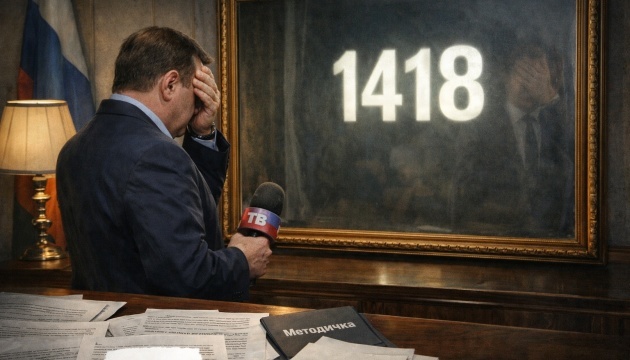
1418: The Number Russia Is Running From
The war against Ukraine Russia is referring to as “special military operation” has crossed the mark of 1,418 days and has officially lasted longer than the Soviet–German war, which in Russia is referred to as the “Great Patriotic War.” When the calendar of the full-scale invasion of Ukraine inevitably passed this date, Russian propaganda responded in unison: “This is different.” Just like that—without explanations, without arguments, and without the courage to call things by their proper names.
Official media outlets preferred to pretend that nothing had happened. The topic disappeared from broadcasts, news feeds, and talk shows. Judging by all indications, the Kremlin decided from the very beginning that this comparison was too dangerous to be allowed into the public discourse. It raises too many questions, while offering too few answers.
Z-Resources Search for Meaning in the War
Silence, however, did not last for long. Once the number became impossible to ignore, the propaganda machine was forced out of hiding and immediately set about not explaining, but obscuring; not answering, but clouding the issue. Vladimir Solovyov began speaking of the “main war of the 21st century”—naturally, not against Ukraine, but against NATO. The symbolic dates, he implied, were irrelevant. The war would last as long as it takes.
At the same time, other historical figures were invoked: the Great Northern War, which shaped Russia as an empire, lasted 20 years; the Thirty Years’ War, which reshaped Europe, lasted 30 years; the Hundred Years’ War for French independence lasted 116 years. Each comparison added another layer of verbal noise, all to divert attention from a simple fact: the “special military operation” in Ukraine has already outlasted the Great Patriotic War—and yet no meaning has emerged.
The absence of meaning was acknowledged even by the propagandist Zakhar Prilepin:
“The ‘special military operation’ has matched the Great Patriotic War in duration. I finally watched the video of the recent Oreshnik strike. Has anyone explained convincingly how effective it was? Have we already wiped out 50 percent of Ukraine’s gas reserves? In all the triumphant analysis I’ve seen only one thing repeated over and over: ‘Ukrainians are going mad with fear’ and ‘the West is going mad with fear.’ But didn’t they all supposedly go mad with fear last time as well? So they’re going mad again? How much more so? It would be nice to hear something more specific about the results—how much gas Ukraine actually has left. Given today’s date, I’d like to understand. Surely we are supposed to understand something on this day.”
In response, pseudo-philosophical constructs were rolled out: talk of a “war of intellects,” a “war of technologies,” and even a “century-long war aimed at the elimination the Russian nation.” Anything at all—except answers to the basic questions: why, for what purpose, and how much longer.
At the same time, the Kremlin continues to stubbornly cling to the formula “this is not a war.” That was the case in 2022, and it remains so today. Attempts to replace it with the notion of a “people’s war” (previously promoted by Donbas “curator” Sergey Kiriyenko, and before him by Yevgeny Prigozhin) have failed. The concept of a “war between the West and Russia” has taken root more successfully, but it too fails to resolve the core contradiction: the country is living in a state of full-scale war that the authorities still do not dare to call a war.
Sociologists point to a troubling detail: a majority of Russians—up to 70 percent—have, in one way or another, learned about the figure of 1,418 days. And this knowledge works against propaganda, because it erodes the image of a “successful special operation” and gives rise to what the authorities fear most of all—a silent but persistent question: why?
This is precisely why federal television pretends that the number 1,418 does not exist—because it offers no convenient framing. That figure does not fit into any triumphant narrative. It is not about victory; it is about repetition—not of heroism, but of duration. And this, perhaps, is the only thing that has truly been “repeated.”
The pro-war Z-channel Military Informant notes that “drawing parallels may be unwise, but the results inevitably force reflection—as does the question of how many more days, months, or years this may last, and what further consequences it will entail.”
And the consequences are already evident. According to NATO estimates as of December 2025, Russia’s army has lost 1.15 million personnel. The number of disabled—around 400,000—is effectively equivalent to the population of a large provincial capital. The war has consumed 42.3 trillion rubles, an amount comparable to eighty annual budgets of Sverdlovsk Oblast or twenty-five years of funding for Russia’s entire higher education system. Russia has become the most sanctioned country in the world, while the scale of losses has far surpassed those of the Afghan and Chechen wars put together.
In its absurdity and duration, the twelve-year war against Ukraine increasingly resembles those conflicts. Afghanistan, too, began with the deployment of a so-called “limited contingent,” officially described as responding to a request from the local government. A similar maneuver was attempted with Ukraine, when Russia’s then permanent representative to the UN, Vitaly Churkin, waved a piece of paper allegedly containing a request from Viktor Yanukovych to introduce Russian troops. The First Chechen War was likewise disguised as an effort to “restore constitutional order.”
1,418 days is a mirror into which Russians are unwilling to look
Whatever the case, the main outcome of 1,418 days of full-scale war is already evident: the collapse of Putinism is only a matter of time. This is understood at all levels of Russian society.
The “patriotic” Telegram channel Federation Towers states it bluntly:
“A coincidence in the number of days is not a coincidence in substance. During World War II, the entire system worked for the war. The economy was fully mobilized. The war was total. The ‘special military operation’ is being waged differently… Officially, they say there will be no new mobilizations and that existing resources are sufficient. In other words, the system believes it can win without full mobilization. That explains why it does not demand sacrifices from itself. If it believes it can win without total exertion, why exert itself at all? The USSR won the war in 1,418 days because all strata of society were mobilized for that goal. A war of that scale required the full mobilization of the entire system. If the system is not doing this now, it means it does not believe such mobilization is necessary.”
Even radical supporters of the invasion, such as the group DSHRG Rusich, admit bitterly that, “it took the same amount of time to capture Berlin in 1945; the current campaign has achieved nothing that could be called a victory.”
Meanwhile, prominent Russian nationalist Yegor Kholmogorov argues that, “the entire magic of the number 1,418 is the result of our poisoning by Soviet and contemporary neo-communist official propaganda, which claims that ‘the peoples of the CIS defeated fascism on their own,’ while various dubious ‘allies’ supposedly did nothing but delay opening a second front. Today we are fighting precisely against that coalition. Militarily, only North Korea supports us. All other ‘friends’ are purely economic or diplomatic. Accordingly, if we compare this war to the real Great Patriotic War—not the invented one sold by propagandists—then only one question remains: why are we still alive at all, and moreover, why are we still advancing?”
Thus, as we can see, the “sacred” 1,418 days—so deeply embedded in the Russian historical myth—have turned into a mirror that Russians are simply afraid to look into.
The next uncomfortable milestones for them are already approaching: February 24, marking four years since the launch of the full-scale invasion, and June 10, the date on which the so-called “SMO” will surpass even the duration of World War I.
Max Meltzer