Europe is learning from Ukraine
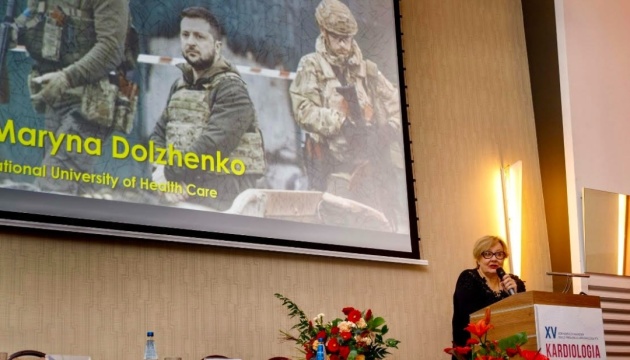
When Professor Maryna Dolzhenko concluded her presentation, "The Impact of the Guidelines of the European Primary Care Cardiovascular Society on Pharmacotherapy Prescribing in Ukraine," at the European Summit in Palma de Mallorca, silence filled the room.
Normally, audience members raise their hands to ask questions after a presentation, while the moderator invites other specialists to share their views on the topic under discussion. This time, however, there were neither questions nor comments. Those present were deeply impressed by the vast body of analytical data that Dolzhenko, Head of the Department of Cardiology at the Shupyk National Healthcare University of Ukraine, had compiled together with her colleagues and practicing physicians over more than four years of war in Ukraine.

Every presentation by Professor Maryna Dolzhenko is illustrated with photographs, including images from the front line.
At the same time, the speaker was fully prepared to answer any question from Europe's leading experts. Over the past six years, Dolzhenko has delivered hundreds of lectures and reports through WebCardio.org, the online educational platform she established in Ukraine to provide continuing professional education for physicians, pharmacists, and nurses.
Every Saturday at 11:00, four times a month, year after year, she appeared on the screens of thousands of family physicians, internists, endocrinologists, and rheumatologists, who set aside their other work to attend the professor's master classes. The popularity of these conferences was evident from the attendance: on some Saturdays, as many as 15,000 physicians joined her lectures.
What sustained Ukrainian medical professionals' continuing interest in these master classes? First and foremost, it was Professor Dolzhenko's extensive experience, expertise, and scientific research, which have earned recognition both in Ukraine and abroad. As a result, her European colleagues recommended her as a peer reviewer for one of Europe's most respected medical journals, the European Journal of Preventive Cardiology. This work has enabled Professor Dolzhenko to remain at the forefront of the latest advances in preventive cardiology.
The strong interest shown by her Ukrainian colleagues also stemmed from the fact that, in addition to her own presentations, participants could hear lectures by other leading Ukrainian and European experts. These included Professor Yurii Syrenko, Honored Doctor of Ukraine, State Prize laureate, and Head of the Department of Therapy and Rheumatology at the Shupyk National Healthcare University of Ukraine; Professor Oleh Sychov, Deputy Director of the M.D. Strazhesko Institute of Cardiology and Honored Doctor of Ukraine; Professor Borys Mankovskyi, Director of the D.F. Chebotarev Institute of Gerontology and Corresponding Member of the National Academy of Medical Sciences of Ukraine; Dr. Liubov Sokolova, Head of the Department of Diabetology at the V.P. Komisarenko Institute of Endocrinology and Metabolism; and Professor Dmytro Lashkul, Head of the Department of Internal Medicine at Zaporizhzhia Medical and Pharmaceutical University.
On such occasions, Professor Dolzhenko served as moderator, ensuring that every aspect of a patient's condition, diagnosis, and treatment protocol was examined thoroughly by all participating physicians.
Maintaining this high standard required constant preparation. Despite her extensive experience, Professor Dolzhenko began preparing for each new conference the very day after the previous one had ended. Her desk was always covered with publications by both international and Ukrainian experts, extending well beyond the field of cardiology. Brainstorming sessions with colleagues from the Department of Cardiology, with whom she developed a lecture series devoted to the clinical analysis of patients, helped ensure that every presentation was not only highly informative but also distinctive, each offering its own "intrigue" and a fresh way of presenting new knowledge.

Conferences and congresses always provide colleagues from different countries with an opportunity to exchange ideas. Renowned British scientist Peter Sever showed particular interest in Maryna Dolzhenko's research.
More often, the topics for upcoming lectures were suggested by the participants themselves, who wanted to discuss treatment approaches and receive guidance from Ukraine's leading specialists. Even when Professor Dolzhenko traveled abroad to present her scientific findings at international congresses and symposia, she continued to appear on participants' computer and laptop screens according to the regular schedule. On those occasions, her discussion partners were prominent international experts, most often Professor David Wood, former President of the World Heart Federation; Professor Kornelia Kotseva, consultant at King's College London; Professor Catriona Jennings; and Professor Ana Abreu, President of the European Association of Preventive Cardiology.
From the very beginning of Russia's full-scale invasion, the information shared by participants during these lectures increasingly resembled field reports. The use of antidepressants had doubled. Chronic stress was causing hormonal changes in nearly all Ukrainians, leading to elevated blood pressure, heart rhythm disorders, and a higher risk of heart attacks and strokes. The most common consequences were well known: arterial hypertension, coronary artery disease, and heart failure. As a result, deaths from cardiovascular diseases increased by more than one-third. Cardiac surgery departments began performing significantly more heart operations, and in some cases, patients were brought to the operating room directly from the front line.
In wartime, with many hospitals and clinics destroyed by Russian missile strikes and numerous medical professionals serving on the front lines, unconventional solutions became essential. Treatment protocols already existed, but were the conditions always in place to follow all the recommendations developed in peacetime? At that point, Professor Dolzhenko had to draw not only on her professional expertise but also on her remarkable energy and, it could be said, her iron determination. She understood that this sense of optimism had to be passed on to the thousands of participants attending her Saturday conferences. That required not only new knowledge and medical techniques but also meticulous attention to every detail: an elegant appearance and complete confidence reflected in every gesture and every word. No matter what attacks on Kyiv she had endured the night before – even when neighboring buildings had come under fire – Professor Dolzhenko always maintained the highest level of professionalism, remaining a strong and authoritative leader.
How effective were her lectures and conferences for Ukrainian physicians? According to a 2023 study by IQVIA, 25 percent of Ukrainian cardiologists named WebCardio.org the country's best educational platform, recognizing Professor Dolzhenko's personal contribution to its success. Physical exercise, breathing techniques to reduce stress and anxiety, adherence to prescribed medications, and seeking help from psychologists and psychiatrists all formed part of the recommendations promoted through the platform. Through years of leading this educational initiative and her unwavering dedication to her professional duty, Professor Dolzhenko demonstrated how crucial the physician's own personality is in the healing process, as well as the confidence that every patient can overcome their illness.
Yet none of this fully conveyed the scope of Professor Dolzhenko's presentation at the European Summit, which focused on latent atherosclerosis and pre-infarction conditions among Ukrainians during the war. The examples and statistics she presented to Europe's leading cardiologists gave them a clearer understanding of the health of the Ukrainian people and of their determination to defend their freedom and independence. The discussion also addressed Professor Dolzhenko's work and the efforts of Ukraine's entire healthcare system to safeguard the nation's health under wartime conditions.
The award she received at the 2025 Congress of the Royal Pharmaceutical Society for her presentation, "Optimizing Pharmacotherapy for Coronary Artery Disease with Comorbidities: The Impact of an Online Continuing Professional Development Program in Ukraine," further underscored the importance of education through the WebCardio.org platform.
Professor Dolzhenko's long-standing role as Ukraine's national coordinator for the European epidemiological studies EUROASPIRE IV, V, and VI also contributed to the inclusion of clinical data from Ukrainian patients in the development of European treatment guidelines for diabetes mellitus, myocardial infarction, chronic coronary syndrome, and the prevention of cardiovascular disease.
After returning to Kyiv from the European Summit, Professor Dolzhenko learned that she had been awarded the Honorary Certificate of the Verkhovna Rada of Ukraine "For Special Services to the Ukrainian People."
Oleksandr Fedorov, a member of the International Federation of Journalists
Advertisement in accordance with Clause 3 of Article 9 of the Law of Ukraine No. 270/96-VR of July 3, 1996, and Law of Ukraine No. 2849-IX of March 31, 2023.