Hague presents All-Ukrainian mental health program “How are you?”
This was reported by a Ukrinform correspondent in The Hague.
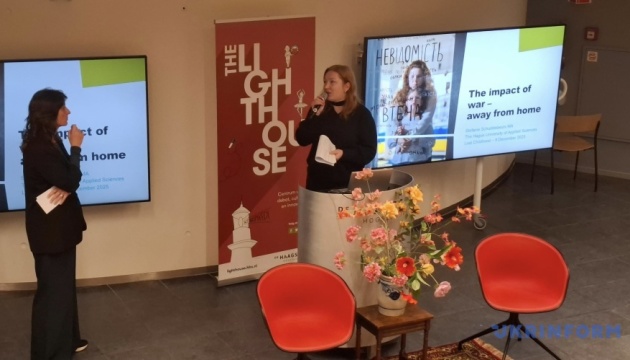
During a speech at the Hague University of Applied Sciences at a panel discussion on the impact of war, expert Anna Sokolenko, who represents the Coordination Center for Mental Health of the Cabinet of Ministers, which is implementing the “How are you?” program, noted that 83% of Ukrainians experience high levels of stress due to Russian aggression.
"I want us to be heard in the Netherlands, because you too can help us build a mental health system in Ukraine. To understand the scale of our work, you need to see the depth of the challenge we face. This is not a local crisis — it is a mass condition of society. 83% of Ukrainians experience constant stress and tension — it has become an everyday occurrence. This has forced us to move away from a purely medical model and build a comprehensive, multi-level system of support and resilience for both individuals and communities," she said.
Sokolenko explained that the “How Are You?” program is integrated into everyday life through family doctors, schools, universities, children's hubs, cultural and sports spaces, and scaled up to the community level. It also includes ongoing training for specialists.

"More than 130,000 medical professionals, including family doctors, pediatricians, and therapists, have been trained to provide basic psychological support under the WHO mhGAP program. For example, children come for a medical examination and receive basic diagnostics at the same time. And this is only in the medical field. Mental health is also integrated into all other state policies at all levels: from the government to the community," the expert noted.
According to her, the “How Are You?” program aims to reduce stigma, support mental health, and strengthen the resilience of Ukrainian society in the context of war.
In an exclusive comment to a Ukrinform correspondent, Sokolenko said that Ukrainians who are abroad due to the war can also receive qualified assistance online.
“Our ”How are you?“ platform has a separate large section with verified services available online. Here, our children, young people, and adults who are abroad, especially those who have experienced loss, can receive support. Depending on the request, you can choose the appropriate specialist, training event, or educational series,” she explained.
The representative of the Mental Health Coordination Center also emphasized that communication with Dutch colleagues was very valuable: "It was a very meaningful meeting, we received important messages from our colleagues. I really liked that in-depth research is being conducted here. We are open to cooperation and exchange of experience. It would be useful for our psychologists, social workers, and teachers to learn from each other. We have now reached a level where we can teach others ourselves — our country has gained unique experience and expertise that can certainly be useful to other countries."
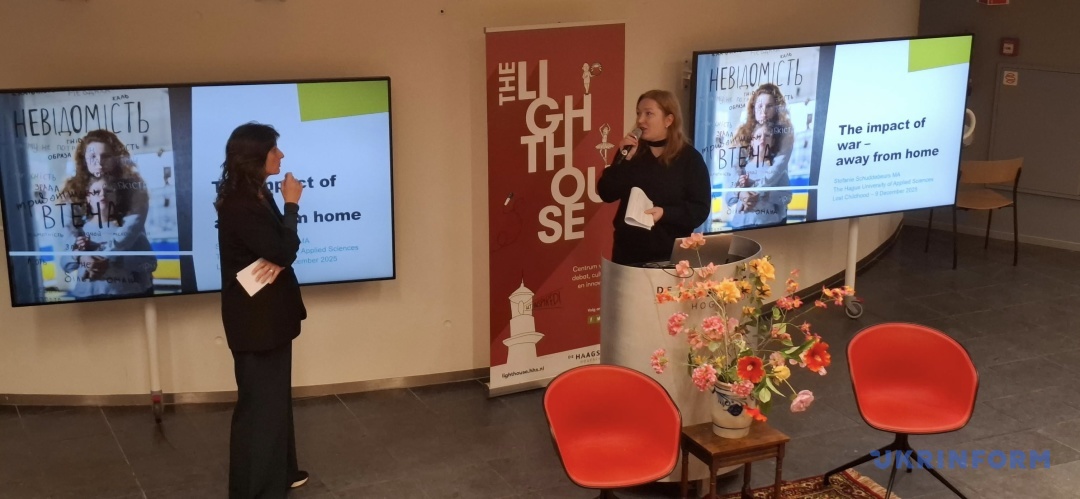
In turn, researcher Stefanie Schuddebeurs, project manager at The Hague University of Applied Sciences, presented the results of a study on Ukrainian teenagers who found themselves in the Netherlands due to Russia's full-scale invasion.
“Since the start of the war in Ukraine, between 5.1 and 5.3 million Ukrainians have been displaced to Europe, of whom around 130,000 are currently in the Netherlands. There is little research on their well-being yet, but we have already received the first preliminary results. The survey showed that 55% of adult Ukrainians in the Netherlands have good mental health, while 45% do not, which is a very high percentage. Among adolescents and young people aged 15–24, 43% show signs of possible mental health problems. A study of children aged 12-15 showed that 50% have problems with sleep and concentration, and 40% have varying levels of depression, anxiety, or panic attacks. Only 25% feel good," she said.
Experts note that adapting to a new school, language, and housing, as well as uncertainty and instability, create additional stress for Ukrainians. The study is being conducted with the aim of developing effective support programs for Ukrainian teenagers in Europe and improving their mental health.
As reported by Ukrinform, more than 13,000 mental health and psychosocial support service providers work in 23 regions of Ukraine.
Photo: Iryna Drabok / Ukrinform
Photos from Ukrinform can be purchased here