
Otakar Foltin is a prominent Czech military officer, security analyst, and public intellectual, known for his criticism of the Russian regime and his outspoken support for Ukraine.
A Ukrinform correspondent met him for an interview at Prague Castle. Colonel Foltin serves as Deputy Head of the Military Office of the President of the Czech Republic, where he oversees the analytical department. He stressed, however, that in speaking with Ukrinform he was expressing his personal views, not an official position.
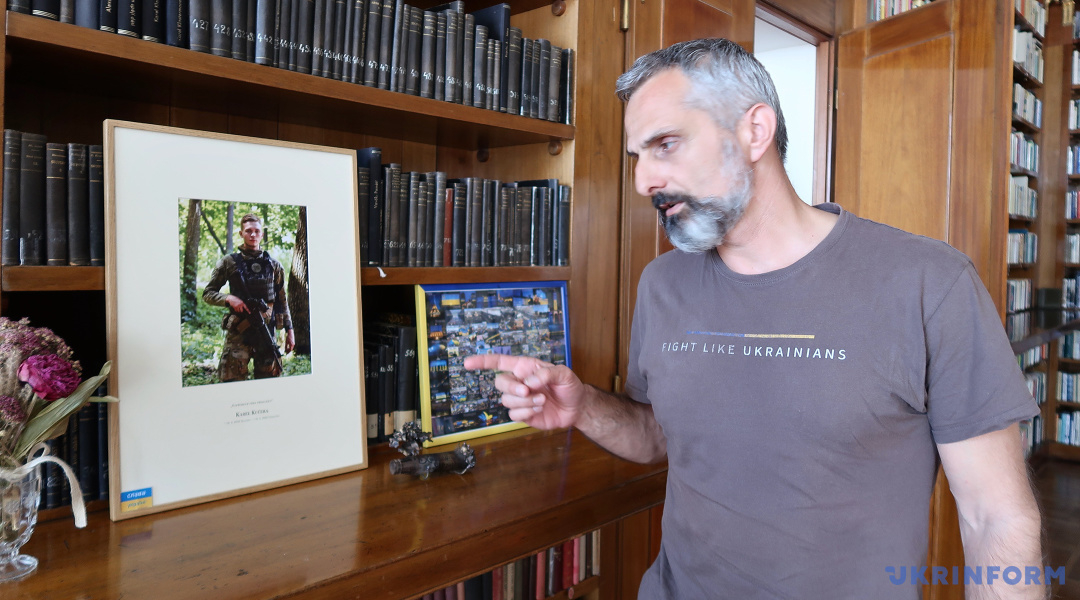
His stance is symbolized by a Ukrainian flag displayed in the window of his office within the Prague Castle complex. The interview itself took place in the presidential library—once used by the first President of Czechoslovakia, Tomáš Garrigue Masaryk, who founded the Military Office in 1919. In a place of honor there, Foltin pointed to a photograph of Czech volunteer Karel Kučera, who gave his life for Ukraine’s freedom and was posthumously awarded a state honor for battlefield heroism by President Petr Pavel.
Our conversation ranged from Ukraine’s fight for European values and its role as an integral pillar of Europe’s security architecture, to the degradation of the Russian Empire and its increasingly desperate attempts to halt its decline. We also discussed what February 24 represents for Foltin personally.
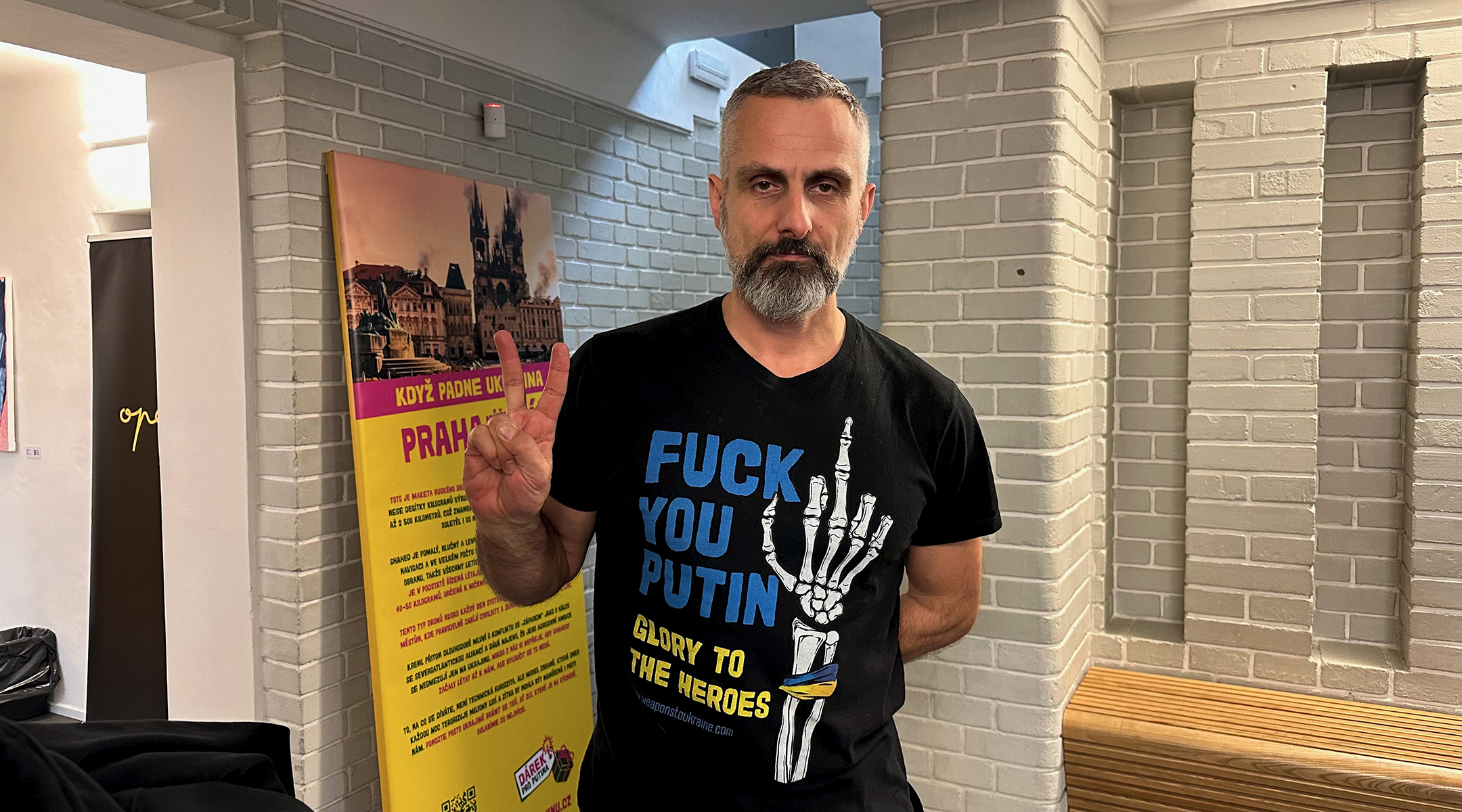
THE STATE CANNOT OUTSOURCE RESPONSIBILITY FOR SECURITY AND STRATEGIC COMMUNICATIONS
Q: Colonel, just a year ago you served as the government coordinator for strategic communications, stepping down in the autumn of 2025. The respective body—and the position itself—no longer exists. Prime Minister Andrej Babiš has said the Czech Republic no longer needs it, even though he initiated its creation in 2021 during his first term. Do you consider this role important? And which institutions are now responsible for this agenda?
A: Strategic communication is the alignment of messaging, policy, and action across state institutions. In practical terms, there are at least two domains in which the state can never outsource responsibility to non-governmental actors—communications and warfare. Certain areas, such as social services or healthcare, can be partially delegated to private or non-profit entities; sometimes that works better, sometimes worse. But this logic does not apply to strategic communications or security. Unfortunately, we lack the political will to address security challenges.
By dismantling the strategic communications structure, the state has effectively abandoned values-based communication. I had very little time in the role, so I focused primarily on articulating the core values on which the state rests. That was not difficult, as they are embedded in our constitution: freedom, dignity, justice, and compassion.
These are, in essence, the same values for which Ukraine is fighting today against Russian aggression—and which every free society is meant to uphold.
If we fail to define these values and defend them publicly, we risk losing them. Ukrainians will not forget them—they are shedding blood for them right now. We, fortunately, have not had to do so for a long time, and as a result, we have partly forgotten them and are losing the will to defend them.
It is clear that some political forces prioritize short-term, self-serving gains, and for them, the defense of values holds little appeal…
Q: One would assume that, given their history, Czechs have these values embedded in their DNA?
A: Every decent person has them embedded in their DNA. The real question is whether we are capable of recognizing that short-term gain cannot outweigh the long-term meaning of life. And that meaning, among other things, lies in being an honest person. It means one cannot remain passive when the strong attack the weak—whether in everyday life, when a man assaults a more vulnerable woman, or in geopolitics, when the mafia-like thugs of the Kremlin regime attack a smaller Ukraine. The moment the weaker party becomes the target of a stronger aggressor, passivity is no longer an option.
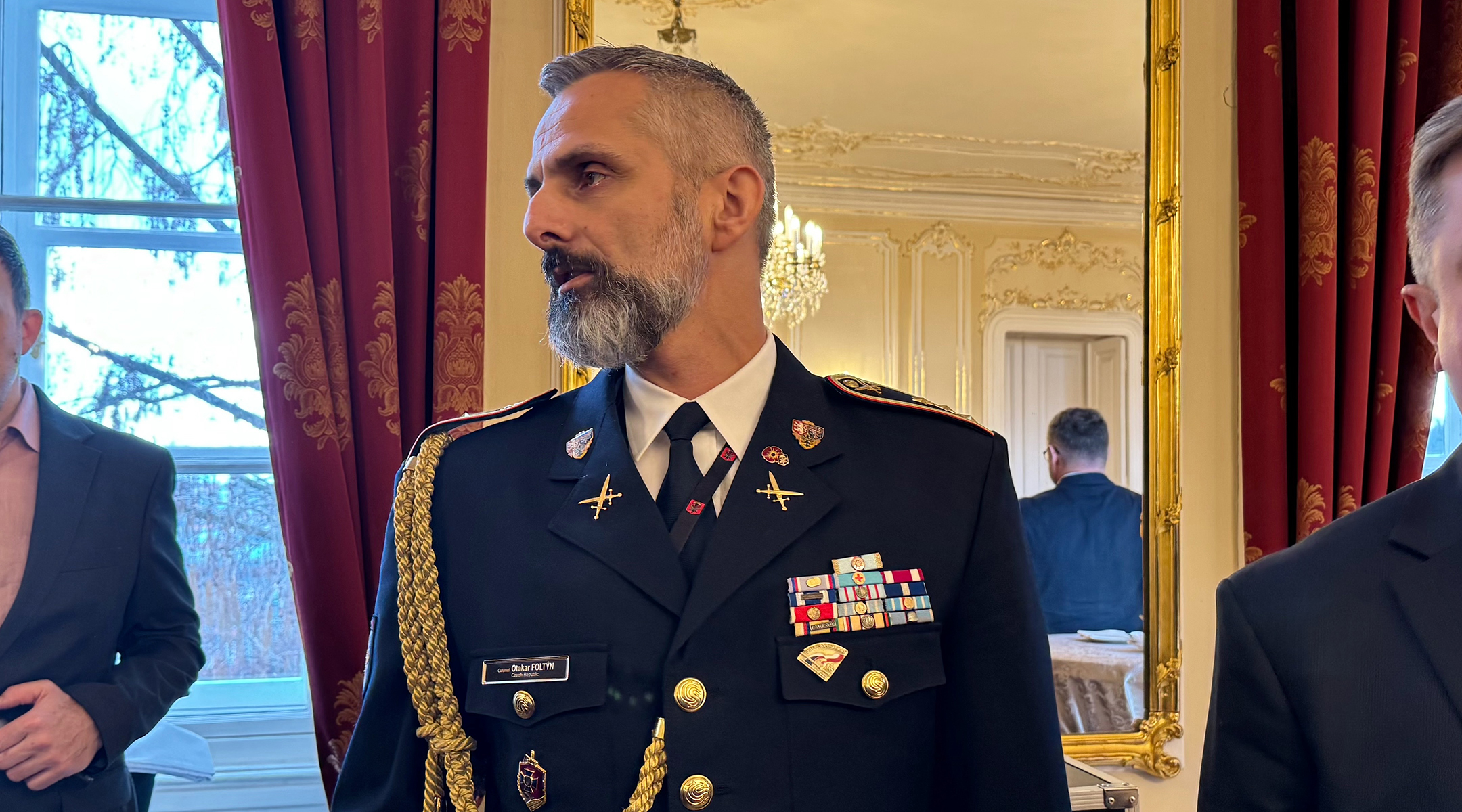
THE BEST GIFT IS THE COLLAPSE OF THE KREMLIN’S MAFIA REGIME
Q: We met at a rally in support of Ukraine marking the fourth anniversary of Russia’s full-scale invasion...
A: My birthday is on February 24—the day the end of the Russian Empire began.
Q: That’s quite symbolic. Have your birthday wishes changed in recent years?
A: I would like to receive one gift: the collapse of the mafia regime in the Kremlin.
Q: Do you think Russia could actually disintegrate as a state?
A: I don’t know whether that would serve anyone’s interests. But every decent person has an interest in Russia losing.
Q: If the war ended tomorrow, would the threat from Russia disappear? Today, children and young people there are being raised in a militarized environment, taught that Ukraine is an enemy—and that Europe and NATO are enemies as well…
A: Of course, the threat would not disappear. A fanatical population, largely shaped by propaganda, becomes a passive accomplice to aggression. Over time, that turns into frustration, which in itself becomes a security risk for neighboring countries.
Russia would need to undergo a process similar to the denazification of Germany after 1945. But that scenario is not feasible in Russia’s case—it required occupation, and Russia is simply too large to be occupied; militarily, it is not realistic, nor is anyone planning such a scenario. At the same time, it is highly likely that Russia has already expelled, imprisoned, or eliminated most independent-minded individuals and lacks a sufficient pool of responsible elites capable of governing the state. This makes any post-defeat scenario inherently risky—both for its neighbors and for Russia itself.
That said, there are still many free and courageous people in Russia. In the Czech Republic, we sometimes distinguish between “Russians”—people like Anna Politkovskaya, Boris Nemtsov, and others of integrity—and “russnya,” meaning Putin, Lavrov, and the entire criminal circle in the Kremlin. There are still enough Russians in Russia—but, unfortunately, also a great deal of “russnya.” And those people will have to hit a wall before they fully grasp what they have enabled and supported.
After the Velvet Revolution, President Václav Havel was asked by Americans what they could do to help Czechoslovakia free itself from Soviet influence. His answer was: help Russia. It was, in fact, a very sound idea.
Q: Today, more and more people argue that this is not merely “Putin’s war,” but a war waged by Russia and its citizens against Ukraine…
A: The greatest victims of Russian imperialism are the Russians themselves. We often do them a disservice by refusing to acknowledge that, in certain respects, they are “the best in the world.” Historically, Russians have been the most effective at killing and torturing their own people; more Russians have been killed by Russians than by anyone else. That is the tragedy of that nation. They do not want to confront this, because through their passivity they have shared responsibility for the regime’s crimes. But this is not the moment to address that. First must come a bitter defeat—only then can we begin to discuss how to give Russia a chance to become a free country. For now, that is secondary. What matters first is a free Ukraine with its territories liberated. Once Ukraine and Europe are secure, we can turn to the question of how to help Russia become a normal country.
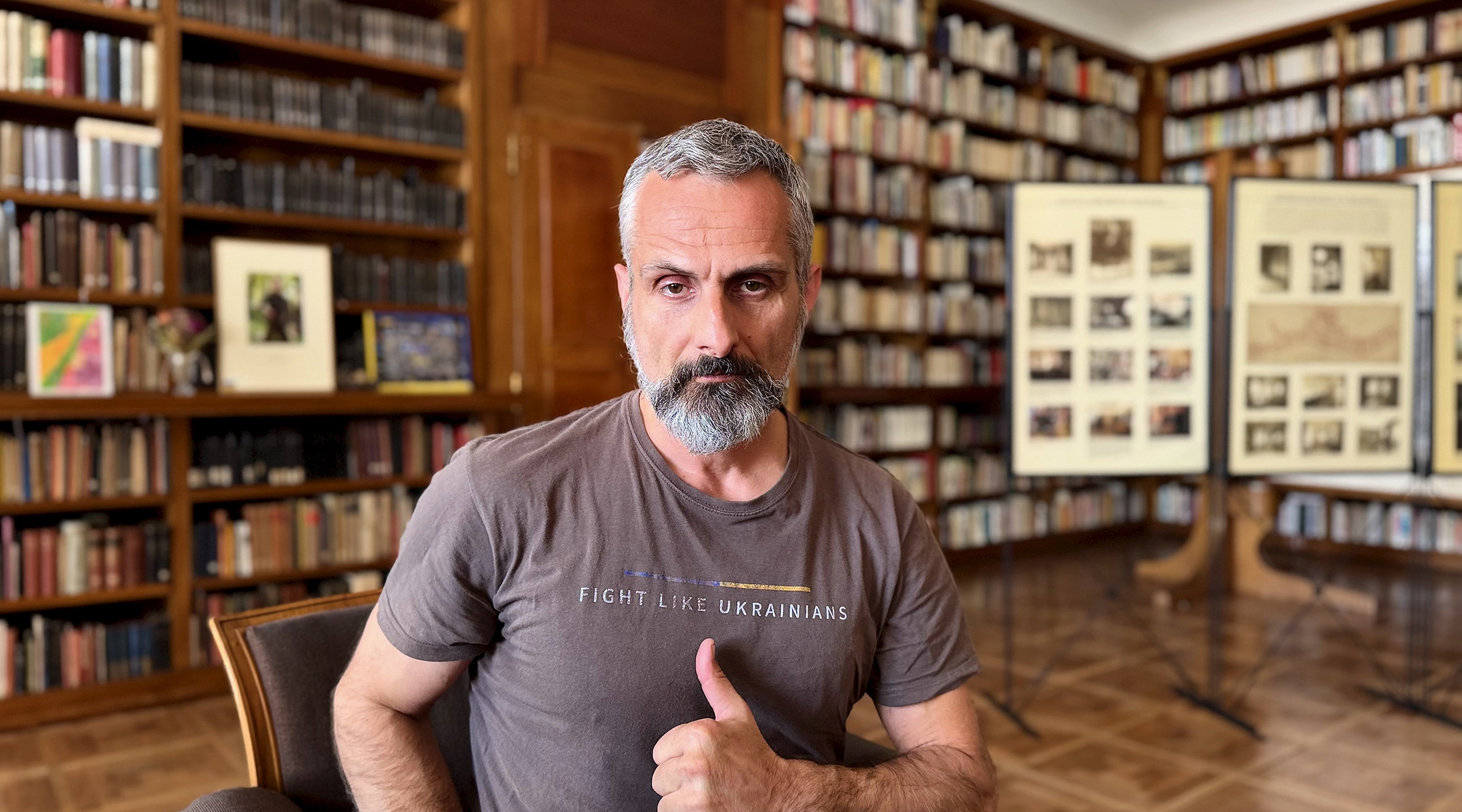
A RUSSIAN WILL DECLARE EVERYTHING RUSSIAN “SLAVIC,” AND THEN EVERYTHING SLAVIC “RUSSIAN”
Q: You have repeatedly said that the Czech Republic as a state is doing too little for Ukraine, while Czech citizens are doing a great deal…
A: As a state, we are among the weakest in Europe when it comes to meeting our NATO commitments, and we are certainly below average in what we provide to Ukraine—in fact, almost negligible. At the same time, we are probably among the strongest in Europe in terms of voluntary contributions from individual citizens. That says a great deal about us: our relationship with the state is somewhat peculiar, but when it comes to helping those in need, a large number of people are willing to act on their own. And that is a positive thing.
Q: In the Czech Republic, there are still those who do not understand—or choose not to understand—what is really happening. What role do Russian propaganda and disinformation play? Russia does not shy away from sabotage either.
A: In the 1980s, during the decline of the Soviet Union, Russian influence was limited but never disappeared entirely. After Vladimir Putin came to power in 2000, it strengthened again, and since 2007–2008 it has intensified significantly and continues to grow.
What we are seeing is a continuation of the deeply flawed 19th-century concept of Slavophilism—the myth that there is a “big brother” in the East who will save us. Karel Havlíček Borovský warned about this long ago, noting that a Russian would first declare everything Russian to be Slavic, and then everything Slavic to be Russian. This is a manipulation of linguistic kinship—there is no other meaningful connection, political, cultural, or historical. Beyond belonging to the Slavic language family, there is no real affinity. Yet this linguistic link allows Russia to exploit simplistic and misleading narratives of “brotherhood.”
In reality, there is no brotherhood, no shared identity, no inherent closeness—and there never was. Still, in the Czech Republic, such narratives can resonate, particularly because a significant portion of the population was educated during the communist era. Russia is adept at identifying and exploiting societal “pressure points”—whatever vulnerabilities it can use to its advantage.
Every society has its own tensions—issues that require open debate. But Russian propaganda systematically amplifies the extremes. It has no problem simultaneously backing both communists and fascists. The objective is to push public discourse as far as possible from any rational center toward the most radical positions. Unfortunately, this strategy is often effective, reinforced by the algorithmic dynamics of social media, which tend to reward and amplify polarization. Countering this is exceedingly difficult—especially when strategic communication is neglected.
RUSSIANS ARE IN DESPAIR—AND THAT DESPERATION SHOULD BE MADE DEEPER
Q: The Russian Ministry of Defense recently published a list of European companies producing drones or components for Ukraine, including firms in the Czech Republic. There were also threats. And we still do not fully know what happened at the LPP Holding warehouse in Pardubice…
A: Years ago, Russian military personnel—regular officers—blew up an ammunition depot in Vrbětice, causing billions in damage and killing two Czech citizens. While that pales in comparison to the scale of losses in eastern Ukraine, the fact remains: Russian operatives acted on our territory, killing and destroying. That is an enormous affront. And if they are willing to do that physically, one can assume they observe no limits in the information domain either. They operate this way constantly, restrained only by their own assessment of what serves their interests.
As for their threats about what we can or cannot produce: we are a sovereign country. We will produce what we choose, and we certainly do not need authorization from the Kremlin. Those days are long gone. If Russia has a problem with our support for a country that has been attacked, then it should withdraw from Ukraine. That would eliminate the need for such production.
Q: The list includes not only Czech firms, but also companies from other European countries and Turkey. Why do you think it has appeared right now?
A: They are escalating their rhetoric because the Ukrainian army is inflicting losses on them at a scale that exceeds their capacity to replenish manpower. The Russian economy is edging toward collapse, and without Chinese support they would have long since lost the ability to sustain much of their weapons production. So they are grasping at anything—intensifying pressure in the information domain. But again, if Russia does not want European states to assist Ukraine, it can end that by leaving Ukraine.
Q: Is this a sign of desperation?
A: I am convinced they are already desperate—and everything should be done to make the desperation deeper.
RUSSIA SIMPLY CANNOT VIEW THE WORLD THROUGH PEACEFUL EYES
Q: The Chief of the General Staff, Karel Řehka, recently said that “the boundary between peace, crisis, and war is becoming increasingly blurred.” Where does Europe stand today—at peace, or already in a new form of war?
A: Peace should be the natural state; war should be an aberration—undesirable and avoided. Normal people do not seek war—neither Ukrainians nor Europeans. That is why we draw a clear line between peace and war. Russian military doctrine, however, has long operated on the premise of permanent conflict. In that framework, international relations are seen as a continuous duel: any advantage gained by others is automatically perceived as a loss for Russia. As a result, it is in a constant state of competition, modulating the level of violence depending on what it sees as beneficial.
Russians do not view the world through a lens of peace—they perceive only varying intensities of conflict.
This is why they employ both overt military force against Ukraine and so-called hybrid measures against European states—a mix of economic, diplomatic, geopolitical, intelligence, criminal, and military tools, applied as needed.
This operates in the gray zone between peace and war. When Russian actors blow up an ammunition depot on our territory, carry out killings, or wage information warfare, it may not meet the legal threshold of declared war—but it is far from normal international conduct. It stays just below the level at which we are willing to formally recognize it as aggression, yet it is aggression nonetheless. Russia interferes in elections and manipulates domestic environments. Even its rhetoric reflects this posture: nearly seven years ago, it designated the Czech Republic an “unfriendly country.” At the time, that list included only the United States and the Czech Republic. When a state labels you an enemy without explanation, you have little choice but to accept that this is how you are perceived. Today, the list has expanded to more than fifty countries. If the Kremlin chooses to treat most of the world as adversaries, others have little option but to respond accordingly—until that posture changes.
Q: In this context, there is increasing discussion not only about the Czech Republic, but also about the Baltic states and tensions with Russia…
A: The hostility comes from Russia—not the Baltics. In reality, no one is inherently hostile toward Russia—not Ukraine, not the Baltic states, not the Czech Republic. It is this mafia-style, bandit regime that behaves like an imperial power, seeking expansion and the occupation of territories it does not even need. It already possesses vast lands in the east, yet—at the cost of enormous human losses—it risks losing territory after the war not in the west, but in the east, where China has its interests.
The real winner of the war in Ukraine, regardless of how it ends, is China. The inability of the Kremlin’s mafia-style regime to grasp that it risks losing territory in Siberia is a profound tragedy for the Russian people. Driven by narrow, self-serving interests, it has undermined its own prospects for a viable future and long-term prosperity—despite possessing immense natural resources. China, for its part, will likely continue to “take bites” out of those resources, as it has done for years, offering industrial goods and semi-finished products on strictly transactional terms. Russia is paying a heavy price for this—in human lives and in the declining standard of living of its own population—all to enrich a circle of corrupt elites in the Kremlin.
Vladimir Putin will go down in history as one of the gravediggers of Russia.
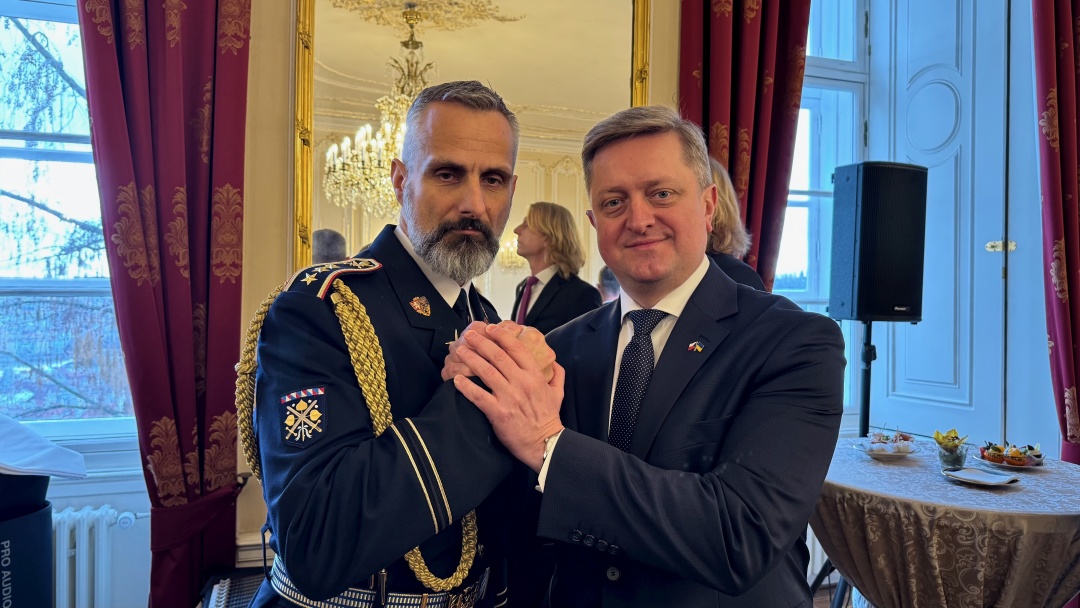
UKRAINE HAS DEMONSTRATED STRONG DIPLOMATIC CAPABILITIES IN THE MIDDLE EAST
Q: Regarding the conflict in the Middle East: many analysts argue that it has diverted global attention—particularly that of the U.S. president—away from Ukraine and peace negotiations. Others suggest it has created new opportunities for Ukraine, for example in drone technology and regional partnerships. How do you assess this?
A: I spent much of my career in Special Forces Command, where we were taught to treat even major problems as opportunities. Ukraine’s ability to build partnerships in the Gulf and contribute to strengthening air defense will bring benefits, not only economic but also technological. Ukraine has proven capable not only of fighting effectively, but also of conducting highly competent diplomacy.
I am convinced this will ultimately work in Ukraine’s favor. Even if, in the short term, rising oil prices have brought additional revenue to Russia, I do not believe this will help it in the long run. Moreover, Russia is now less dependent on Iran, as it has begun producing drones domestically rather than purchasing them at high cost.
Q: Who, in your view, is the main beneficiary of the conflict in the Middle East?
A: Overall, no one truly benefits. A partial advantage lies in Ukraine’s decision to share its experience with Gulf countries that have faced Iranian attacks. I hope Ukraine will convert this into long-term geopolitical gains. I worked in the region and know that timely assistance is remembered—despite cultural differences. Ukraine stepped in quickly, offering its combat experience in a genuinely selfless way, and continues to provide meaningful support. That is a significant advantage—perhaps greater than it currently appears.
Russia, meanwhile, is grasping at straws. But a straw does not save a drowning man—even if he does not realize it. Moscow is clearly hoping that global attention will shift and that fatigue over the war in Ukraine will deepen. But this will not change the strategic picture. Russia is racing toward self-destruction—of its own making—at full speed. And that is a good thing.
WE ALREADY HAVE A EUROPEAN ARMY—IT IS THE ARMED FORCES OF UKRAINE
Q: U.S. President Donald Trump has repeatedly expressed dissatisfaction with NATO and has raised the possibility of the United States leaving the Alliance. Do you see this as realistic? And is Europe capable of ensuring its own security without the U.S.? Should Ukraine be part of the future European security architecture?
A: Throughout my military career, I opposed the idea of a European army. If something works well, there is no need to duplicate it. For a force to qualify as a true European army, it would require unified command, as much interoperable as possible and battle-tested equipment, motivated personnel, ideally with combat experience—and, above all, the will to fight. Europe, as such, has lacked that will.
Ukrainians understand better than anyone else that the decisive factor in successful defense is the will to fight. Europe, by contrast, has largely lacked that will—while NATO has long possessed a highly functional military structure that has repeatedly proven its effectiveness.
I was wrong to argue against the idea of a European army. In reality, we already have one—and it is the Armed Forces of Ukraine. We would even save on symbolism: like the European Union, Ukraine’s army carries the blue and yellow colors, so there would be no need to repaint anything.
If anything truly works today, it is the Ukrainian army. It has demonstrated that the Russian armed forces—once claimed by the Kremlin to be the second strongest in the world—are, in fact, second strongest in Ukraine. The fact that Ukraine has managed not only to halt but to outperform Russian forces is, in itself, a form of victory. It also means that the Armed Forces of Ukraine constitute the most capable military force in Europe—combining unparalleled combat experience with a resolute will to fight.
So the conclusion is straightforward: Europe already has its army. What remains is to ensure it is properly equipped. In practical terms, that means Europe should be financing weapons for this “European army.”
From this perspective—and I stress this is my personal view—if any country has earned the right to join the European Union, it is Ukraine.
Q: And what about NATO?
A: NATO is a different story. Morally, Ukraine clearly deserves membership, but the reality is more complex. At present, accession is not feasible for a number of reasons and could even be counterproductive. Most importantly, it is technically difficult for a country engaged in an active armed conflict to join a collective defense alliance.
That said, however, I see no compelling reason why the European Union could not admit Ukraine without delay. Yes, Ukraine still falls short on certain administrative criteria. But compared to the scale of sacrifice it has made in defending its freedom, those shortcomings are secondary. Ukraine arguably deserves EU membership more than any current member.
Q: Does Europe need alternative alliances or smaller regional coalitions?
A: That would be entirely consistent with the history of warfare. Alliances are constantly evolving, forming, and reconfiguring. In fact, something akin to this already exists—the so-called “Coalition of the Willing,” bringing together primarily Northern European countries, the Baltic states, Poland, Germany, and the United Kingdom, all of which provide Ukraine with significantly stronger support than many other EU members. In that sense, such a framework is already in place, though there are many possible configurations for future cooperation.
What Europe should focus on first is increasing its domestic defense production and, just as importantly, learning from Ukraine’s battlefield experience. If we do both—scale up support and absorb Ukraine’s operational know-how—then together we will be extremely difficult to defeat.
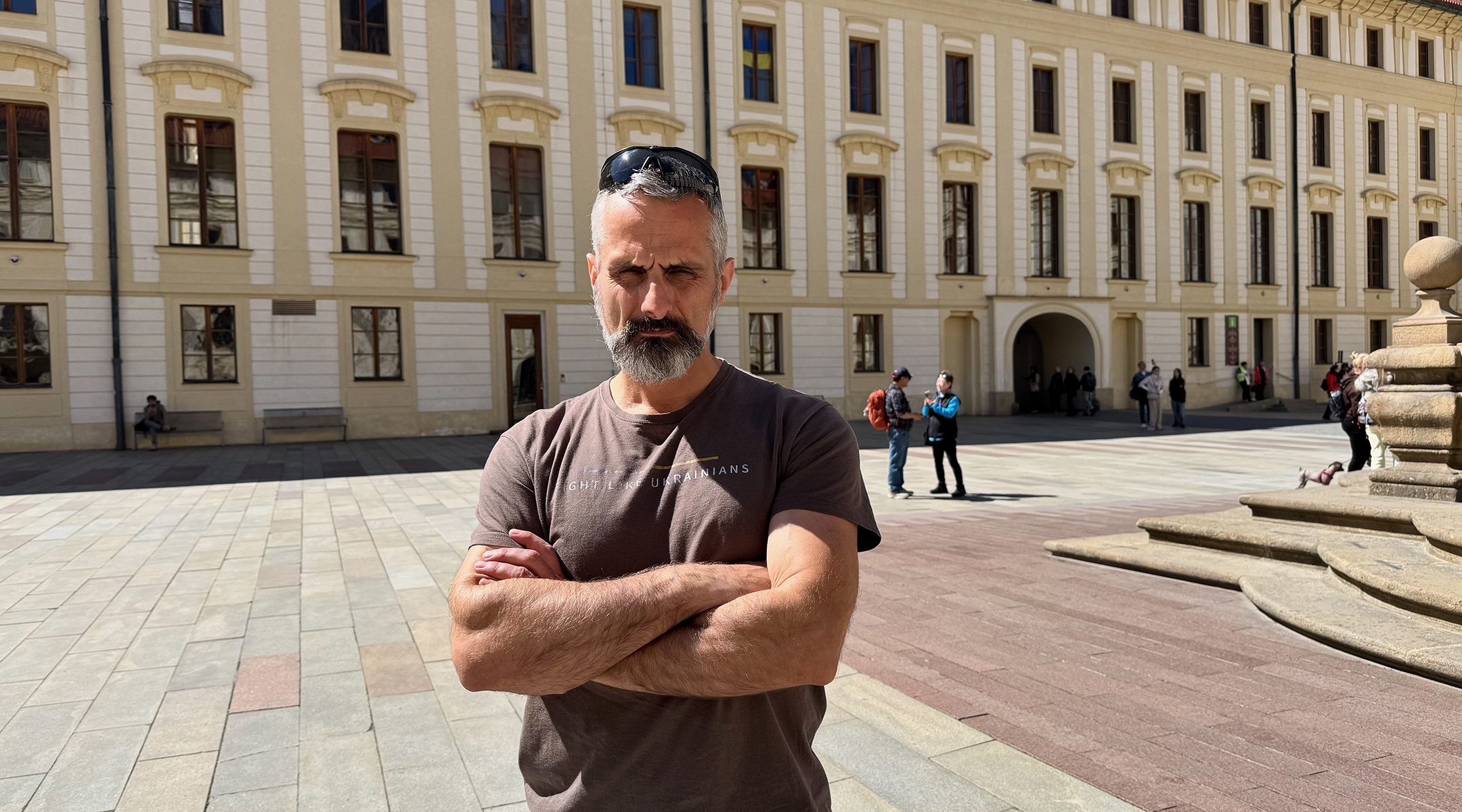
WE SHOULD START LEARNING FROM UKRAINIANS—FAST
Q: Is the Czech army learning from Ukrainians?
A: I would welcome a much deeper effort by all European armies to learn from Ukrainians. After all, Ukraine has been offering this exchange for some time: in return for weapons support, it shares hard-earned combat experience.
From a military standpoint, combat experience is the most valuable currency on the battlefield—and today, Ukraine is the only country that possesses it at scale. If we are serious, we should be absorbing those lessons as quickly as possible.
Q: The Czech Ministry of Defense plans to spend more than 350 million crowns this year on unmanned systems and aims to field 3,000 drones by 2028. Is that sufficient? And should the Czech Republic pursue joint drone production with Ukraine?
A: It is a sensible step, but it is not enough. Any professional soldier will tell you that drones are now a decisive factor on the battlefield.
Ukraine has outpaced Russia not only in quality—where it held an advantage for most of the war—but increasingly in quantity as well. This marks a significant shift from earlier phases, when Russia, aided by China, could produce drones in the hundreds of thousands. Ukraine is now producing them in the millions.
Against that backdrop, a fleet of 3,000 drones is modest. What we truly need are scalable production chains and a rapid innovation cycle. It makes little sense to reinvent solutions that Ukraine has already refined under combat conditions. The rational approach is integration: sustained flows of financial and military support from Europe to Ukraine, matched by a continuous transfer of operational experience in the opposite direction. These exchanges must be streamlined and shielded from bureaucratic friction—which, to some extent, is already improving.
Q: Is the Czech ammunition initiative still functioning effectively?
A: Yes, it is. Over time, the Czech initiative has supplied nearly half of the artillery shells used by Ukrainian forces against Russian troops. That is a significant contribution. At the same time, it remains a commercially structured effort, funded by Western donors.
One moment that stayed with me was when Ukrainian soldiers at the front said: “We don’t care if you profit from this—just give us the weapons.” That captures the urgency.
It is positive that we are supplying weapons at a scale that makes a difference. But it is still below what the situation demands—and that should concern us.
Although Ukraine has already achieved a strategic success by preventing defeat, the war continues and casualties are ongoing. For that reason, every European country has a direct interest in accelerating and expanding its support. Incremental increases are not enough; the scale must rise significantly.
THE UKRAINIAN ARMY HAS MASTERED THE ART OF OPERATIONS
Q: How do you, as an officer, assess the situation on the battlefield?
A: What impresses me is not only how Ukrainians have defended themselves. In that respect, I even envy them—their courage in defending their homeland—because we never had that chance. My country experienced the invasion of Soviet troops in 1968 (the Soviet Union was essentially a Bolshevik label for imperial Russia), and our army did not fight; people tried to stop tanks with their bare hands. You cannot hold back a tank that way for long.
We took the Czechoslovak flag stained with the blood of those who defended Czech Radio on August 21, 1968, and brought it to the front—to Vuhledar, now, unfortunately, occupied. Against that flag, Ukrainian soldiers recorded a video message to the Czech people.
From a purely military standpoint, I am equally struck by how professionally and precisely the Ukrainian army has mastered operational art. Mistakes, of course, are inevitable in war. But Russian forces are advancing only at the cost of extreme losses—sometimes 100, 200, even 400 troops per square kilometer—until their offensive culminates. At that point, when their momentum is spent, Ukrainian forces counterattack with precision, retaking territory at far lower cost.
This has a powerful demoralizing effect. Ukraine’s strategy—trading small areas of ground for disproportionate enemy losses—is pushing Russian forces beyond their capacity to replenish manpower. For the fourth consecutive month, Russian losses have exceeded recruitment. In other words, the force is shrinking.
From both a strategic perspective—exchanging limited terrain for massive enemy attrition—and an operational one—timing counterattacks to coincide with the exhaustion of enemy momentum—this is a textbook application of operational art.
UKRAINE’S LOGISTICAL INGENUITY AND INNOVATION EDGE
A separate story is the logistical “miracle” that has enabled Ukraine to integrate a wide array of weapons systems. Equally remarkable is its capacity for innovation: the coordinated use of different classes of drones deep into Russian formations effectively degrades Russia’s capabilities dozens of kilometers behind the front line. And that is just one example. Personally, I take my hat off.
Q: How often have you been to Ukraine?
A: I don’t keep count. I try to go at least once or twice a year, though I would prefer to go more often.
As a military professional, I feel a certain shame that we are not there alongside you—though there are objective reasons why that is not possible. But as a human being, I feel it nonetheless. We spent our lives preparing to defend Europe from aggression, and now Ukraine is doing that for us—and doing so with such courage that we will be coming to Ukraine for the next hundred years to pay our respects.
Q: At a Senate conference marking the fourth anniversary of the all-out war, you presented a gift to Artem, a Ukrainian veteran for whom Czechs raised funds for prosthetics for both arms. What was it?
A: My son made a heart embroidered in blue and yellow. Artem is a Ukrainian veteran who lost both arms. So in the Czech Senate I said: we cannot give wounded Ukrainian soldiers back their limbs—but we can give them our hearts.
OUR ASSESSMENTS OF RUSSIA WERE TOO LENIENT
Q: You have been outspoken in your support for Ukraine. When did you come to see Russia as a threat that must be addressed openly?
A: I co-authored the book At the Crossroads (2016), in which we warned about Russian aggression already after 2014—at a time when, I believe, even the most naïve observers should have recognized that Russia might again resort to military force. We raised these concerns repeatedly—first within professional circles, then publicly—and were labeled Russophobes for it. Looking back, our only real mistake was that we were not firm enough. Our forecasts turned out to be too mild compared to what Russia ultimately did.
What we did not anticipate was the scale of Russia’s miscalculation more than four years ago. The fact that they believed their own propaganda—and assumed Ukraine would not resist—may have made sense within their system, but from the outside it was clearly flawed. It was evident that the operation, as designed, could not succeed militarily. Yet they went ahead—and what stopped them above all was the will of the Ukrainians, who in the early phase were largely defending themselves alone, as substantial military support arrived only later.
For at least a decade, within a relatively small circle of military analysts, we had been warning that Russia would act aggressively. Few were willing to listen.
Q: But the buildup was visible: tanks, vehicles, thousands of troops amassed on the border… And still it came as a shock?
A: Russia had conducted similar exercises before—two of them on a large scale—deploying forces, conducting drills, and then withdrawing. In effect, they conditioned us to see this as routine.
However, the late-2021 buildup was different. They brought in supplies for a prolonged campaign, stockpiled fuel far beyond what previous exercises required, and accumulated blood reserves—something you do only when anticipating heavy casualties. These were clear indicators that this was not another exercise.
Even so, the force they assembled was smaller than what the Soviet Union deployed in 1968 against Czechoslovakia—a much smaller country. It seemed illogical; we assumed they could not be that irrational. But it was not irrationality—it was arrogance.
RUSSIA WILL NOT ENTER NEGOTIATIONS UNTIL BEING GOT BEATEN UP
Q: Do you believe that talks between Ukraine, Russia, and the United States could eventually produce a peace agreement?
A: Every war ultimately ends at the negotiating table—this one will as well.
I have long believed in the strength of the United States’ democratic foundations, and I have long been dismayed by the behavior of Donald Trump—particularly by what he did to your President in the Oval Office. I could not have imagined—even in my worst nightmares—seeing something like that in the office of the leader of the world’s largest democracy. It was beyond comprehension. And I felt a profound sense of shame for what was done to the head of a country under attack.
Q: Should Europe step in more actively and act as a mediator, given the conduct of the United States?
A: Who ultimately sits at the negotiating table is a separate question. Personally, I would prefer to see seasoned American professionals there—rather than New York real estate agents.
The reality is simple: Russia will stop only where it is forced to stop. For negotiations to begin, it has to be dealt a decisive blow. It already has been—but not yet enough.
If the fundamentals remain unchanged—if the West continues supporting Ukraine, and China continues providing Russia with just enough backing to keep it afloat—then Russia will not win.
Last year, we brought that 1968 flag—stained with the blood of our heroes who tried to stop Russian tanks with their bare hands—to Kyiv. In an unannounced public event, we displayed it as a military band of the Armed Forces of Ukraine, together with the Prague Castle band sent by the Czech president, performed the Ukrainian and Czech national anthems. It was spontaneous; passersby had no idea what was about to happen.
Then I saw a Ukrainian veteran on crutches descending an escalator. As the Ukrainian anthem began, he took both crutches into one hand and placed his other hand over his heart. Something about his stance seemed unusual—I looked closer and realized he had no leg. With nothing to support himself, he was prepared to fall rather than fail to honor his anthem.
A nation like that cannot be defeated.
Olha Tanasiichuk led this conversation. Prague