
On April 15–19, 2026, the 152nd Assembly of the Inter-Parliamentary Union (IPU) was held in Istanbul—an institution often described as a “world parliament.” The gathering brought together more than 1,500 delegates, including over 720 parliamentarians from 126 countries, among them more than 65 speakers and 46 deputy speakers. The IPU remains one of the few international platforms where virtually all states are represented, including Russia and others pursuing aggressive policies toward Ukraine.
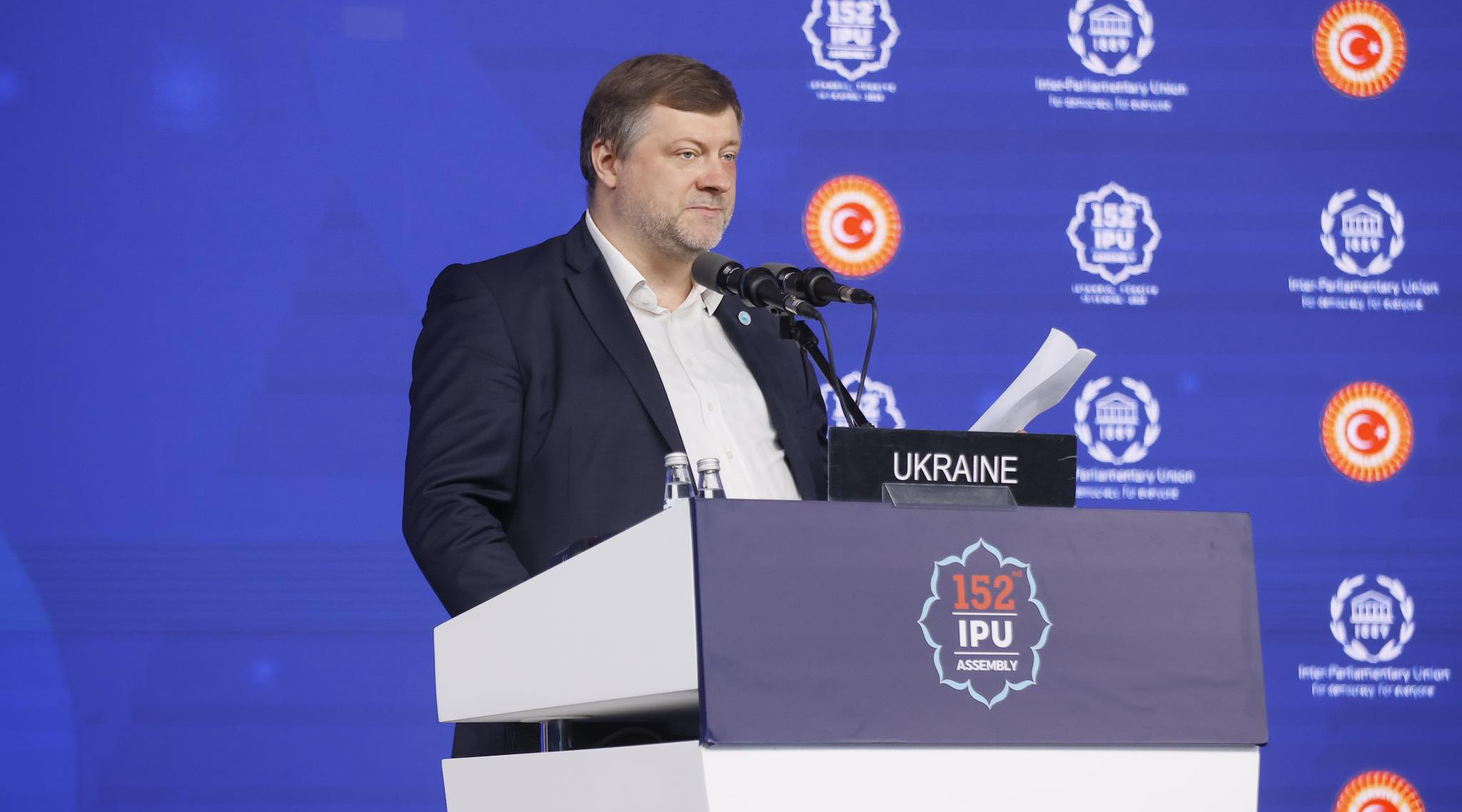
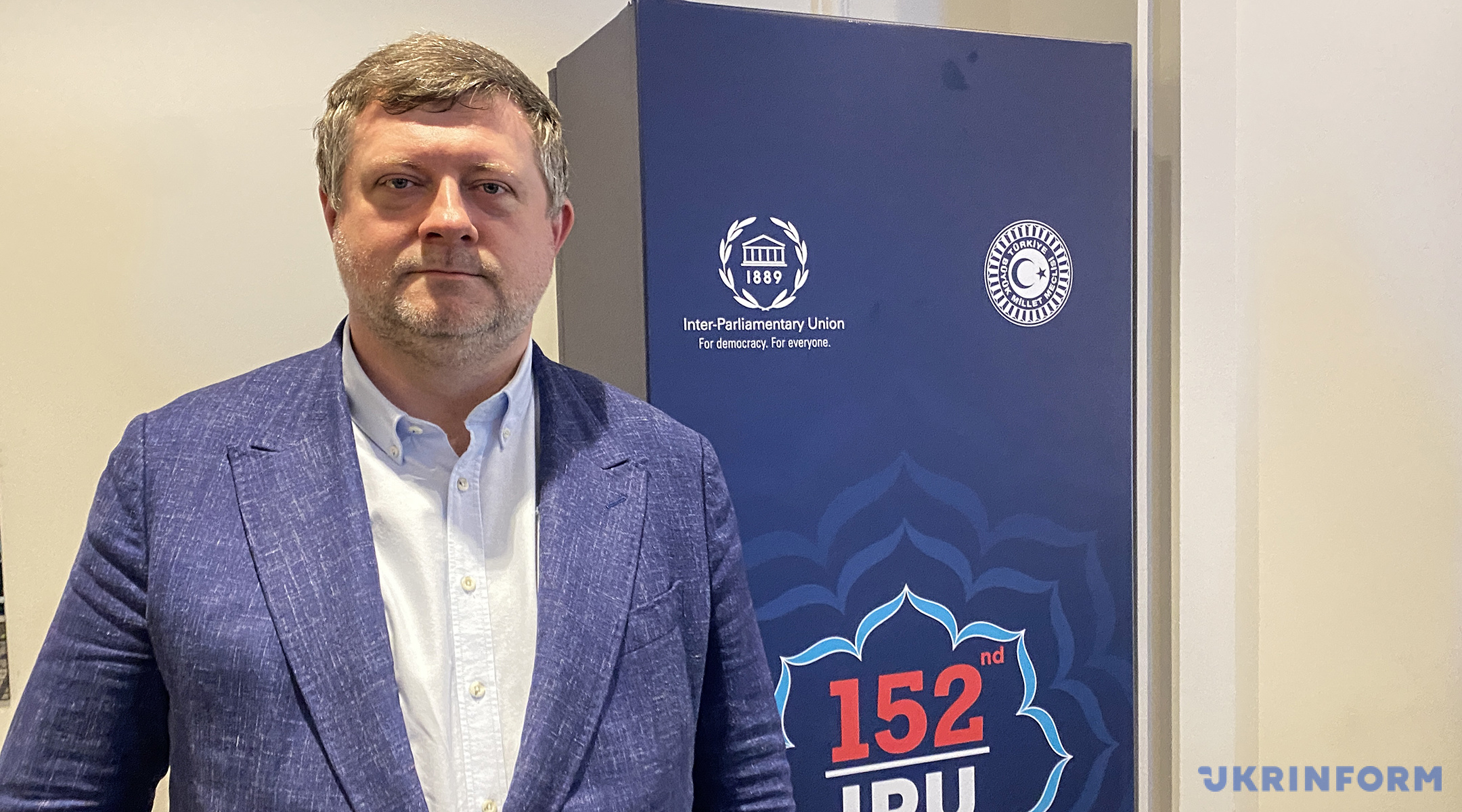
In a conversation with Ukrinform, Oleksandr Korniienko, First Deputy Speaker of the Verkhovna Rada of Ukraine and head of the Ukrainian delegation to the 152nd IPU Assembly, outlined the challenges of this work. He addressed efforts to counter Russian propaganda within the IPU, Ukraine’s role in building an international coalition, engagement with countries of the Global South, the impact of Middle Eastern developments on the global agenda, and prospects for reforming international institutions.
Work in the IPU Is Unique: All of Ukraine’s Adversaries Are Present, with No Mechanism for Exclusion
Q: Mr. Korniienko, what key messages and objectives did the Ukrainian delegation bring to the IPU Assembly? What feedback did you receive? How is Ukraine perceived, and is that perception evolving?
A: Over the course of the full-scale invasion, we have developed a clear strategy and a set of tactics for operating within IPU assemblies. The IPU functions as a kind of global parliamentary forum, where each country sends its representatives. Unlike other international bodies, there are no mechanisms to suspend or exclude delegations. As a result, all of Ukraine’s adversaries -- from the Russian Federation to Iran -- are present. This makes the work highly specific and requires a multi-track approach.
First, there is substantive engagement with the organization’s documents. These are large-scale resolutions addressing global issues—wars, conflicts, environmental challenges, security, artificial intelligence—essentially the full spectrum of concerns facing humanity. Ukraine fields a strong, multiparty delegation with the expertise to draft, amend, and defend proposals. We are therefore highly active in committee work, drawing on both parliamentary experience and institutional knowledge of the IPU. In nearly every resolution, we push for explicit references to Russia’s invasion of Ukraine and its consequences for civilians and global security.
Second, we focus on political dialogue through bilateral meetings. For Ukraine, the IPU is one of the few platforms where, within two or three days, it is possible to engage with a wide range of delegations. We typically schedule dozens of meetings, primarily with countries from the non-Western world, as we have more frequent contact with our European partners in Kyiv and across Europe. We engage actively with countries from Africa, Latin America, Asia, Australia, and Oceania—seeking common ground, conveying accurate information about Ukraine, and exchanging perspectives.
We take particular pride in the fact that, back in 2022, we succeeded in passing two emergency resolutions on Ukraine condemning Russian aggression—an outcome that, at the time, many countries considered a bold step.
PERSIAN GULF STATES VALUE UKRAINE’S WILLINGNESS TO SHARE EXPERIENCE AND PROVIDE SUPPORT
Q: How have developments in the Middle East affected the session’s agenda? Do you sense any decline in attention to Ukraine?
A: Naturally, the 152nd Assembly has been shaped by developments in the Persian Gulf, where serious threats to global security have emerged. We feel this shift. At the same time, Ukraine is increasingly seen as a reliable new partner in the region, and this has been reflected in our work. At the request of Bahrain, Qatar, and the United Arab Emirates, we held meetings with their parliamentary delegations—at the highest level, including speakers and deputy speakers. We exchanged views and reaffirmed our mutual readiness to deepen cooperation in the defense domain, including at the parliamentary level.
Q: So, can we say that developments in the Persian Gulf have heightened regional interest in Ukraine and its experience?
A: In fact, interest in Ukraine has always been present. In the first year, many countries expressed solidarity and sought ways to help. Now, the focus has shifted: many are asking how we have managed to withstand such a powerful adversary—and continue to do so.
Events in the Persian Gulf, in a relatively short period, have given other countries a sense of what Ukraine has endured for more than four years. They now understand that Ukrainians can offer practical insight—not only into how to live under such conditions, but also how to resist. Unfortunately, this experience has come at a very high cost, but we are willing to share it. Countries in the Persian Gulf, in turn, value Ukraine’s openness to sharing that experience and providing support.
UKRAINE USES THE IPU PLATFORM TO PUSH BACK AGAINST RUSSIAN PROPAGANDA
Q: Speaking of Ukraine’s experience over the past four years, our delegation organized a dedicated side event during the Assembly.
A: Yes, and it drew significant interest from IPU colleagues. For many participants—especially those living in stable and secure environments—it offered a rare opportunity to engage directly with the realities Ukrainians face on a daily basis.
We organize such events at nearly every assembly. Our “geopolitical group” within the IPU—comparable to a parliamentary faction—includes countries from Europe, Canada, Australia, and Turkey. These are our allies, and they consistently support our initiatives, recognizing the importance of receiving first-hand, up-to-date information about developments in Ukraine and the evolving situation on the ground.
We have organized side events on demining, the deportation of children, violations of the rights of Crimean Tatars in Crimea, and the destruction of cultural heritage there. This time, following the most difficult winter of the full-scale Russian invasion, we focused on the war’s impact on civilians—survival in conditions of extreme cold, prolonged power outages, and disrupted water supply.
We also screened a short but deeply moving documentary, “Fight and Dance,” depicting events in Sumy during Easter 2025. It highlights how young Ukrainians continue to live, grow, and pursue their aspirations despite the war.
Among the speakers was José Manuel Rojo Edwards Silva, head of the IPU’s Latin American group. He was recently awarded Ukraine’s Order of Merit (3rd class) by the Minister of Foreign Affairs in recognition of his sustained support both within the IPU and in Chile. The event was also attended by representatives of the Arab group, a Vice-Speaker Qatar’s legislature, and members of the IPU Secretariat.
Q: And the IPU President attended as well, which speaks to the level of attention…
A: Yes, although we do have certain questions regarding Tulia Ackson. We appreciate her participation in our side event, but we would strongly encourage her, before the end of her term this autumn, to visit Ukraine. Notably, she has visited the Russian Federation on multiple occasions and has even met with Putin.

RUSSIA EXPLOITS THE IPU TO MAINTAIN LEGITIMACY AND ADVANCE ITS NARRATIVES
Q: You highlighted Russia’s continued presence in the IPU. How significant is the influence of Russian propaganda on this platform? And could the IPU President’s absence from Ukraine be linked to that influence?
A: Russia actively leverages the IPU platform to pursue its own objectives—both to maintain a degree of international legitimacy and to promote its narrative, including through propaganda. This remains one of the few multilateral venues where Russia is still fully represented. At present, it also enjoys a certain degree of support from the IPU President.
That said, I would not characterize the IPU itself as overtly pro-Russian, even though such claims do occasionally surface. The organization is simply structured in a way that reflects a wide range of political perspectives and, at times, competing ideological currents. This is precisely why our work here includes a strong informational and educational component.
Unfortunately, many countries—and even entire regions—remain either influenced by Russian narratives or insufficiently informed about the true causes and nature of the war. Some still fail to grasp Russia’s imperial ambitions or its intent to undermine Ukrainian statehood and identity. This makes it essential to consistently articulate these realities on the IPU platform—and we do so.
Q: You mentioned that the IPU reflects certain ideological currents. Could you elaborate?
A: One example is the promotion of BRICS-related narratives—an alignment comprising Russia, Brazil, India, South Africa, and China. It is often presented as representing the majority of the global population. While this may be numerically accurate, it does not automatically translate into decisive global influence. The continued role of the Western world demonstrates that influence is not determined solely by demographics.
Under the current leadership, the IPU may at times appear sympathetic to Russia—particularly if one conflates the institution with its President. However, the IPU is broader than any single officeholder. Its governance is based on rotation, with each incoming President representing a different geopolitical group. The previous President, Duarte Pacheco, was unequivocally supportive of Ukraine and visited the country multiple times. During his tenure, concerns about pro-Russian bias were far less pronounced. A new President is scheduled to be elected in October this year.
THE IPU NEEDS REFORM—BUT BUREAUCRACY AND POLITICAL WILL STAND IN THE WAY
Q: Ukraine initiated these resolutions but later pointed to Russia’s failure to comply with them. Has the IPU responded in any meaningful way to this non-compliance?
A: The response has been minimal. Any decision within the IPU requires prolonged deliberations involving all member states, which makes the process inherently slow and complex. For the organization to respond effectively, amendments to its Statute would be necessary. Discussions on such reforms have been ongoing for years—commissions have been established and draft proposals developed—but progress remains limited.
We have consistently pushed this issue, emphasizing the need for accountability when decisions are ignored. However, these efforts are often absorbed by institutional bureaucracy. The IPU, closely linked to United Nations structures, effectively represents the parliamentary dimension of the UN, and it faces similar systemic constraints. Many well-intentioned initiatives dissipate in extended negotiations.
The same structural limitations apply to broader UN reform, which remains constrained by Russia’s presence in the Security Council. Within the IPU, the situation is comparable: even dedicated working groups on reform frequently fail to produce tangible outcomes.
At the same time, Ukraine has adapted its approach. We operate proactively—building coalitions, consolidating support, and engaging in continuous negotiation. This is not a passive diplomatic posture; it reflects how we function domestically in parliament. While this approach sometimes draws criticism, it also ensures that Ukraine is taken seriously.
Silence is not an option for us. We must consistently highlight violations of international law, systemic abuses, and the brutality of Russia’s actions. As a country under aggression, we not only have the right but the obligation to speak clearly and forcefully—and we do so.
Q: You’ve pointed to the structural difficulties of reforming both the IPU and the UN. Given the increasingly volatile global security environment, and the UN’s evident inability to fully carry out its functions, do you believe meaningful reform is still achievable under current conditions?
A: We would very much hope that such reform can be achieved without another large-scale war. No one should have to experience what Ukraine is going through. However, whether the international system currently has the capacity for such transformation is an open question.
It is possible that these processes have already entered an irreversible phase, beginning with the events in Georgia and later in Ukraine. Equally, it is possible they have not—we would certainly prefer the latter.
When additional pressures are factored in—such as artificial intelligence and emerging global risks—the challenge becomes even more acute. An institution like the UN, if unable to respond effectively, risks a gradual erosion of its relevance.
For now, the system continues to function, sustained by long-established programs, financial contributions, and institutional inertia built over decades. The UN has operated for nearly 80 years and, in many respects, has performed adequately. The central question, however, is whether it can continue to operate effectively in its current form within a profoundly transformed global landscape. That question remains unresolved.
Q: A meeting of the Ukraine group was held behind closed doors on the IPU platform. What was discussed, and are you satisfied with the outcome?
A: The meeting was held under closed-door rules, which means its substance is not subject to disclosure. This Ukraine group was established in 2022 as a platform primarily focused on humanitarian issues. It serves as a channel for conveying critical information—on prisoner exchanges, the return of deported children, and the cessation of shelling.
The group effectively acts as an intermediary: we present our position, and it may be relayed to the Russian side. I will be candid—there have been attempts to bring us to the same table with Russian representatives. We have consistently declined. Ukraine has a designated official negotiation framework, and no alternative formats on other platforms are envisaged.
Q: Can parliamentary diplomacy contribute in any meaningful way to peace negotiations?
A: We support the participation of Davyd Arakhamia, head of the parliamentary majority faction, in the official negotiation process. We have full confidence in his role.
Q: The final declaration of the IPU Assembly in Istanbul also addresses the role of parliaments in peacebuilding—support for ceasefires, condemnation of violations of humanitarian law, and similar provisions. Broadly speaking, this reflects standard “peace for all” language…
A: This is a typical consensus resolution outlining the role of parliaments in peaceful conflict resolution. Notably, only Russia, Iran, and a small number of other countries did not support it. The document emphasizes multilateralism and the active engagement of parliaments, which is both appropriate and necessary.
The key question, however, is how applicable such frameworks are in the current geopolitical environment. Institutions like the IPU require time to adapt to rapidly changing realities. As the Ukrainian delegation, we intend to actively contribute to that process.
Olha Budnyk led this conversation. Istanbul
Photos via Author and facebook.com/oskorniyenko