
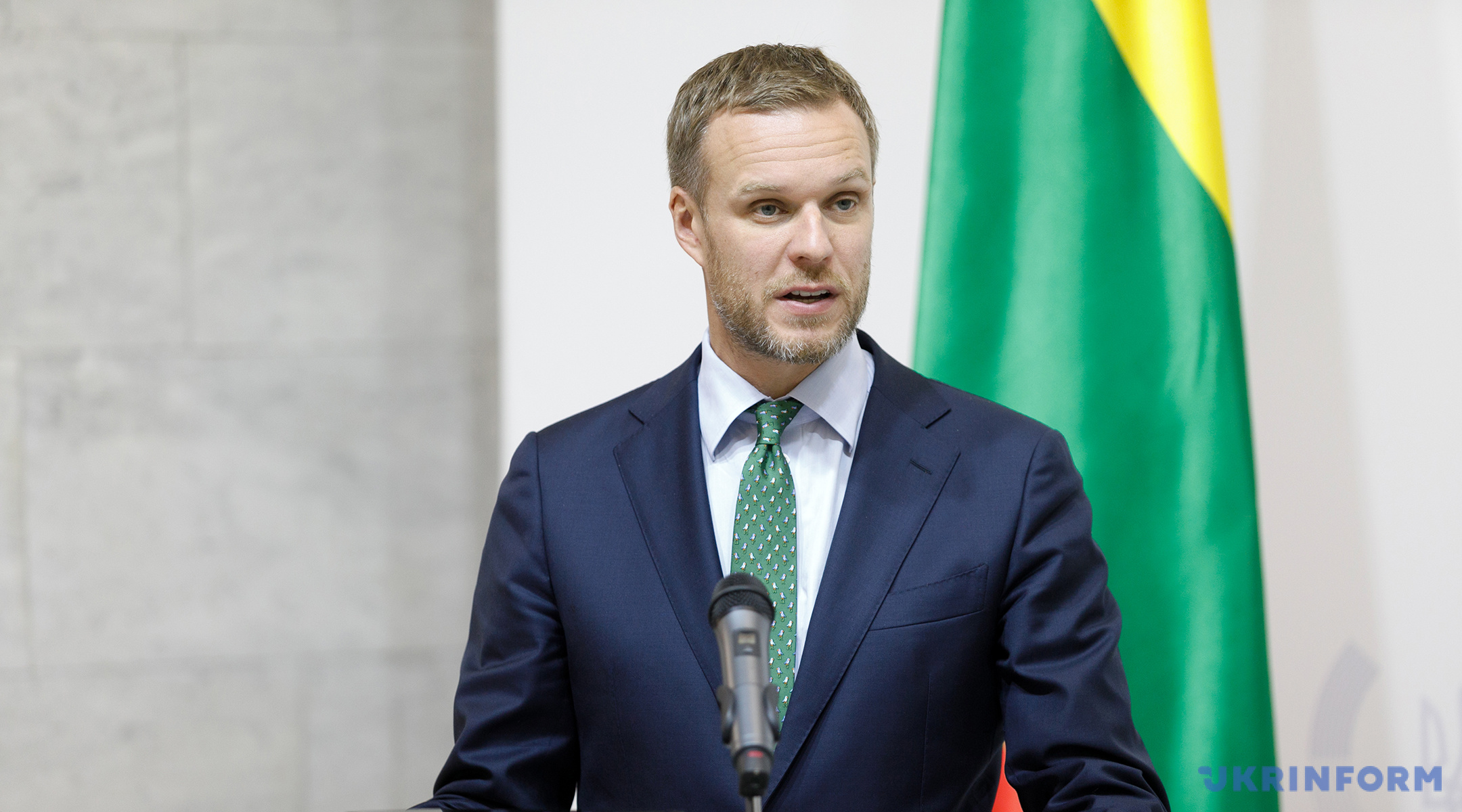
Lithuanian politician and former Foreign Minister Gabrielius Landsbergis has arrived in Kyiv to participate in the September session of the YES (Yalta European Strategy) international conference. Starting September 16, Landsbergis is set to take on a new academic position at the Center for International Security and Cooperation at Stanford University, where he will engage in research and discussions on international security and democracy.
During his stay in Kyiv, he spoke to Ukrinform about the potential for new Russian air attacks in Europe, Ukraine’s strategy in peace negotiations with the aggressor, and sanctions on foie gras during World War II.
OVER THE LAST THREE AND A HALF YEARS WE LEFT THE ESCALATION SPACE FOR PUTIN
- May I just briefly ask about the main purpose of this visit to Kyiv?
- I'm here to attend the YES conference, the Yalta conference. I'm trying to make that a habit to participate whenever I'm invited here. It's a very good opportunity to meet many people who are involved in helping Ukraine, but also to reinforce certain messages.
- I have seen already your reaction on this attack of Russia on Poland quotes in different media. How do you think it will influence the logistic routes from Poland to Ukraine and how do you evaluate the general reaction of the NATO, the EU on this attack?
Well, my hope is that it would rather strengthen Polish resolution to help Ukraine. And not just Polish, but also NATO resolution. I'm glad that at least among certain part of society there is a debate that now it's time to close down the skies above Ukraine. So, it's very unfortunate that these incidents need to happen for us to restart thinking. I was asked about what could have Putin hoped to achieve during this like trying to sow some doubts about further assistance to Ukraine which would be an enormous win for him.

- Well, in my opinion, it would backfire him.
- Yeah, I mean, normally this is how we should be thinking about it. I mean, one of the gravest mistakes over the last three and a half years was that we left what is called the escalation space for Putin. He tells how far and with what means he is ready to go. He makes a step and then we discuss, maybe we should help Ukraine more. And then usually kind of we make a half step. Then he pushes further and further. So, we are in a situation because we allowed everything to happen. My worry is that it is possible once again, right? We meet in Article 4, we discuss, we consult and we say, well, there's not many things that we can do and leave it as it is.
IN CHINA, THEY DO UNDERSTAND THAT THEY ARE INVOLVED IN THE WAR IN EUROPE
- How do you evaluate the 18th package of sanctions of EU against Russia and do you think it's effective enough?
- Well, I've been in this situation 18 times. It is difficult to criticize in principle because any sort of sanctions brings more pressure on Russia. So, in principle, it's good. But what we need to see is have we been able to stop Russia? I don't think so. That means that our sanctions were too little and too late. That has been always the case. Now it is evident that Russians have found a way how to circumvent them. You know, China is a major contributor to Russia's war. Not just from Chinese perspective, basically they do understand that they are involved in the war in Europe. And they're okay with it. So, for us the question is - do we really want to stop their cooperation, their ability to help each other? Or will we allow this coalition to continue? My hope is that we should be going much further than we are currently. And I usually criticize that the statements around the new sanctions package sound much stronger than the sanctions themselves.
- According to European Commissioner for Energy Dan Jorgensen some EU countries continue to purchase Russian natural gas. So, that means that on one side Europe is inflicting sanctions, but on the other hand still buying natural resources from the aggressor. So, does this really undermine the sanctions process in your opinion?
- I've found this information somewhere that before the Second World War, when Nazi Germany invaded Czechoslovakia and Italy invaded Bosnia and Northern Africa, France imposed sanctions on Italy, on Foie Gras. Not on gas, not on oil, not on any production, but on the thing that is well. You can imagine how much damage that did. So, somehow for me it is that we are doing the same things. It's a history repeating itself.
- How do you evaluate the actions of Ukrainian defenders against Russian oil refineries recently? Is it a better sanction?
- Yeah, it is amazing. It's very good sanctions for nature, it's very good sanctions for Ukraine and for Europe. I've said that before that when I open news in the morning to see how the war is going, the only thing that is giving me hope, real hope, is Ukrainian ability to hit Russians. Because if I try to see the whole picture, I see that Americans have basically stopped their assistance to Ukraine. Europeans are taking over it, sort of, but I don't think that they are able to compensate in a meaningful way. So, that means where does the strength or, I would like to say, victory come from? From Ukrainians. So, that has been extremely successful. I just wish that Ukraine would have even more capability to do that, so that it would be relentless, so that Russians would know that every night they will lose and lose. And this is where Europe can help. We are able to invest and strengthen Ukrainian ability to produce these sort of weapons.

IN EUROPE, THE IDEA OF A FULL-SCALE WAR IS BEING REJECTED, JUST LIKE IN UKRAINE IN 2021
- It looks like this peacemaking process is stuck while Russia keeps terrorizing Ukrainian civilians. What would you recommend to Ukrainians in this zugzwang political situation?
- Well, I think that President Zelensky has found a rather good way, that I'm also using as an example for what other countries should be doing. Is that on one hand he is trying to play a nice diplomatic game, right? I try to calculate how many times does he say thank you in his tweets. It's like hundreds of times per day. But on the other hand, this is what I really like, that it's not the main thing that he's doing, he's not in a begging position. So he represents Ukrainian dignity. And this is what I admire. I wish we would be a bit more like Ukrainians in this sense, because when I look at Europeans, we're begging, always begging. We're begging Trump not to walk away. We're begging Putin take Ukrainian land and, you know, leave us safe. We should be bravely like Ukrainians.
- Delphi outlet quoted that you said that Ukrainians are defending the honor of the West. Is it a widespread opinion in the EU that Ukrainians here are defending not only Ukraine, but Europe? And that Putin is threatening the whole Europe?
- I would say that it's more understood in Eastern flank. But even in Eastern flank countries, the public communication by the government is trying to calm everything down. I remember Ukraine was in a similar situation in 2021. So when Americans started saying, well, you know, we have the information that the war is coming, the president, the government were saying, well, maybe not to calm people down so people would not leave, the business would not leave. So we are now a bit like Ukraine in 2021. I mean, you were the first ones. So it's understandable that you had nowhere to learn from how to behave in these situations. We know. So I would like us to be a bit more awake to the reality of what actually could happen if Ukraine is unable. Because, we talked about this, that I'm happy that Ukrainians figure out new ways to how to fight and develop new weapons and all the things. But it's nowhere, it's written that Ukraine can do that forever. You know, people are dying. It's a horrible war on morale and on many other things. And, you know, maybe just one day Ukraine will say, well, this is it, we cannot do it any longer.
RUSSIAN ESCALATION IN EUROPE WILL INTENSIFY
- I honestly feel as a Ukrainian that these deep concerns is not that deep anymore. We experienced these attacks a lot and children die among these civil victims. And it's like a war fatigue that we still can feel in the world. Do you agree with me?
- Outside Ukraine, you mean? It is some sort of habitation with the situation. So it's lower intensity. And then, you know, the only thing that's happening with Putin is awakening us, like with Poland. Now everybody's in shock and this is going to escalate. There's literally no reason that it wouldn't. You know, those who are saying, oh, you know, President Trump did so much to achieve the peace, but when I look at the numbers of how many drones now attack every day and how many did before.
- Over 500.
- Yeah. And before it was 100 and it was a lot. Now it's five times more. So this has happened. This is how much peace we achieved during the last half year. So why should Putin stop? I mean, is he afraid of anything? The only thing that he's afraid of, potentially, is Ukrainians.
TO ACHIEVE PEACE, WE WILL HAVE TO PAY THE PRICE, BECAUSE UKRAINE IS ALREADY PAYING IT FOR US
- And just to sum up, what would be your main messages on YES Conference?
- Well, it depends on what we're talking about, right? So, I mean, when it comes to Ukraine, if I'm speaking to a Western audience, it's usually trying to really break through about the meaning and centrality of Ukraine. That this will not go away. We cannot wish it away. We cannot just go to bed, wake up in the morning and, you know, oh, everything is fine. It won't be like that, unfortunately. Certain fundamental things are broken.
- The world order is broken.
- Yeah, the world order is broken. And, you know, we're talking what the world order will look like in the future. We're living it. You know, if we still think that we're living in 2021, no. It's already a new world order. So that is my main message. Or more about the practical things. We spoke about security guarantees, what it means, like real security guarantees to Ukraine. That means that we also have to go from the strategic communication where we will say we are giving security guarantees to Ukraine if Putin allows. If it's only in Western Ukraine, we will withdraw if Putin attacks again. I mean, to kind of confront those, you know, ideas with an uncomfortable truth. So, unfortunately, this won't work that way. If we want to help Ukraine, well, we will have to pay the price, because Ukraine is paying the price for us.
Anna Kostiuchenko, Kyiv
Photo credit: Kyrylo Chubotin / Ukrinform