“Special Valdai operation”: How Kremlin trying to sabotage peace talks with fake drone attack claims
On Sunday, December 28, at the Mar-a-Lago residence in Florida, U.S. President Donald Trump and Ukrainian President Volodymyr Zelensky held multi-hour negotiations on resolving the war in Ukraine. After a two-hour closed-door meeting, both presidents held a press conference announcing significant progress toward peace in Ukraine.
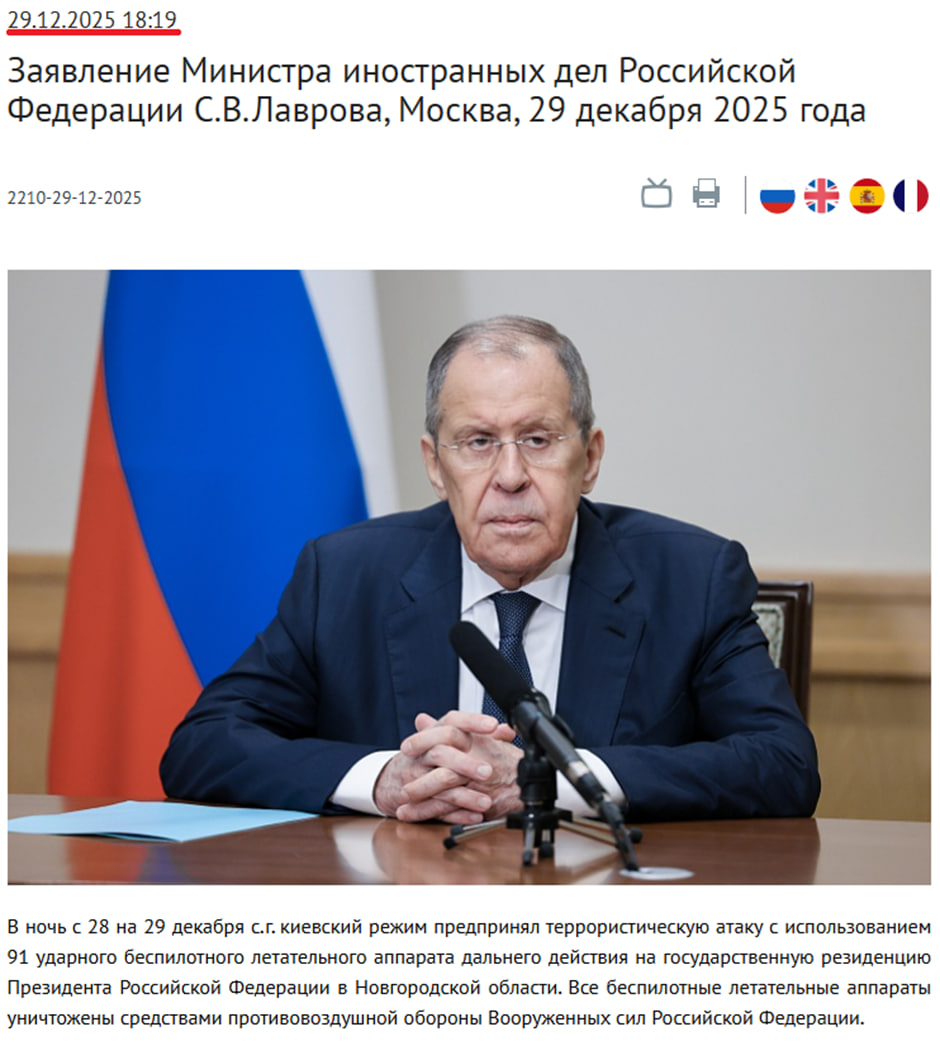
The following day, December 29, Russian Foreign Minister Sergey Lavrov claimed that 91 drones had allegedly attacked Vladimir Putin’s residence in Valdai, Novgorod region. Afterward, Putin’s advisor Yuriy Ushakov stated that “Trump was shocked and outraged by the attempted Ukrainian attack on Putin’s residence” and that the U.S. administration “thankfully did not provide Tomahawks to Kyiv.”
WAS THERE A DRONE ATTACK?
The so-called attack on Putin’s Valdai residence is reported only by Russian officials. No evidence has been presented to support it.
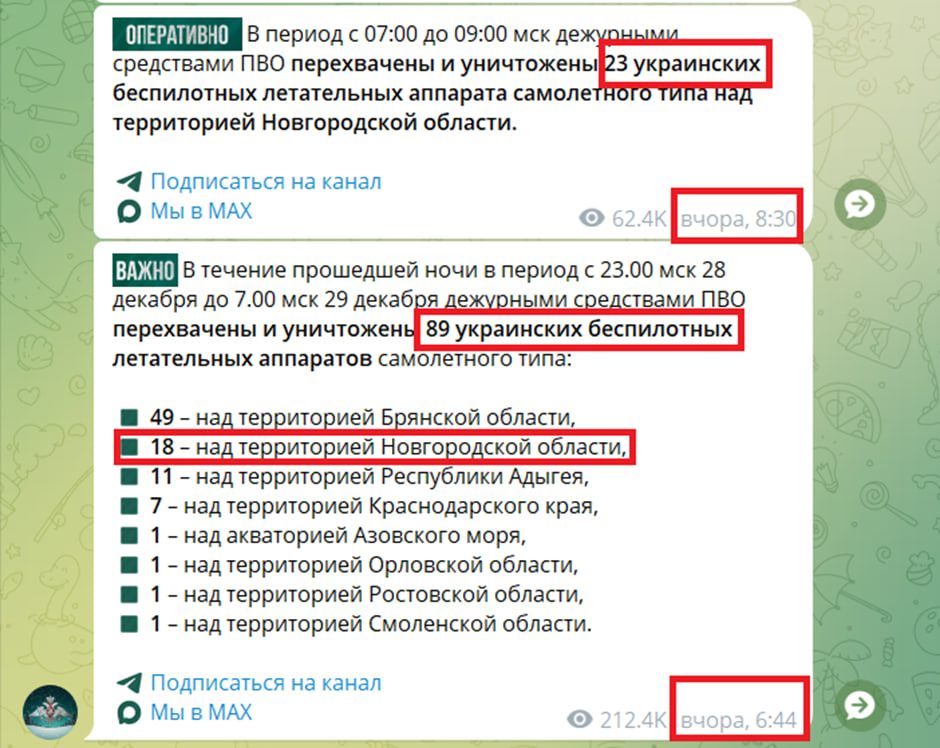
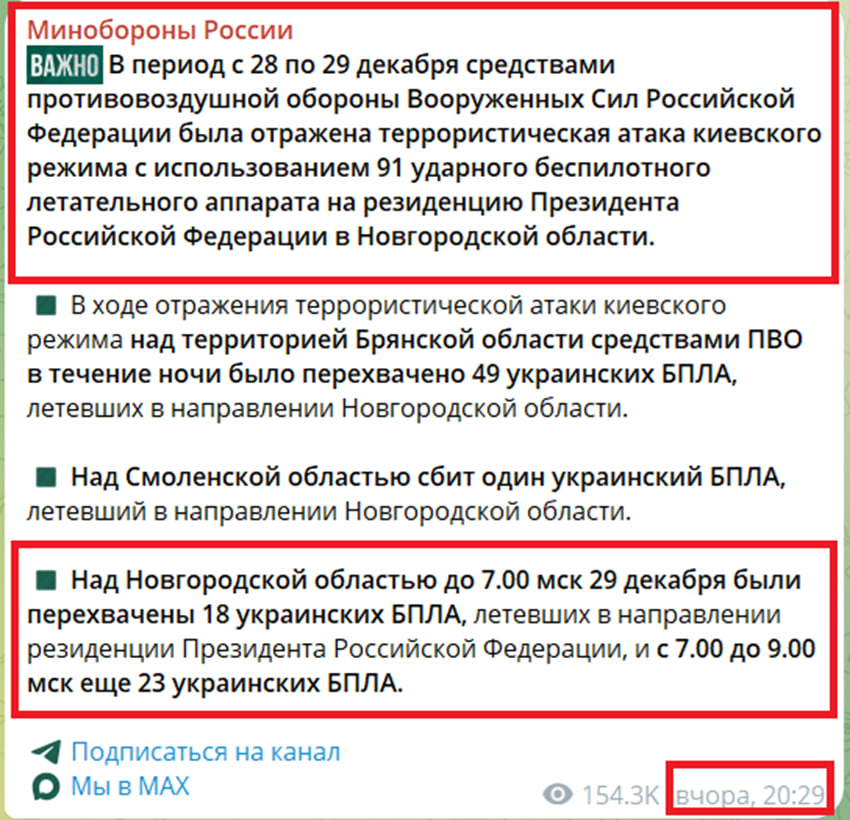
Moreover, these claims contradict data from the Russian Ministry of Defense. Initially, at 6:44, the MoD reported shooting down 89 Ukrainian drones overnight between December 28-29, of which only 18 were in the Novgorod region; later, at 8:30, they reported 23 more drones downed. The Ministry of Defense only mentioned the “attack” on the Valdai residence at 20:29 – more than two hours after the Russian Foreign Ministry’s statement.
Local residents also confirmed that no drone attack occurred. The Russian opposition outlet Point Media interviewed 14 residents of the Novgorod region, all of whom reported that they had not received any drone alerts, nor heard the sounds of drones or explosions.
Analysts at the Institute for the Study of War (ISW) also refuted the claims. They noted that the alleged strike on Putin’s residence lacks the typical signs of verified Ukrainian attacks, which are usually documented in open sources: videos with geolocation, flashes, fires or smoke near targets, and statements from local or regional Russian officials who typically downplay strikes.
RUSSIANS INVENTED TRUMP’S REACTION
After Lavrov’s statements, Russian media narratives began claiming that Trump was allegedly outraged by the attempted Ukrainian attack on Putin’s residence and that the U.S. administration was glad not to have supplied Tomahawks to Kyiv.
However, the source of these claims is Yuriy Ushakov, a longtime aide to Putin who oversees the Kremlin’s foreign policy. Neither Donald Trump nor any White House representative confirmed these statements.
The only official reaction from the U.S. President to Russian claims came during a meeting with Israeli Prime Minister Benjamin Netanyahu:
"No, I really don’t know about it. I’ve only heard about it, but I don’t know. That would be very bad. That would not be good," Trump said when first asked about the attack.
Minutes later, while summarizing his morning call with Moscow, Trump revised his statement:
"You know who told me about it? President Putin told me. Early in the morning, he said he had been attacked. I was very angry about this," he said. He also noted that the information about the attack itself still needed verification, meaning he acknowledged receiving a report but did not publicly confirm its authenticity.
UKRAINIAN RESPONSE
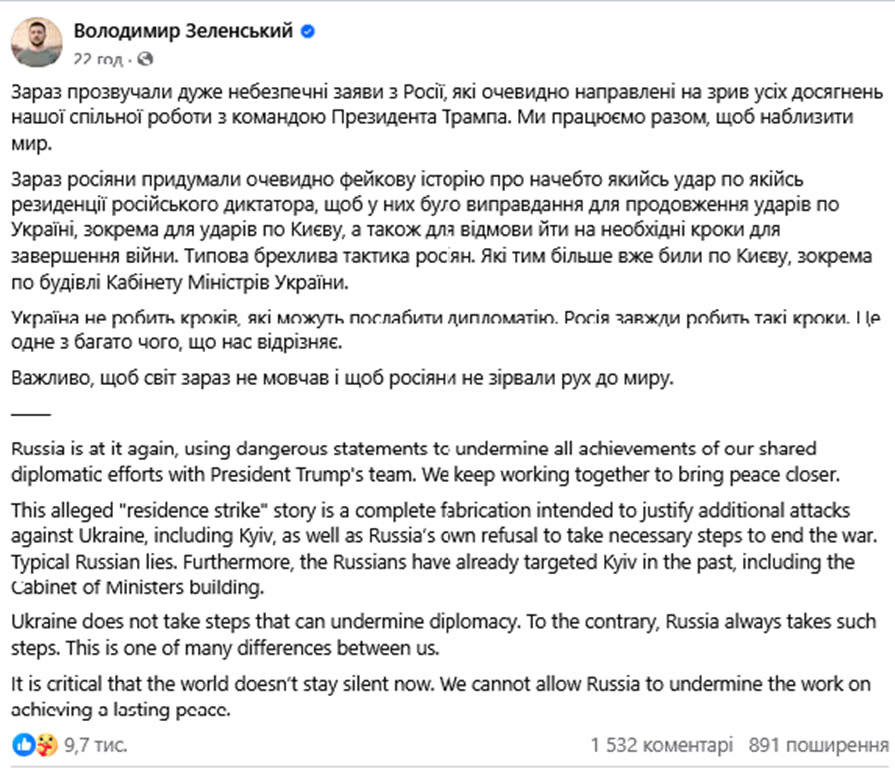
Ukraine immediately denied that any attack occurred on Putin’s residence in Russia’s Novgorod region. President Volodymyr Zelensky called Lavrov’s claims fake in his social media posts:
"This alleged ‘residence strike’ story is a complete fabrication intended to justify additional attacks against Ukraine, including Kyiv, as well as Russia’s own refusal to take necessary steps to end the war. Typical Russian lies. Furthermore, the Russians have already targeted Kyiv in the past, including the Cabinet of Ministers building. Ukraine does not take steps that can undermine diplomacy. To the contrary, Russia always takes such steps. This is one of many differences between us. It is critical that the world doesn’t stay silent now. We cannot allow Russia to undermine the work on achieving a lasting peace."
Ukrainian Foreign Minister Andrii Sybiha also stated that the Russian officials’ claims are false, emphasizing that Russia “still hasn’t provided any plausible evidence for its accusations.”
"Almost a day passed and Russia still hasn’t provided any plausible evidence to its accusations of Ukraine’s alleged ‘attack on Putin’s residence’. And they won’t. Because there’s none. No such attack happened," Sybiha wrote on Telegram.
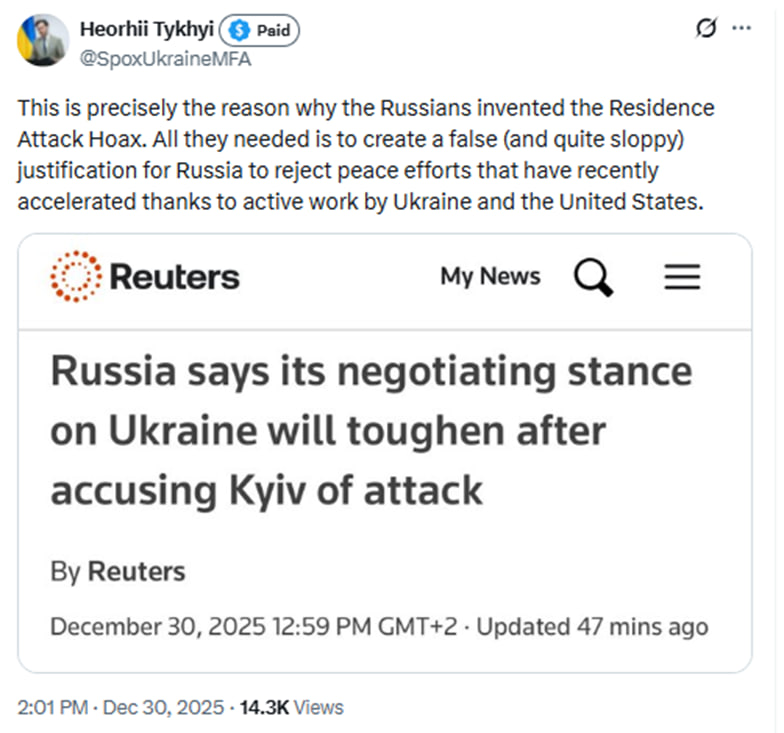
The Ukrainian Foreign Ministry spokesperson, Heorhii Tykhyi, stated on X that the Russians fabricated “the Residence Attack Hoax” to create a false excuse for rejecting peace initiatives.
"All they needed is to create a false (and quite sloppy) justification for Russia to reject peace efforts that have recently accelerated thanks to active work by Ukraine and the United States," Tykhyi wrote.
THE GOAL – TO KILL THE PEACE PROCESS
Thus, the Russian authorities are attempting to sabotage peace agreements, push Donald Trump to side with Putin, and force Ukraine into capitulation. Russia does not concern itself with evidence. When asked by Russian journalists, Kremlin spokesperson Dmitry Peskov said:
"I don’t think any evidence is needed here. If there is a massive drone raid, which our air defenses have successfully intercepted..."
By Andrii Olenin