“Here, life and death walk the city’s streets like old friends”
The wail of air raid sirens, the thunder of artillery, and the constant threat of drone attacks and guided glide bombs (KABs) are the reality in which the “Shield of Life” medical service of the National Police Assault Brigade “Liut” has been operating for the past two years.
The unit first served in the Kharkiv sector and is now deployed in Donetsk Oblast. During that time, its combat medics, evacuation crews, and drone operators have saved thousands of Ukrainian defenders and civilians.
Ukrinform correspondents accompanied officers from the Pre-Hospital and Medical Care Directorate of the Medical Company within the National Police Assault Brigade “Liut” on an evacuation mission to see firsthand how the casualty rescue system works — from extracting the wounded from the battlefield to fighting for their lives at a stabilization point.
“IT HAS BECOME A HABIT, A WAY OF LIFE”
To spend time with the brigade’s medical service, we traveled to Kramatorsk.
Waiting to greet us is the deputy commander of the tactical evacuation company, whose call sign is “Otto.” We have known each other since childhood, though we had not seen one another for many years. It is hard to believe that this tall, broad-shouldered man with a magnificent mustache was once the skinny teenager I met at the age of fifteen during a rock concert at a local cultural center.

“Otto”
"Otto" begins by explaining how the casualty evacuation system works.
“The first stage is telemedicine. When a soldier is wounded, his comrades contact us for guidance on providing first aid. He is then taken to a casualty collection point, where our personnel are on duty. As soon as the security situation allows, an armored evacuation vehicle is dispatched to retrieve him. Our medevac teams receive the casualties at a designated transfer point and provide emergency medical care. The primary mission of our officers is to get the wounded to the stabilization point alive. From there, they are transported to medical facilities for further treatment,” Otto explains.
According to him, the intense activity of enemy FPV drones now prevents medevac crews from getting as close to the front line as they once could.

"Otto" shares stories of evacuation teams coming under fire, saving lives while on the move, and transforming over the past two years from a small unit into a full-fledged directorate while continuously improving their skills and capabilities.
His phone rings constantly as he coordinates the work of his subordinates. There seems to be hardly a free minute in his day. Yet “Otto” says that it is here, in the medical service, that he feels most at home.
“I do what I love. And I even get paid for it. Of course, I miss my family, but when I go home, I find myself missing the job. It has become a habit, a way of life,” he says.
I ask what qualities a person needs to do this kind of work. “Otto” emphasizes that a combat medic must know how to prioritize.
“You have to understand whom you can save and whom you cannot. If you devote all your efforts to someone beyond help, you may lose the chance to save a person who still has a chance of surviving,” he says. “At first, that’s difficult, but over time you learn. For example, I’m not very good at remembering faces. So I don’t know which of the people I treated or trained later died in combat. That actually helps.”

“THEY’RE PROMISING A CORRIDOR — GET READY!”
The evacuation is carried out through a so-called “green corridor” during designated time windows, when Ukrainian troops can provide the highest possible level of security for evacuation vehicles. These windows are used not only to retrieve the wounded but also to deliver supplies, food, water, and other essentials to frontline positions.

“Today they’re promising a corridor, so get ready!” “Otto” tells us.
We are always ready. At the first command, we climb into the medevac vehicle.
The ambulance was donated to the unit by the family of a volunteer whose call sign was “Istanbul.” He was killed in the war. His call sign lives on as the vehicle’s name. After being converted into a fully equipped ambulance, it has carried dozens of wounded Ukrainian defenders to safety.

“Odesa”
The crew of the Istanbul consists of its driver, call sign “Odesa,” and a young combat medic known as “Deku.”
The medic chose his call sign after the character from the anime My Hero Academia. “Deku” is the nickname of the series’ protagonist, Izuku Midoriya, and by the end of the story it becomes a proud hero’s name. Deku says it was his girlfriend who helped him discover his own superpowers, much like the character in the anime. In many ways, the young police officer’s story mirrors that journey.

“Deku”
Deku is 27 years old. Before the war, he worked as a bank accountant, though medicine had always interested him. After the start of Russia’s full-scale invasion, he joined the police force, completed tactical combat casualty care training, and deployed to the front as a platoon combat medic in an assault battalion. He has been seriously wounded several times and has lost more than one close friend.
During the evacuation mission, he is quiet and focused. There is no smile on his pale, tired face. Instead, his sky-blue eyes constantly scan the horizon. He says that life before the war and life now feel like two entirely different realities.
“We evacuate soldiers with blast injuries, shrapnel wounds, massive soft-tissue damage, and amputations. Every mission in which we manage to bring out a critically wounded soldier alive is a success. I wanted to help people, and I get to do that every day. That’s what motivates me,” Deku says.
I ask whether he has ever counted how many lives he has saved.
“It doesn’t matter — as long as I can save one more,” he replies without hesitation.
Deku’s greatest source of support is his girlfriend. As a talisman, he wears a keychain she gave him — or rather, what remains of it: a pink heart-shaped attachment. The rest was lost somewhere on the front line.
When he talks about her, a gentle smile briefly appears on his face. Just as quickly, however, he returns to business. Showing us the equipment inside the ambulance, he explains that it contains everything needed for emergency care — from a refrigerator stocked with blood products to a ventilator, a defibrillator, and an oxygen concentrator.

“Besides providing medical care, we often have to support the wounded psychologically. Sometimes all it takes is a conversation. I’ve been where they are. I understand what they’re going through, and I can find the right words,” Deku says.
He notes that one of the most difficult aspects of his job is dealing with mistakes made during the earlier stages of treatment.
“A major problem is tourniquets that have been applied incorrectly or used when they weren’t necessary. We also frequently encounter cases where a tourniquet is not converted in time, which can ultimately cost a person a limb,” he explains.
The medic recalls one incident from his own experience.
“We were evacuating a critically wounded soldier when a mortar round landed right at our feet. The casualty became even more critical, and both I and the second medic were wounded. In total, three of the six people there sustained injuries. Still, the other medic had a tourniquet applied and it was converted in time.
“In a stressful situation, you can’t afford to panic. Everything has to be done quickly and precisely. Poor first aid is often the result of stress, but it can also stem from insufficient training,”Deku" says.
“I’VE BEEN HERE SINCE THE FIRST WORLD WAR”
At this point, "Odesa" joins the conversation.
“Things are good. There are plenty of wounded, the war isn’t ending anytime soon, and my leave is coming up. It’ll be nice to spend a little time walking around in house slippers,” the evacuation driver says with a grin.
We ask what keeps him motivated.

“I’ve been at war since 2014—that’s half my life. At this point, I don’t really know any other way to live,” he replies.
"Deku" jokes that "Odesa" has actually been fighting since 1914.
“They like to joke that I’ve been here since the First World War. But the truth is, the war has changed. These days, you spend a lot of time running and hiding from drones. I joined as a volunteer, and then they handed us ‘sticks and swords,’ so I transferred to the Storm Battalion. In 2023, I moved to a medevac crew with Liut. We’re moving up in the world! We used to give injections; now we’re transfusing blood and restarting hearts.
“We’ve served in a lot of sectors—Pokrovsk, Vovchansk, Toretsk—and now we’re here,” he says.
"Odesa" rarely speaks without making a joke. You can tell immediately where he is from.

DEFENDERS WITH SEVERE BURNS ARRIVE IN AN ARMORED VEHICLE
Caught up in conversation, we barely notice that we have reached the casualty transfer point. Within minutes, vehicles carrying wounded soldiers are expected to arrive and hand them over to the medics.
We wait.
The first armored vehicle pulls up carrying defenders with severe burns. As they are transferred to the evacuation vehicles, we learn that their position near Kostiantynivka was attacked by Russian “dragon drones” carrying thermite-based incendiary mixtures that burn at extremely high temperatures.
Fortunately, there were no fatalities.


Among the wounded are two soldiers with shrapnel injuries. They are loaded into our ambulance. Deku examines them, confirms that their condition is stable, and we set off for the stabilization point.

A NURSE AND A WOUNDED SOLDIER WHO SEEM LIKE OLD FRIENDS
Everything is ready for the arrival of the casualties.
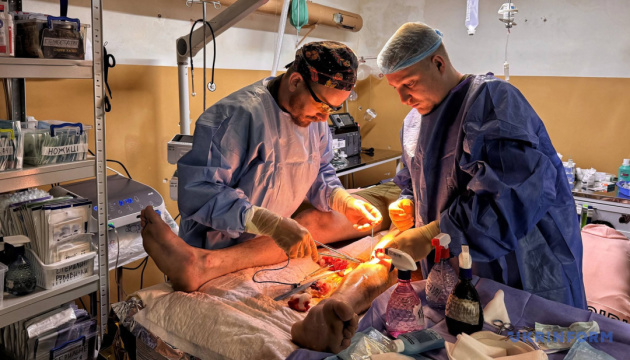
Two surgeons, several nurses, and other specialists are on duty. In total, more than twenty medical professionals work at the stabilization point, including anesthesiologists, trauma surgeons, and orderlies.
The wounded are quickly placed on operating tables and asked what medications they have taken and when their tourniquets were applied. The doctors begin their assessments and administer pain relief.
One soldier is missing part of the muscle in his thigh and is in severe pain. A nurse stays by his side, talking to him constantly. He responds easily, and for a moment it seems as though they are old friends. In reality, the conversation serves a purpose: it distracts the wounded man and allows the surgeon to work more effectively.
To ensure no fragments remain in his body, the soldier is sent for an X-ray. The doctor then begins treating the wound. Once the procedure is completed, the serviceman is transferred to another medical facility for further treatment.
A PEDIATRIC SURGEON TREATING VERY ADULT WOUNDS
The staff at the stabilization point say they are expecting many more casualties today, leaving little time for the surgeons to rest. We have only a few minutes to talk.
Yevhen Vitaliiovych, a police lieutenant and commander of the combined stabilization point, is originally from Sumy. Before the war, he worked at a children's hospital. Now, instead of treating childhood illnesses and injuries, he spends his days dealing with the devastating wounds of war.

Yevhen Vitaliiovych
“Well, that’s how life turned out. There was a war, and I decided to join the service,” Yevhen Vitaliiovych says.
He explains that the stabilization point operates under the command of the National Police Assault Brigade Liut, with the police providing equipment, medical supplies, and other essential resources.
“We’re now moving to a higher level of medical care. We can perform amputations and apply external fixation devices for open and gunshot fractures. We’re becoming more and more like a hospital,” he says, describing how the facility has evolved.

According to the surgeon, the most challenging cases involve abdominal injuries.
“It’s like opening a box of surprises. You never know exactly what’s inside. Sometimes there’s only a tiny entry wound, but no one knows what that bullet or fragment has done internally. As we say, we’ll cut and see. Fortunately, we have ultrasound and X-ray equipment, which allows us to perform the essential diagnostic procedures on site,” he explains.
I ask Yevhen Vitaliiovych how different his current work is from his previous experience as a pediatric surgeon.
“I worked in Sumy, right on the border. From the very first days of the war, we were operating on children with gunshot wounds, so I was prepared for this kind of work. Patients differ only in size. In terms of behavior, children and adults are much the same,” he replies.
Under protocol, a wounded patient is expected to spend no more than 30 minutes at the stabilization point. In severe cases, however, and when circumstances allow, medical teams continue treatment for as long as necessary to stabilize the patient before evacuation to a higher level of care.

“We have oxygen supplies and ventilators. If necessary, we can work on a patient all day. Recently, we operated on a soldier for three hours. He had suffered massive trauma, with three tourniquets applied to his limbs and injuries to both the chest and abdominal wall. We had to amputate his arm at the forearm because the tourniquet had been in place for more than eight hours and irreversible changes had already begun.
“Before that, we treated another soldier who had lost his right leg and sustained multiple other injuries. We managed to save his arm, although amputation had also been considered. His heart stopped, and we performed CPR for 50 minutes. Successfully. He is now undergoing rehabilitation,” Yevhen Vitaliiovych says.
The doctor notes that injuries to the limbs are now the most common type of wound among soldiers. He also says the number of casualties has increased as the situation around Kostiantynivka has worsened.
I ask what motivates him to keep going.
“I want to live. And I want everyone else to live too. I don’t count the people we save. One, two, ten—beyond that, the number no longer matters,” he says.
Our conversation ends there. Another operation is waiting.
THE MEDICAL POINT AND THE CREATIVE MEDICS
The work does not stop at the stabilization point. Medical personnel are also on duty at the brigade’s medical point, which becomes our next destination.

A medic who writes poetry
About a dozen staff members are on duty.
The walls are covered with children’s drawings, and on a board reserved for “strategic planning” we notice a poem. One of the medics wrote it.
“Here, life and death walk the city’s streets like old friends.”
Every word rings true. It is difficult to imagine a more accurate description of life in frontline Kramatorsk.
The author says it was her first attempt at poetry, but it will not be her last.

Olha
Olha has headed the medical point since the day it was established.
“What do we deal with here? Mostly non-trauma medical cases. We see patients with heart attacks and strokes. If we cannot provide the full scope of care ourselves, we coordinate with other hospitals. We also treat soldiers with minor injuries,” Olha explains.
She says her family supported her decision to pursue medicine.

“My mother worries a lot. She always says, ‘I knew you’d pull some kind of stunt one day—at least let this one be useful,’” she says with a smile.
The medics occasionally receive gifts from grateful patients.

“T-shirts, unit patches, things like that. But all of those were left behind in my previous apartment, which was hit by a guided glide bomb during the massive attack on the city on May 5.
“I still keep in touch with former patients by phone. It’s unbearably painful when the guys don’t make it. It hurts. I haven’t truly grieved a single loss yet. If you allow yourself to dwell on it, it takes you out of the fight. That’s work for after the war,” the head of the medical point says quietly.

“BUT THE BRAVE ARE ALWAYS FORTUNATE”
When asked what motivates her to remain in a city that is constantly under attack, she smiles and shows us a pendant shaped like a book.
“But the brave are always fortunate.”
The quote comes from the novel Tiger Trappers by Ivan Bahrianyi.
“That’s just how life turned out. While I was still a student, I began volunteering with the military in 2017. Later, during my internship in another city, I continued working with servicemen there as well.
“I connect easily with soldiers. To be honest, I find it harder to work with civilians. I wanted to be involved. I wanted to help. That’s why I’m here. And seeing the results keeps me going,” Olha says.

After visiting the medical point, one gets the impression that the staff do far more than provide medical care. There is a remarkable sense of humanity in the way they treat people.
Despite the constant explosions outside, the facility feels calm and welcoming. The medics greet wounded soldiers warmly, and it seems that this alone makes the men feel at least a little better even before treatment begins.
“LIOKHA” THE HEAVYSHOT AND THE LONG-LIVED “VAMPIRE”
Logistics support is another important part of the medical company’s mission.
Given the realities of modern warfare, supplies are delivered to remote positions using unmanned ground vehicles (UGVs) and drones. The latter are even used to transport blood products.

“Fart”
“Fart,” the deputy commander of the unmanned systems platoon, explains that his operators control HeavyShot and Vampire drones, as well as robotic ground vehicles, from a dedicated command post. The equipment itself is deployed and maintained at a separate location.

“Liokha”
“The ground robots deliver food, water, medicine, and even weapons systems to the guys on the front line. The HeavyShots can carry up to 40 kilograms of payload, though we usually load them with around 15.
“Once, we were flying back when the signal started being jammed. We had to switch to manual control. We got a little mixed up about which courtyard was ours and nearly landed the drone in the wrong place, but the guys managed to orient themselves using visual landmarks and brought the bird down exactly where it needed to be,” Fort recalls.
The operators of the unmanned systems platoon jokingly call one of their HeavyShot drones “Liokha.” They say it can fly roughly 20 kilometers one way—significantly farther than a Vampire drone.
“Besides "Liokha", we also have Peredovyk (‘Frontliner’) and Tylovyk (‘Rear Echelon’). We used to have Stas, but it died a hero’s death. It completed the mission, but on the way back it was hit by an FPV drone.
“As for the Vampire, it’s a real veteran. It’s been with us for almost two years. Right now, it’s out on a mission. Immortal, just like a vampire,” Fart says.

The soldiers recall using drones to deliver steaks to their comrades on positions near Kostiantynivka and, during Easter, traditional paska bread.
The ground robots can carry far more cargo than drones, Fart says.

“Once we loaded nearly 400 kilograms onto one of them—fuel, food, water, medicine. And it just trundles along the streets at 5–7 kilometers per hour.
“Of course, it can be destroyed along the way. To improve its chances, we first check the route and conduct a reconnaissance flight to identify possible mines and enemy FPV operators using fiber-optic drones. After that, one operator monitors the route, while another remains on interception duty.
“If an enemy FPV appears at night, we switch off the lights and hide as quickly as possible—under a bush or beside already destroyed equipment. That has saved us more than once,” he says.
Later, we spot a ground robotic vehicle operating near the outskirts of the city. We do not know whether it belongs to the police unit. But when we stop to photograph it, the robot suddenly begins spinning in circles as if it were dancing—a greeting, it turns out, from its operators.
We spend nearly a week in Kramatorsk alongside the police officers.
During that time, we heard countless stories about their work—stories that are tragic, funny, inspiring, and deeply human. One thing becomes unmistakably clear: behind every life saved and every successful mission are people. Motivated, sincere, exhausted, yet completely devoted to what they do.
They are not superheroes, but they come remarkably close.
As we prepare to leave, I turn to my childhood friend “Otto”.
“Tell me, could either of us have imagined twenty years ago that you would be saving lives under fire, and that I would be writing about what a hero you are?”
He smiles, lights a cigarette, and says that life has a way of taking unexpected turns.
Hanna Bodrova, Odesa
Photos by Nina Liashonok