Russia amassing forces for an ultimate offensive in Donbas this fall, but this is unlikely to succeed
Ukrainian media discourse is again filled with alarming reports. British intelligence, analysts from the Institute for the Study of War (ISW) and the authoritative publication Bloomberg almost unanimously state that Russia is carrying out a large-scale regrouping of its forces, redeploying up to 100 thousand troops to the Donetsk front. The troops are being withdrawn from the Kharkiv, Sumy and even Kherson regions in order to concentrate the striking force to successfully achieve the "seizure of the entirety of the Donetsk region".
The discourse is focused on the forces referred to by Russian propagandists as "elite". These are the units of the 40th and 155th Marine Brigades, the 177th Marine Regiment of the Caspian Flotilla, units of the 11th and 76th Airborne Assault Brigades, as well as the 70th Motorized Rifle Regiment. Some analysts predict that such a concentration of forces points to Russia’s intention to focus its autumn offensive on capturing the still-unoccupied part of the Donetsk region, in particular the areas of Dobropillya, Pokrovsk and Kostyantynivka. At the same time, the decrease in activity in the Sumy and Kharkiv directions indicates the failure of Russian attempts to create a so-called buffer security zone in the north.
We are again faced with a number of natural questions. Is this the preparation for the same “ultimate and decisive” offensive being talked about nearly every season? What’s the extent of the threat being posed by this 100,000-strong force? And most importantly, will the enemy have enough forces and capabilities to achieve the strategic objectives set for its autumn-winter offensive campaign?
IS IT “SPRING BREAK” OR A NEW PSYOP CAMPAIGN?
Reports of Russia preparing for a major offensive have been thrown into pubic discourse with a regularity that made people highly sceptical about Russian forces’ ability to achieve at least operational goals at hand. Every spring and autumn, narratives about the “ultimate offensive” and “mobilization of all resources available ” are heard. We should take the coming news of the Russian offensive with a grain of salt, experts say.
Oleksandr Kovalenko, military columnist at Information Resistance think tank calls for caution about the news of the scale of Russian troops redeployment. He confirms the reports about individual Russian units being redeployed closer to the Donbas front, but believes the “global concentration of forces” to be an exaggeration.
“Do you remember the years 2022–2023 when reports were actively shared about hundreds of thousands of reservists being purportedly mobilized from “beyond the Urals” regions? In actual fact, however, there are simply no such resources in Russia. Currently, Moscow is trying to mobilize more people than it is losing on Ukrainian battlefields just to at least keep the existing troop level. But mobilizing a 100,000-strong force “from scratch” is an undertaking that is highly unlikely to succeed due to a lack of resources, or a reasonable chance of positive outcome,” Mr. Kovalenko argues.
In his opinion, the current redeployment campaign looks more like a tactical move related to the acute shortage of personnel reserves in deep rear areas. The Russian military command is forced to “patch holes” in areas of priority for itself, redeploying troops from less challenging areas of the frontline. This does not indicate the amassing of forces and capabilities for achieving a strategic breakthrough, but rather an operational crisis.
A similar opinion is shared by Kyrylo Sazonov, an Armed Forces of Ukraine officer and war blogger, arguing that the adversary is acting situationally, responding to the successes of the Defense Forces of Ukraine. Analyzing the failure of the Russian offensive on Kupyansk, he points to the tactical miscalculations committed by the occupiers, which they are keen to make up for with quantity rather than quality.
Thus, if we assess the situation on a virtual scale of “apocalypticism” from 1 to 10, then the current events can be rated around 3-4. This is not about preparing for the ultimate battle, but about yet another attempt to seize the initiative in one of the hottest axes of Russia’s war against Ukraine, which is a logical follow-up to the war of attrition.
THE MAGIC OF NUMBERS: WHAT DOES “RUSSIA REDEPLOYING UP TO 100 THOUSAND TROOPS TO THE DONBAS FRONT” REALLY MEAN?
The Bloomberg-stated figure of 100 thousand troops is impressive indeed. Such a force grouping can significantly change the balance of power on any sector of the frontline. Experts, however, urge looking not at the numbers, but at what is behind them.
Oleksandr Kovalenko categorically denies the possibility for Russia to swiftly redeploy that large force in a single organized process. There can be talk of the redeployment of individual brigades, but not of fully-sized armies, he says.
“What is a 100 thousand-strong force capable of? This would suffice to, relatively speaking, create conditions for the encirclement of Pokrovsk. If another 100 thousand were added to the already existing grouping, this would really be enough for a large-scale offensive scenario. But what regards the current redeployments... These involve the brigades that will be distributed among the Pokrovsk, Kostyantynivka and part of Novopavlivka sectors... For better understanding -- a brigade does not consist of 100 thousand or even 50 thousand troops, but of four thousand or less,” the analyst explains.
Thus, according to Kovalenko, the actual reinforcement is far more modest than it might seem at first glance. The redeployment of a few brigade-size units would not be enough to achieve any of the strategic objectives. This is a tactical-level reinforcement aimed at closing gaps and maintaining the pace of the offensive in narrow areas.
He explains that 100 thousand actually amounts to two full-fledged combined arms armies in full force plus vehicles, equipment and logistics. Such a large force is practically impossible to organize and redeploy unnoticed, and there are currently no signs of preparation for an operation of that scale and extent. Therefore, according to the expert, the figures reported by Western media outlets are obviously inflated and don’t seem to reflect well the situation on the battlefield.
REINFORCEMENT FROM THE RESERVE: RUSSIAN “ELITE” FORCES, IF YOU CAN CALL THEM THAT
Western media and intelligence reports put a special emphasis on the fact that “elite” units -- marines and paratroopers -- are being relocated to Donbas. Theoretically, this would suppose a concentration of the most combat-ready, experienced and motivated units. However, the reality, as is often the case with the Russian army, is dramatically different from that depicted by Russia’s propaganda machine.
Oleksandr Kovalenko gives a vivid example – the infamous 155th Separate Marine Infantry Brigade, which has already become a living (or, more precisely, dead) symbol of the degradation of the Russian “elite” army.
“The 155th Separate Marine Infantry Brigade has already been practically fully obliterated twice in battles of Vuhledar. It was reduced to complete zero twice, which speaks well that there is no longer any reason to regard such formations as “elite”. Russia’s elite units ran out back in 2022. Now all that remains of them are the loud names – “guards divisions”, “guards brigades”, etc. But behind these names are not professional military personnel, but so-called “chmobiki”, the civilians mobilized for war during recent months... The Russian "elite" troops are now nearly all lying in our black soil," the expert states without undue pathos.
This argument is supported by the impressive statistics cited by Oleksandr Kovalenko. At the beginning of the full-scale invasion in 2022, about 180 thousand Russian military personnel invaded Ukraine, composed primarily of professional contract soldiers with combat experience, including particularly the conflicts in Syria or Libya. Today, Russia deploys a force of some 700 thousand personnel in Ukraine. But with a fourfold larger army, they capture 23 times less territory in 2025 at the cost of four times more casualties.
"In 2022, in the first three months of the invasion, the Russians captured more than 32 thousand square kilometers of Ukrainian territory. Instead, in 2025, in the three summer months of June, July and August, they were able to seize only 1,574 square kilometers, having failed to capture a single major city, neither a regional nor a district capital. As regards the number of casualties... In 2022, in the first three months of the war, Russia lost a little more than 22 thousand soldiers, and this grew to 93.5 thousand casualties lost in just three summer months of 2025,” the military analyst emphasizes.
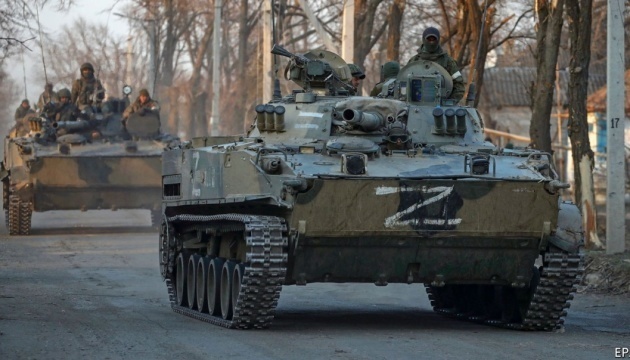
This clearly indicates the attrition and degradation of the Russian armed forces. Instead of professional assault operations supported by armored vehicles and artillery, we are witnessing “meat grinder assaults” - endless waves of infantry, which the enemy uses as consumables. This tactic brings the occupiers minimal tactical gains at the cost of enormous losses.
“And this is what makes a major challenge for Ukraine. Russia is keen to compensate for the lack of high- quality personnel with quantity. That is why our challenge at the current stage of the war is not to effectively destroy dozens of armored columns (which we are already doing effectively, - ed.), but to effectively destroy dozens and hundreds of assault troops on motorcycles and small assault groups. Unfortunately, for the most part, the same methods are used as against armored vehicles, but motorcyclists are “meat” that the enemy has thousands of times more than equipment. The defense forces must adapt to the new reality of war faster,” Kovalenko believes.
BATTLE FOR DONBAS: OBJECTIVES, CAPABILITIES AND FORECASTS FOR WINTER
The priority objectives set by the occupiers for their autumn-winter offensive campaign are quite obvious and pragmatic from a military point of view. As Oleksandr Kovalenko points out, the prime objective of Russia’s failed summer campaign was to set up a bridgehead for further advances in the cold season.
“Moscow was seeking to bring its human resources into urban areas to avoid protracted fighting in the open terrain during the season of rains, frosts and snowfalls, and thus preclude undue additional casualties and equipment losses... That explains why Pokrovsk, Kupyansk, Lyman, Borova, Siversk and Kostyantynivka were identified as key targets,” the expert says.
Since that plan failed to be executed to full extent, the adversary is now forced to focus maximum effort on the seizure of Pokrovsk -- the last major city on the western edge of Donetsk Oblast, serving as a gateway for Russian forces to continue advancing deeper into the region. At the same time, as Kyrylo Sazonov notes, the Russians’ ambitions reach much further. The dreams of the Russian General Staff include the implementation of a global plan: a major encirclement of Sloviansk – Kramatorsk – Kostyantynivka – Druzhkivka -- the key urban area in the Donetsk region. An offensive on Pokrovsk from the south and a simultaneous push on the Lyman direction towards Sloviansk from the north are supposed to take Ukrainian forces into huge ticks.
It's okay to dream, as is said. The enemy’s capabilities are extremely limited, and the Ukrainian Defense Forces prove this every day. Not only do Ukrainian soldiers hold their defenses firmly in pre-equipped positions, but conduct successful counterattacks. Kyrylo Sazonov recalls the recent liberation of the village of Novoekonomichne by the 425th Assault Regiment “Skelya”, which is strategically important for the defense of Pokrovsk. This makes the deployed Russian reserve forces try to break the extremely unfavorable situation for them instead of “building on the momentum”, spending already limited resources on extinguishing “fires”.
Forecasts for the autumn-winter campaign boil down to one thing: we are facing extremely hard and exhausting battles. The enemy, unable to wage a maneuverable war, will attempt to draw Ukrainian forces into bloody urban battles for Pokrovsk, Chasiv Yar and other key settlements. As Oleksandr Kovalenko emphasizes, Russia does not intend to cease fighting. It is instead seeking to exploit any peace talks for time buying purposes only, in a bid to recover its warfighting capabilities and launch a new offensive campaign in the spring of 2026.
CONCLUSION NOTES
Russia is relocating its troops to Donbas, but not in such quantities as rumored. This is not a preparation for the “ultimate and decisive” offensive, but rather a tactical step forced by resource shortage and the failure of previous plans. The Russian “elite” army, if you can call it that, has long lost its quality and is trying to compensate for this with quantity, which causes enormous losses in personnel and equipment.
The forthcoming autumn-winter campaign promises to be a heated one, as the enemy is concentrating all the forces available to it on attempts to capture key cities in the Donetsk region, Pokrovsk in the first place. The Ukrainian Defense Forces, for their part, are showcasing a high level of readiness and a capability of not only effectively containing the enemy, but also of conducting successful counteroffensives. The most important thing is not to allow the occupiers an operational pause, because the Kremlin will exploit any “truce” only to prepare for a new, even larger-scale aggression.
Myroslav Liskovych, Kyiv