
Over the past four years, French public opinion has evolved from rather superficial perceptions of Ukraine to a much deeper understanding of the war, Ukrainian identity, and the stakes this struggle holds for all of Europe. Civil society organizations have played a significant role in this shift, including Stand With Ukraine (SWU), founded just days before the full-scale invasion.
Its president, Edward Mayor, told an Ukrinform correspondent how attitudes toward Ukraine and Ukrainians have changed — from the first rallies in Paris to systematic work with media outlets and opinion leaders. He also spoke about long-term formats of cooperation, including partnerships between French and Ukrainian communities, cultural initiatives, and efforts to counter Russian propaganda in France.
BEFORE THE FULL-SCALE INVASION, THE FRENCH KNEW VERY LITTLE ABOUT UKRAINE
Q: I remember the hashtag StandWithUkraine at the very beginning of the war — people who supported us united under it on social media. But why does a French organization have such an international name, and are you part of that movement?
A: When the full-scale invasion began, “Stand with Ukraine” was indeed a global call for unity — it was an emotion shared across the world. By saying “Stand with Ukraine,” you were essentially identifying yourself with that support. But when we started, we actually didn’t know — like probably no one did — that the war would last for more than four years. And if you add the eight years since Russia’s annexation of Crimea and aggression in Donbas, it is even longer. So the slogan “Stand with Ukraine” naturally evolved from a hashtag into the name of our organization.
Q: But when and how exactly was it created?
A: It was three days before the full-scale invasion. My Ukrainian wife and I were on a train. Why? Because on February 21, 2022, Putin gave that speech in which he essentially said outright that Ukraine does not exist. At that moment we finally realized that it was really going to happen. For several weeks we had already been anxiously waiting, like everyone else. We were sitting in chats, organizing ourselves, thinking about what to do. Even though we were in Paris, our relatives and many of our family’s friends were in Kyiv. We were constantly talking with both French people and Ukrainians who were in Ukraine at the time.
Q: Were you worried about your friends in Ukraine?
A: Of course I was worried. So when we realized the invasion was inevitable, we began to act. At the same time, I clearly understood that here in France, unfortunately, very few people were genuinely interested in Ukraine back then. Before February 2022, the French knew very little about Ukraine. They knew about Chernobyl, they knew it had once been a Soviet republic, but they had plenty of stereotypes — for example, that it was some poor, underdeveloped country. For many, it was almost the same as Russia, somewhere far away in the East.
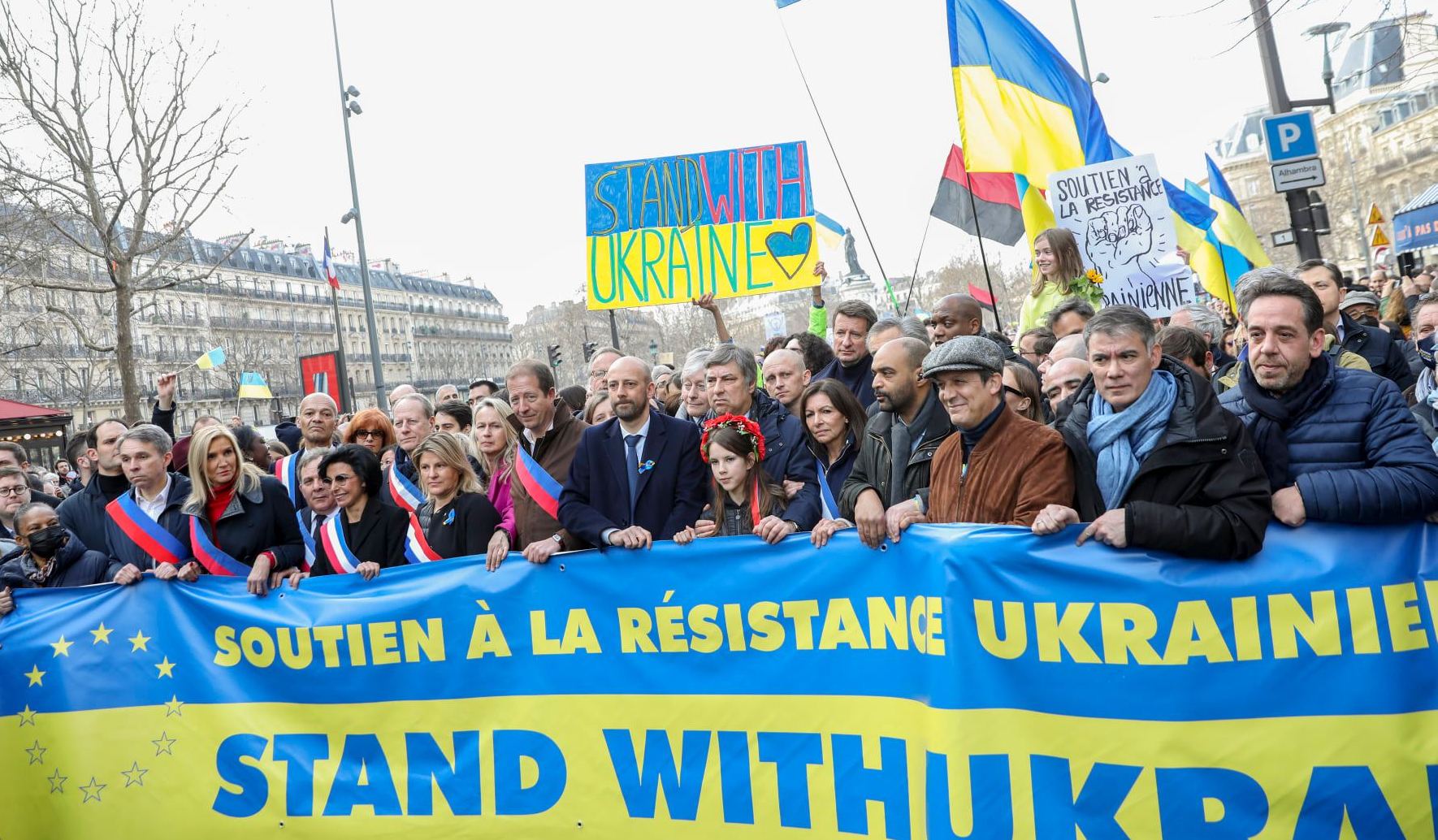
That is why, at that moment, it was crucial for us to create an organization that could mobilize the French themselves — their public opinion, and most importantly politicians and decision-makers — so that they would support Ukraine and say that action was needed immediately: sending weapons and providing Ukrainians with the means to defend themselves. The very next day, on February 22, we held our first rally outside the Russian embassy in Paris. We were not allowed to stand directly in front of the building, but we gathered on the sidewalk across the street. A few French MPs came, and in total there were about 100–150 people.
WHEN A BLATANT INJUSTICE OCCURS, THE FRENCH STAND ON THE SIDE OF FREEDOM AND GATHER AT PLACE DE LA RÉPUBLIQUE
Q: Did you invite those MPs yourself, or was it their own initiative?
A: We reached out through every contact we had. The thing is, I have a long history of political activism, and among my circle in Paris there were many MPs at the time and people close to politics. So I simply called everyone I knew and said: “Come to the rally — this is serious, Ukraine needs support!”
Then, on February 24, my wife and I woke up in the middle of the night to the news that it had begun. Early that morning we started organizing a larger event — a big demonstration at Place de la République that same day.
Because Place de la République is where the French gather. When something important or significant happens, people go there. That evening, thousands of people came to the demonstration in support of Ukraine. As you may remember, France was in the middle of a presidential campaign at the time, so almost all the first-round candidates joined us at République. We rented a van and speakers, and people climbed up and spoke from it. After that, the demonstrations became weekly. I believe the largest one was on Saturday, March 5 — more than 70,000 people attended. Now, four years later, activists continue to hold rallies, and although they are no longer as large, they remain extremely important.
Q: I felt that the French did have a certain special sentiment toward Ukraine — as if our war had struck, as people say on social media, “right at the heart”…
A: I explain it this way. In France there is a historical tradition: the French themselves believe they are always on the side of freedom. It is their motto — “Liberty, Equality, Fraternity.” It also means standing with those who suffer, with those who are attacked. Historically, France tends to stand with those who are treated unjustly; this is part of its identity. That is why most people were extremely shocked by this unprovoked aggression. And even now, if you look at opinion polls, a significant majority still support Ukraine. I hope that our contribution also played a part in this.
IN FRANCE, QUALITY MEDIA HELPED KEEP THE WAR IN FOCUS
Q: After the initial wave of rallies and mobilization subsided, how did you manage to keep attention and focus on a war that is far from France?
A: Yes, it quickly became clear that we would not be able to gather up to 100,000 people every Saturday — life goes on, and the war, fortunately for the French, is far from them. So we needed to engage the media and opinion leaders, and find new ways to keep people interested so that they would remain involved and concerned.
In addition, we began organizing public actions. For example, together with the artist Nikita Kravtsov, we created the mural “Vive la Résistance Ukrainienne!” opposite the Centre Pompidou, which became quite iconic.
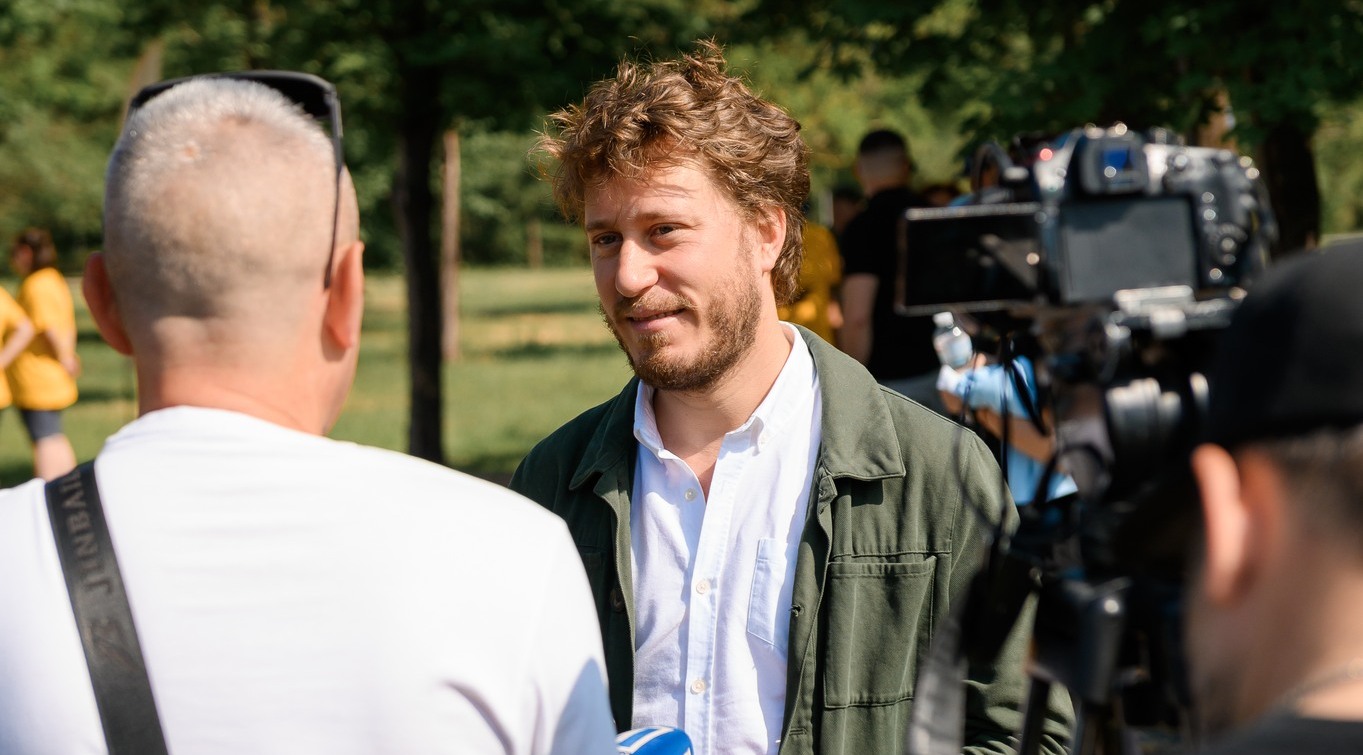
We also started working more directly with the media, and I must say we were fortunate with the French press. Unlike in some other European countries, professional journalists in France have done a very, very good job covering Ukraine. And four years later they continue to do so — they still travel to Ukraine, talk to people, film, and write about what is happening.
This presence is far greater than, for example, in Belgium, or even in Germany or the United Kingdom. Almost all major French media outlets have permanent correspondents in Ukraine. Leading publications such as Le Monde, Libération, and others have two or three journalists based in Ukraine, while television channels maintain rotating film crews. Many outlets also run continuous live coverage about Ukraine.
At the same time, we at SWU devote significant attention to communications work and to countering Russian propaganda. For instance, we launched a major campaign aimed at preventing Russian and Belarusian athletes from participating in the Olympic Games in Paris, and we publicly put pressure on French companies that continue doing business in Russia.
EVERYTHING CHANGED WHEN FRENCH POLITICIANS SAW THE CRIMES IN BUCHA WITH THEIR OWN EYES
Q: Amid this strong journalistic attention — which was truly extraordinary at the time — what did you focus on?
A: Indeed, it was necessary to ensure that the initial support would translate into a long-term commitment. That meant launching specific initiatives — bridges that connect people and help build relationships between Ukrainians and the French. We had already begun thinking about them in the spring of 2022. At the same time, it was crucial to bring politicians to Ukraine, because almost none of them had ever been there before. So we began organizing trips for French parliamentarians, officials, mayors, and members of the European Parliament so they could see everything with their own eyes. And it worked.
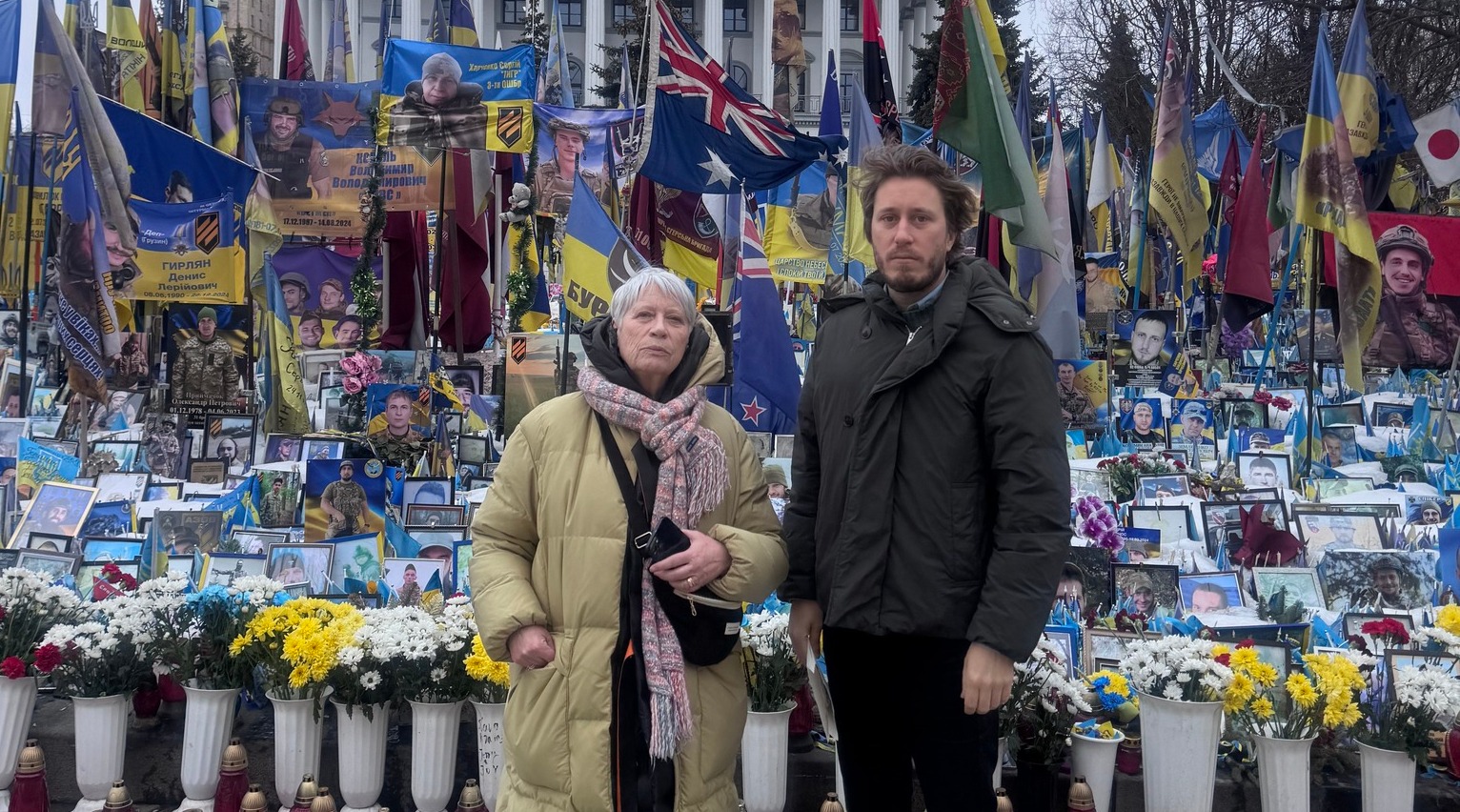
We traveled to Bucha, Borodianka, Irpin — and of course Kyiv. In April 2022, I accompanied the first delegation of French members of the European Parliament to Bucha. It was literally two or three days after the liberation, when bodies were still lying in the mass grave, and we saw how they were being recovered. All the destroyed tanks on the main street, the smell of burning, the smell of death…
Q: As far as I know, the crimes committed by the Russians in Bucha became a turning point for the political establishment, and for the president as well — especially after the French sent their forensic laboratory to Bucha, which confirmed what was already obvious to us — the war crimes committed by Russian forces…
A: Yes, I think that really was a turning point. Everything changed when French politicians began to see Russian war crimes with their own eyes. On April 14 we were in Borodianka with the Mayor of Paris, Anne Hidalgo. I believe that visit deeply affected her. Just before that, the Paris City Council had made an unprecedented gesture of solidarity by voting to grant the city of Kyiv the honorary status of a citizen of Paris. During that same visit to Kyiv, the Mayor of Paris signed a memorandum of friendship and cooperation between the two cities.
THE “MISTO MATCH” CITY PARTNERSHIP PROJECT HELPS STRUCTURE SUPPORT
Q: Was it after the friendship between Kyiv and Paris was established that you decided to develop a network of partnerships between cities?
A: In fact, we began building the city partnership project more systematically a bit later — in November–December 2022, when the Russians began heavily attacking Ukraine’s energy infrastructure for the first time. At that moment, local communities across Ukraine urgently needed generators. What we did was contact French cities and ask them to finance the purchase of generators.
This was our campaign called “Light for Winter” in 2022–2023. Dozens of French cities responded. But for us it was not only about generators — it was also an opportunity to start building connections between cities and communities. Each time a French city financed a generator, we matched it with a Ukrainian city that resembled it in some way and shared certain characteristics.
Q: So you were essentially acting as intermediaries — “matchmakers” between cities?
A: Something like that. We organized their first Zoom meetings, and the Ukrainian city would send photos and videos — for example, of the installed generator — along with messages of thanks. That was the beginning of the partnership. Later the program received the name “Misto Match.” “Misto” is Ukrainian, and “Match” is English. At this stage, the key goal is to structure a national network of cities and communities that support Ukraine.
We also wanted to know exactly where and to whom our assistance was going, so it was important to establish direct connections and see the people who received the help. Because when you know a person’s name, their story, their face — you simply cannot abandon them.
These are human connections — between city administrations, but also between schools, universities, hospitals, businesses, and associations. And this is precisely how long-term support is built: when people truly know one another, they do not simply let go.
FRENCH AND UKRAINIAN CITIES HAVE MUCH IN COMMON
Q: How many such Misto Match partnerships do you have now, and which of them are the most significant for you?
A: At present we have more than 60 partnerships. Among those linked by particularly strong historical parallels is the partnership between Mariupol and Le Havre, which we supported from 2023 until the agreement was signed in February 2025. These are two major industrial port cities that were completely destroyed by war. Mariupol was devastated in 2022, while Le Havre was destroyed during the Second World War. But Le Havre also has a remarkable reconstruction story: the rebuilding of the city led by architect Auguste Perret, who created the entire master plan. From the very beginning we thought about the future reconstruction of Mariupol.
Today we understand that Mariupol will not be liberated immediately, but I am convinced that one day it will be. And when that happens, the city — like many others in Ukraine — will need to be rebuilt. Le Havre has extraordinary experience in this regard.
Another example: in May 2025 Kherson formed a partnership with two French cities at once — Nantes and Saint-Nazaire. There are even geographic parallels: Kherson lies in the delta of the Dnipro River, while Nantes and Saint-Nazaire are in the Loire estuary. There are also shipbuilding industries — Kherson has long been a major shipbuilding center, as is Saint-Nazaire. By the way, more than 600 Ukrainians work at the shipyard in Saint-Nazaire. The cities also share similar challenges — flooding risks, environmental issues, rising water levels, spatial planning, and business development. These are real common points for cooperation and growth.
Q: There is a sense that many of these initiatives may expand on a much larger scale after the war, but are there also projects that are already being implemented now?
A: In fact, it works well when there are motivated people on both sides. There is an example I particularly like: two very small communities — Semenivka in the Zhytomyr region and Sailly-lez-Lannoy in northern France, in the Lille region. It’s a small town of about 3,500 residents. Yet on both sides there are people who are extremely engaged and motivated. There is a constant exchange between schools, between the town halls, and cultural events. A training project for employees of the Semenivka town administration is also now being launched.
Ukrainian cities also tell us: “We want this to work both ways. We want to give something to the French as well.” And when I travel around Ukraine, I see so many inspiring people — with ideas, potential, and vision. At the same time, for small towns the most important thing is not to feel alone. For example, it matters a lot when partners can host children for holidays or recreation. We have some very inspiring partnerships working in this direction — Sainte-Menehould–Kalynivka, Kherson–Nantes–Saint-Nazaire, Boyarka–Palaiseau, Rueil-Malmaison–Chernivtsi, and others. Already more than 500 Ukrainian children have visited France.
Because when you are in large and well-known cities like Kyiv or Lviv, you receive international delegations and have access to international assistance. But when you are in a small town in eastern or central Ukraine, this is far less obvious.
Q; So do you have a team that searches for cities and negotiates partnerships both in France and in Ukraine?
A: We do this together with our Ukrainian partners — the Embassy of Ukraine in France and the Ministry for Communities and Territories Development of Ukraine. In France we work with partners such as the French Ministry for Europe and Foreign Affairs, the Association of Mayors of France, and Expertise France. Together with the SWU team, we analyze specific cases and try to match cities with similar size, population, and shared characteristics.
For example, we paired two cities connected by important cultural figures: Château-Thierry and Chuhuiv. Chuhuiv is the birthplace of the Ukrainian painter Ilya Repin, who worked within the Russian Empire, while Château-Thierry is the hometown of the writer Jean de La Fontaine. A significant part of the city’s economy there is built around the museum dedicated to him.
WE FIND “AMBASSADORS” OF UKRAINE IN FRANCE FOR JOINT PROJECTS
Q: For many Ukrainians, France is associated not only with freedom and culture but also with culinary art and haute cuisine. We have already written about the “Cantine de Mariupol” project. What stage is it at now?
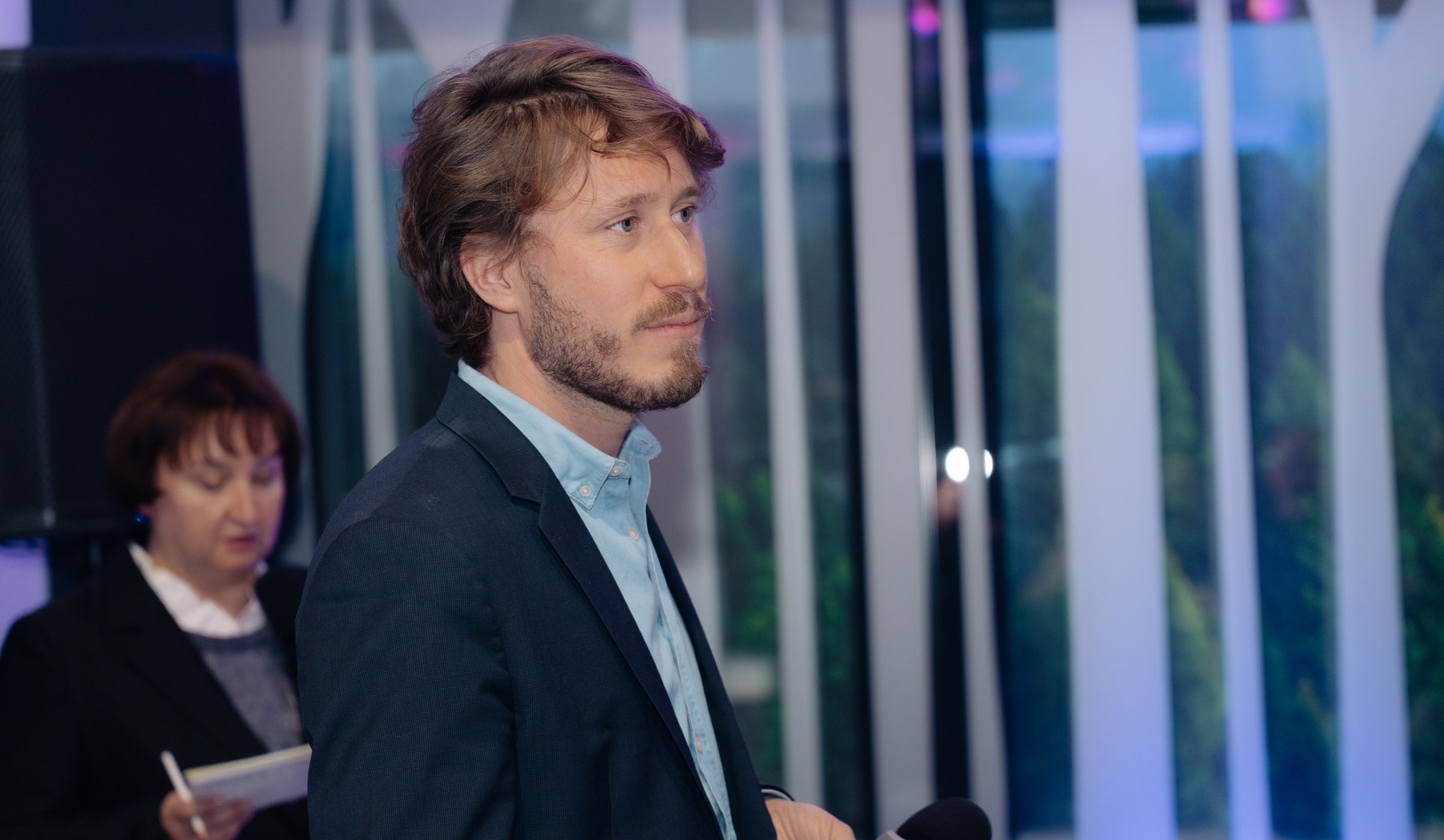
A: We are always looking for “ambassadors” for Ukraine — well-known figures who can give Ukraine a voice here in France. That is how we met chef Thierry Marx. He is extremely well known in France because he hosted a culinary TV show and runs Michelin-starred restaurants. But what is also important is that he is a former soldier, a paratrooper in the French army, who was wounded in Lebanon. After being injured and leaving the army, he found the strength to completely reinvent his professional life. In my view, this is a very inspiring example in the Ukrainian context. And Marx is a very strong supporter of Ukraine.
Having such a voice as Thierry Marx — highly respected and influential — is extremely important. His culinary school now helps train veterans, former soldiers, and internally displaced people in the culinary profession. At his schools in France, in Le Havre and Toulouse, two groups of Ukrainian IDPs from Mariupol have already completed training. About 80% of the Ukrainian students who studied with Marx in 2024–2025 are now working in restaurants in Ukraine or have started their own businesses.
Based on this experience, we hope that within a few months we will be able to open the “Cantine de Mariupol” in Dnipro — it will function as a school, a restaurant, a bakery, and a coworking space.
Q: You also mentioned that you were looking for simple and inexpensive ways to ensure a “Ukrainian presence” in French cities. What was your library initiative, and did it work?
A: Last year we launched a campaign called #DesPagesJaunesetBleues (“Yellow and Blue Pages”). We proposed that French cities purchase books by Ukrainian authors translated into French and place them in municipal libraries. It is symbolic and easy to implement. A book costs between €5 and €30, but it means a bit of Ukrainian culture — a bit of Ukraine — appearing across France.
More than 300 cities have already done this, so it clearly works. Most importantly, those books will remain in libraries permanently. Every time someone visits the library and comes across one of them, they may think: “Oh, this is Ukrainian — interesting, I should read it.” And libraries in France are very active institutions: they organize events, local media cover them, and they maintain social media pages. In other words, people will keep talking about Ukraine. That is extremely important.
Q: Finally, could you explain why you care so deeply about Ukraine?
A: It is probably something very personal. For me, Ukraine is also my country — I hope Ukrainians do not mind me saying that. It is the country of my children, of my wife, of my family. I have lived there and I want to live there again. My connection to Ukraine is not only about places or belongings — my friends are there. So in a way I feel Ukrainian “by adoption.”
And I have only one wish: to return to a peaceful Ukraine. I want to help work on its development and reconstruction. There will be an enormous amount of work to do.
Lidiia Taran led this conversation. Paris
Photos via the SWU association
association