
Germany is one of Ukraine’s largest partners in many areas. One of the key aspects of this cooperation is in the medical field, which has developed especially since the start of the full-scale invasion.
The main program of collaboration between the German and Ukrainian healthcare systems is the Hospital Partnership, which currently includes over 30 German and 80 Ukrainian hospitals across 20 regions of Ukraine. Through this program, medical professionals from both countries help provide people with essential medical care during the war. This is not just immediate support, but also efforts to strengthen Ukraine’s healthcare system for the future and prepare it for the country’s accession to the EU.
On the German side, the program is supported by several specialized ministries and is mainly implemented by the German Agency for International Cooperation (GIZ). Thanks to this initiative, since the start of the full-scale Russian invasion, over 900,000 Ukrainian patients have received a second chance at life.
Among the program’s hospital ‘partnerships’ is the Scientific and Practical Center for Pediatric Cardiology and Cardiac Surgery of the Ministry of Health of Ukraine and one of Europe’s most renowned and leading hospitals in Germany, Berlin’s Charité. The Charité is not only a partner of the Kyiv Center but also collaborates with several other Ukrainian medical institutions in different regions of the country.
Ukrinform’s correspondent spoke with Andrii Maksymenko, Medical Director of the Center for Pediatric Cardiology and Cardiac Surgery and Doctor of Medical Sciences, during his visit to Berlin’s Charité hospital about how Russian attacks prompted German cooperation, field surgeries for young patients in gray-zone areas, and life-saving equipment sent from Germany.
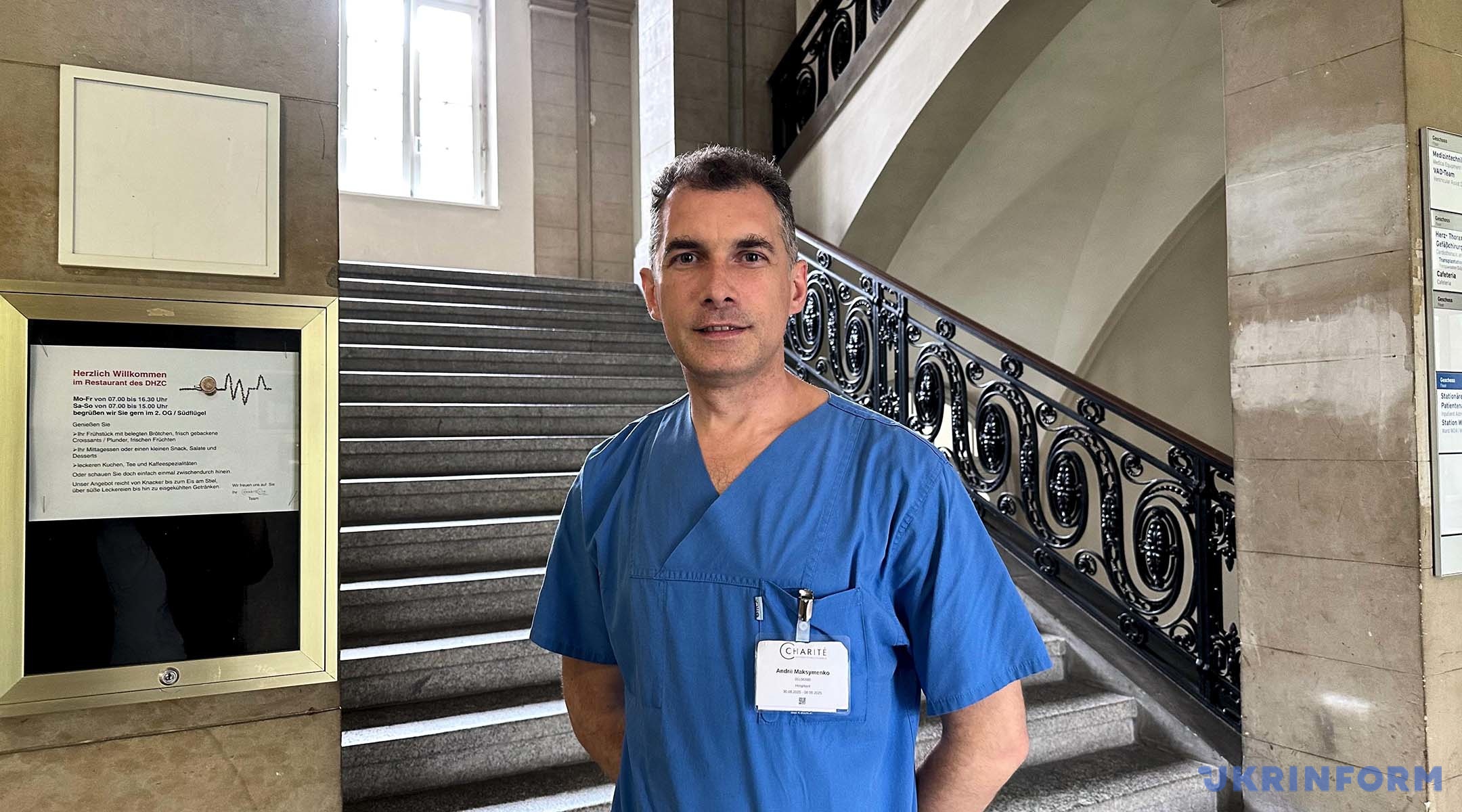
LEARNING ALTERNATIVE TREATMENT OPTIONS
– Mr. Andrii, the Ukrainian Center for Pediatric Cardiology and Cardiac Surgery hardly needs an introduction — everyone knows about the qualifications of your specialists. The recovery rate at your Center is even higher than in some European countries. So, what can Ukrainian doctors learn from their German colleagues?
– The biggest obstacle to progress is when a specialist thinks they already know everything. There is always something to learn, especially at one of the most advanced hospitals in Europe — the largest in Germany — where congenital heart defects in children are treated. In medicine, there are always many open questions, since different approaches often yield very similar results. This is because each pathology has its own specific characteristics that respond better to one method of treatment or another. Every child is an individual case, and each institution has its own approaches. Here at the Charité, as in our Institute, the number of consultations, surgeries, and the complexity of cases are comparable. In this sense, we are learning alternative treatment options for various congenital heart defects.
There is indeed much to learn here. Some aspects differ fundamentally from what we have in Ukraine, and we can use these insights to improve our outcomes, to shape development plans for our Institute, and to help our staff grow into professionals of a truly European level.
We are all waiting for the war to end on terms favorable to Ukraine. If we are well-prepared, we will be able to quickly overcome the setbacks that may arise, restore growth, minimize losses, and improve our work thanks to the experience we are gaining in clinics like the Charité.
MISSILE STRIKE ON KYIV HOSPITALS SPURRED COOPERATION
– Will you, please, tell us how your cooperation with the Berlin university hospital began, and about this particular visit to Berlin.
– We began active cooperation with the GIZ after the missile strike on medical facilities, during which our Center was also damaged (during the missile strike on Okhmatdyt on July 8, 2024, the nearby Center for Pediatric Cardiology and Cardiac Surgery, where even newborns undergo heart surgery, was also hit – ed.). Thanks to these new contacts with the GIZ, we launched a program to provide our Center with certain medical equipment, purchased in the EU and transferred to us as humanitarian aid. We are very grateful for this.
Later, we were invited to join another program organized by the GIZ – Hospital Partnership. That was at the end of last year.
We established contacts with the Charité, and after six months of preparation, the first team of five arrived at the end of this summer: a cardiologist, an intensive care and anesthesiology specialist, a surgeon, an interventional cardiologist (who performs operations without incisions), and myself as an administrative representative. This team covers all areas of our Center’s work. It is the first visit, lasting just under a month. I am returning earlier, while my colleagues will stay on, and upon their return each will be able to bring positive insights to their work in Kyiv.
– So, the doctors can be present during surgeries, can’t they? Do they just observe in the operating room, or are they involved in the process?
– This program provides for observation and professional exchange, but not direct contact with patients. We can be present in the operating room, in laboratories, during all procedures, as well as at organizational meetings and discussions, but we do not directly participate in patient care.
– And have you met Ukrainian patients here at the clinic?
– Yes, I have met at least one young patient.
EVEN FROM EUROPE, PATIENTS CONTINUE SEEKING ADVICE FROM UKRAINIAN DOCTORS
– Since the start of the full-scale war, many women with children have left Ukraine, most going to Germany. Has this reduced the number of patients in Kyiv?
– Yes, the number of patients has decreased. But it’s encouraging that the patients we treated continue to reach out to us even while in the EU — either to organize a return for surgery in Ukraine or to consult and hear our opinion on treatment approaches offered to them abroad. They trust us, sometimes even more than doctors in European hospitals.
– Do you have statistics on how many of your patients left?
– In the first six months of the war, we lost up to 30 percent of our activity. However, by mid-2022, the number of consultations and surgeries had returned to 2021 levels. This was thanks to increased communication with regional doctors, outreach consultations where our doctors traveled to frontline areas, gray zones, and recently liberated territories to provide on-site consultations for children who could not travel to Kyiv or were afraid to do so.
Our Center has always been, and remains, the main institution for treating congenital heart defects in children.
– How often do these outreach consultations take place?
– Since mid-2022, they’ve been regular. We launched the program immediately after the liberation of Kyiv region. It was directly overseen by Yuliia Leonidivna Kiian, Head of the Department of X-ray Angiography and Endovascular Surgery.
Over 6,000 patients have received professional recommendations through these outreach consultations. Depending on the season, they occur about once every two weeks; in winter, less frequently due to safety and logistical challenges.
– Do you operate only in Kyiv, or do you also perform surgeries on-site?
– Yes, we have conducted on-site surgeries, mostly in maternity hospitals and perinatal centers in the regions. This is usually for premature babies with low weight, where transportation could worsen their condition. Even if we manage to transport them, it could set back their recovery despite a successful surgery. In such cases, when the risk is too high, we operate locally. This is rare, roughly once a month.
– Have doctors from the Charité visited you since the full-scale invasion began?
– We have good contacts with doctors there. Two of our specialists, who worked with us for a decade in the early 2000s, are now surgeons at the Charité. We maintain friendly professional communication with them; they help with organizational matters and also acted as coordinators for the Hospital Partnership program during our visit here.
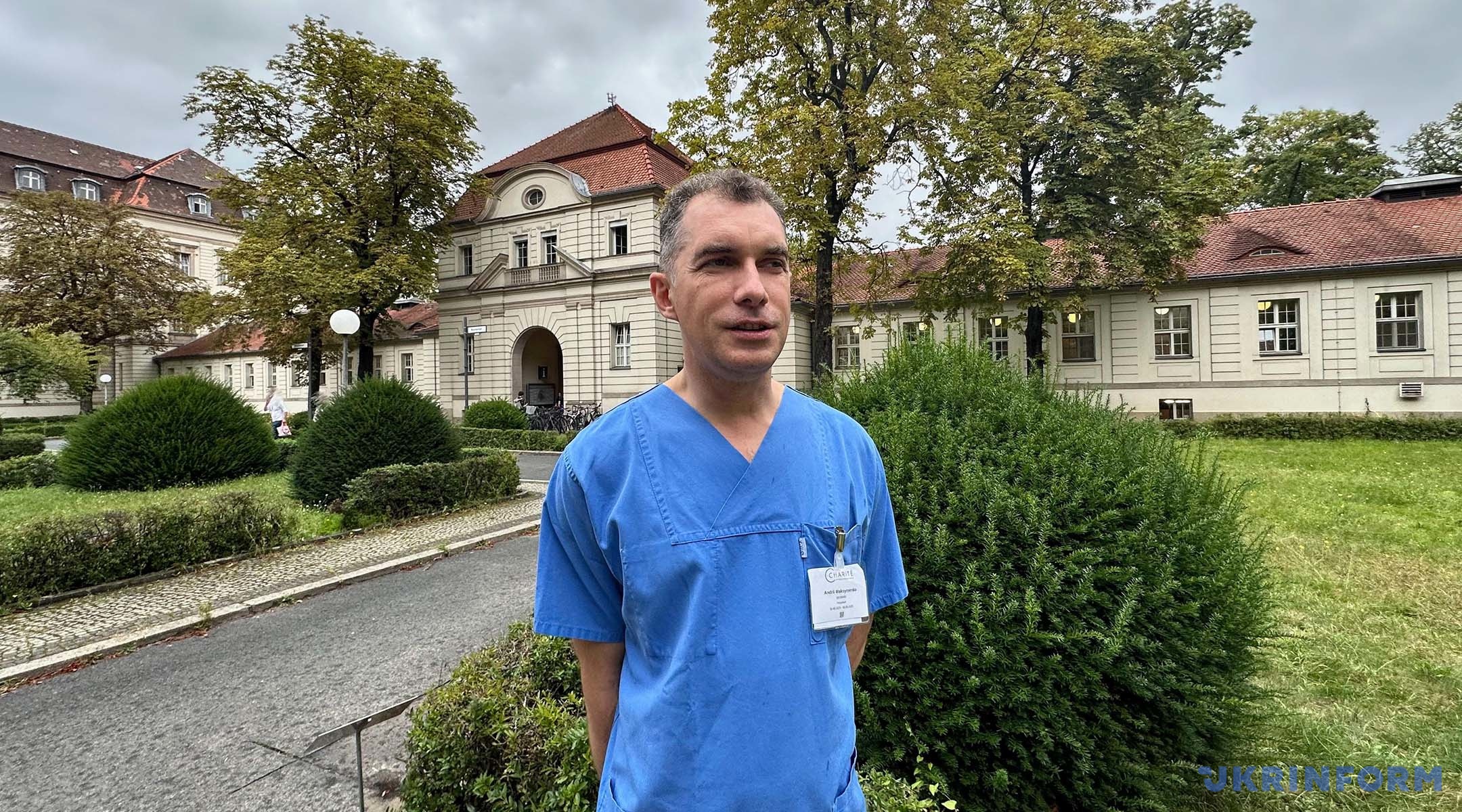
EXPECTING SEVERAL LIFE-SAVING DEVICES FROM GERMANY
– Is Germany the main donor of aid?
– Yes, absolutely. Germany and the GIZ are among the primary donors. Thanks to the program, we expect to receive this month a stationary X-ray machine and three unique ventilators for neonatal intensive care, with high-frequency ventilation modules that are crucial for the most critical patients — premature infants and babies with serious lung problems. These ventilation systems literally save lives, as there are no alternatives.
It’s also very important that we do not receive money directly. All assistance is material, not financial, so we avoid handling cash and receive from the GIZ exactly what we need to work effectively.
– Clearly, you have unique specialists whose work gives many young Ukrainians a chance at a healthy life. Such specialists are vital for the Center. Have many doctors and nurses gone to the front?
– A few doctors are now working on the frontlines and in frontline-adjacent areas — at triage points and providing primary medical care.
Cooperation with German partners, the GIZ, and the Charité allows us not only to continue treating patients but also to learn even during the war — acquiring new knowledge, gaining alternative perspectives, and studying different approaches. This helps raise the level of our specialists, improve treatment efficiency, and establish local networks for future collaboration: conferences, consultations, discussions of complex cases, and more.
For doctors who have been completely absorbed in their work for over three years, this is also an opportunity to discover something new, break the routine, and learn alternative ways to solve everyday challenges. These factors enable us to maintain the front, support the rear, and ensure prospects for the country’s development.
Olha Tanasiichuk, Berlin
Photo by the author
Photo by the author