
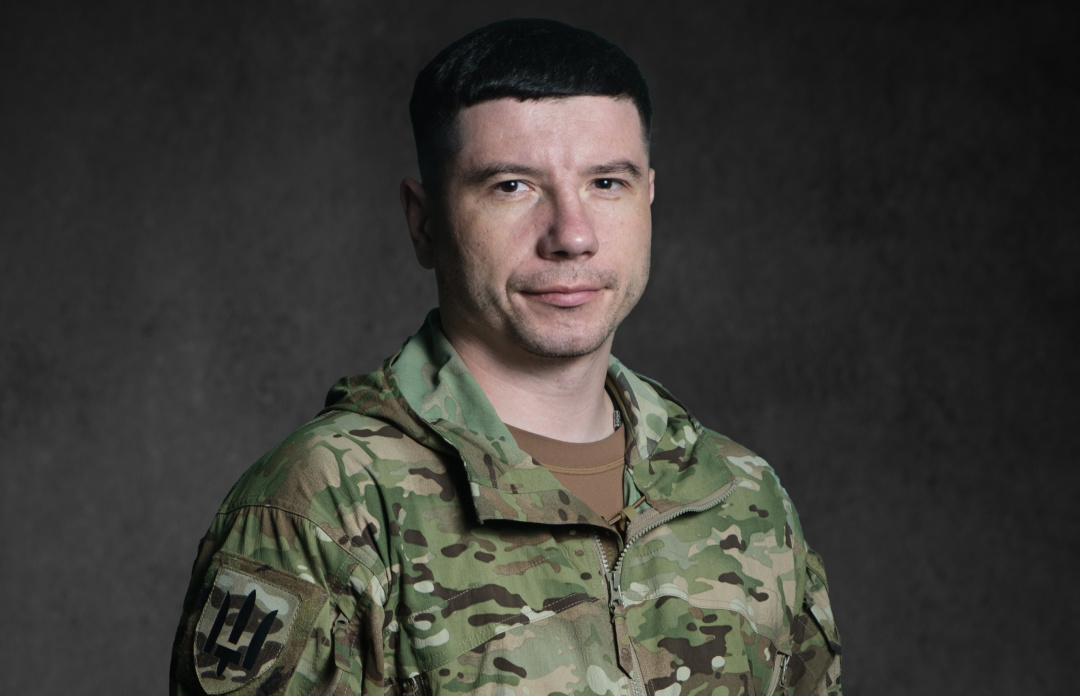
Major Dmytro Rohoziuk, the commander of the 60th Separate Mechanized Brigade, belongs to a new generation of officers shaped by the war since 2014. In an interview with Ukrinform, he shares his experience defending Kyiv, fighting on the Zaporizhzhia, Bakhmut, and Avdiivka axes, talks about his unit’s current confrontation with the enemy in the Lyman area, and explains why modern warfare requires constant adaptation—how command-and-control systems and bottom-up initiative affect force’s resilience.
- Tell us a bit about yourself before the war: what were you doing in civilian life? Did you plan to connect your life with the army, or was it more a conscious choice pressurized by circumstances?
— I studied at the Lviv State University of Life Safety, after which I joined the military on a contract. At that time, the army was a peacetime force: I arrived at my unit in December 2013, and in January 2014 I signed the contract.
I experienced the Revolution of Dignity already as a serviceman. Because of this, I could not be present on the Maidan physically, but I stayed in constant contact with friends who were at the very epicenter of events and followed everything through the news.
Then the annexation of Crimea began. I was serving in a transport aviation brigade, and it was our airfield where aircraft evacuating from the peninsula were landing. We communicated with officers who were leaving Crimea, so I had a clear understanding of what was happening there.
Then the Anti-Terrorist Operation began. At that time, I was mainly involved in providing rear-area logistical support to the force groupings that were conducting combat operations in the East.
My contract ended in 2017. Due to changes in the legislation, I had the right to be discharged, and I took advantage of it. At that time, I did not see myself as a career officer in the Armed Forces as they were then. With my personality, it was difficult for me to find common ground with certain commanders, and I felt that I could achieve more in civilian life.
After returning to Vinnytsia, like-minded people and I set out to revive the football club Niva in order to bring professional football back to the city. We succeeded, and later I became the club’s owner. Before the full-scale war, I transferred the ownership rights to the team’s then captain, Artur Zahorulko, who remains the club’s owner and president today. I am grateful to him for continuing on this path.
And on February 24, 2022, there was no longer any choice left. I had military experience and understood that I had to return to the army. I did not want to go back to my old unit, so, having many friends in the Azov Regiment, I decided to join them in Kyiv. This decision was made without hesitation.
- How and when did you reach the front at that time, and which missions stand out most in your memory?
- Formally, my military experience began back in 2013–2014, at the start of the Anti-Terrorist Operation. But at that time, I was more indirectly involved in combat operations. I gained real combat experience in February 2022, during the defense of Kyiv. That was when I first felt war in its most intense form—when you are directly responsible for people and for carrying out a combat mission on the front line.
- How did February 24, 2022 begin for you? Where were you, and what did you feel in the first hours of the full-scale invasion?
- On February 24, I was woken by a call from my grandmother before my alarm went off. She said, “The war has begun.” At first, I didn’t believe her and tried to calm her down. But as I was getting dressed, I opened the news on Telegram and saw everything for myself… I reacted calmly: I realized that life had been divided into “before” and “after,” that a new chapter had opened—one that could no longer be closed.
I went to my grandmother’s place to support her. At that very time, the Russians began launching missile strikes on the airfield near Vinnytsia. Loud explosions were heard not far from my home. It became clear that simply “calming” my grandmother would not be enough—I needed to choose the right words and explain the new reality, which is what I did.
Then I went to the office of our Centuria Vinnytsia cell. We gathered there and got in touch with other cells across Ukraine. At that moment, there was no clear understanding of where exactly the enemy would strike from—possibly even through Transnistria toward Vinnytsia. But the next day, some of my friends urgently headed to Kyiv. After returning home, I packed my things and also left for the capital.
- From soldier to brigade commander is a far from easy and certainly not a quick path—at least in peacetime. But during the full-scale war, what key events or decisions shaped you as an officer?
- I met the full-scale war holding the rank of sergeant. That meant I already had experience making decisions and knew how to take initiative and responsibility for people.
I was formed as an officer within the Azov Special Operations Command in Kyiv. After the Kyiv campaign ended, we moved to take part in the attempt to break the blockade of Mariupol, to the Zaporizhzhia axis. Later, the 3rd Assault Brigade was established. I took command of a company within the 1st Assault Battalion. In that role, I went through both the Kherson Oblast liberation campaign and the battles for Bakhmut.
Our battalion was one of the most experienced in the brigade. Naturally, the officer corps—including myself—became a key element in the command and control of the 3rd Assault Brigade. Later, I was appointed deputy commander of the 1st Assault Battalion, and in that capacity I went through the entire Bakhmut campaign.
After a short period of recovery, the brigade moved to the Avdiivka axis. There, I was already working as the head of the operations department of the headquarters—the chief of planning of the 3rd Assault Brigade.
When the formation of the 3rd Army Corps was announced, I was tasked with setting up the corps-level planning and employment management structure and taking up the position of deputy chief of staff of the brigade. At the same time, the 60th Separate Mechanized Brigade came under our command. I was already familiar with it from its actions at the front, had visited its command post more than once, knew its officers, and had a positive impression of the brigade—particularly because of its role in the liberation of Kherson Oblast.
At the same time, the 60th Brigade needed changes and a “new breath.” The first personnel decision in the corps to replace a brigade commander concerned it specifically. The corps commander summoned me and ordered me to prepare to assume command of the 60th Separate Mechanized Brigade. That is how I went from sergeant to brigade commander.
- Which day during these years of war was the hardest for you—morally or professionally?
- If we are not talking about a specific battle but about an internal turning point, the most difficult decision was moving from the NCO ranks into the officer corps. That is the step after which there is no turning back.
An officer must constantly engage in self-training and self-discipline, demanding more from himself than he may think he is capable of enduring.
If we talk about combat, every battle is difficult in its own way—regardless of whether you are a soldier, an NCO, or an officer at the company, battalion, or brigade level. Of course, it is always hardest for the infantryman on the front line. My task in my current position is to make decisions so that, there on the forward edge, it is at least a little easier. That is probably the main challenge, and my experience from the trenches helps with this.
- Where was it the most difficult and why?
- When we were near Kyiv, it seemed that nothing could be harder than that. Then there were the battles on the Zaporizhzhia axis—and there, too, there were days when we thought, “This is as hard as it gets.”
After that came Bakhmut. And then, too, it seemed like the peak of intensity. Then Avdiivka came along and showed that the war could be even harsher.
Then there was the Kharkiv axis. At first it seemed easier compared to Avdiivka, but over time it, too, revealed its own very difficult circumstances.
To explain how everything changes… At the beginning of the Bakhmut campaign, when planning combat operations, we took into account about five key factors. By the end of the campaign, there were already 12–15 such factors. Today, there are several dozen more.
The battlefield is constantly becoming more complex, with new threats emerging. So I believe the hardest days are still ahead.
- What is the most difficult thing for you in the position of a brigade commander? What do you have to struggle with every day—both on the battlefield and beyond it?
- The hardest thing right now is to build a command-and-control system that will function regardless of where the commander is physically located—at the command post, in a meeting, or out in the field. The system must respond to the enemy’s actions without failures and prevent mistakes caused by the human factor at any level.
Every day, the main struggle is with myself: not to cling to old experience, but to keep looking ahead. Experience is needed not as an “ultimate truth,” but as a tool for analyzing new information.
The battlefield is changing very rapidly. The density of drones, strike systems, and surveillance and control assets has increased many times over this period. That is why the approach must be constantly creative, not based on “how we did it a year or two ago.” Experience from five years ago—let alone ten—simply does not work anymore in many respects.
Among the external challenges is the need to defend one’s position within the framework of subordination. If a commander is confident that a certain decision will be beneficial on the battlefield, he must voice it and argue for it convincingly. Remaining silent or explaining it poorly is also a mistake.
Within the brigade, I expect precisely bottom-up initiative from battalion commanders. Their proposals should rise upward, and from the top down there should be decisions that take this initiative into account. Then everyone understands what they are doing at a given moment, why they are doing it, and what the ultimate goal is.
- What principles guide you when making combat decisions? Do moments of doubt arise, and how do you deal with them?
- I don’t really like the word “principles” in this particular context. What matters most is a clearly defined objective. When I took up the position of brigade commander, I restructured the defense based on the brigade’s specific objective that I had set. Every combat decision must serve that objective.
One of the key points is not to allow the enemy to impose their will on you and force you into an “either–or” dilemma. If your decisions are reduced to such dilemmas, it means something has been done wrong.
When the system works as appropriate and planning is consistent, decisions are made faster than the enemy’s. Then there are no “unnecessary” hesitations: you know the objective you need to achieve, and your unit understands the logic behind these actions.
As for doubts: this may sound bold, but I don’t really have doubts. There is a discussion phase, when we and the commanders examine different courses of action, assess risks, plan a day, a week, a month ahead, or sum up results. At this stage, questions and differing viewpoints may arise. But once everything has been discussed and a decision has been defined, the doubts end.
The main thing is to have reliable support among your subordinates, to know their capabilities and their moral and professional qualities well. Then you can allocate resources on the battlefield correctly and be confident in those you entrust with carrying out missions.
- What qualities do you value most in your subordinates? Do you feel the brigade as a community, as a “big family”?
- First and foremost, I value “intelligent initiative.” Every unit commander or service chief should not merely carry out orders, but propose solutions and see what can be done better.
The second important quality is continuous self-development. A person should not become locked into the knowledge they have already acquired. They must be ready to learn, to change, and to accept new things. It is precisely such people who meet the demands of modern warfare.
After several months of work in the brigade, I can see that the team has found a “new breath.” Many have begun to work seriously on themselves, strengthening both their professional and leadership qualities. People are not leaving the brigade—on the contrary, they want to join us.
We are gradually forming what can be called a large, strong family of the 60th Separate Mechanized Brigade.
- What, for you as a commander, is the greatest reward? What do you think an ideal brigade commander should be like, and do you allow yourself to be imperfect at times?
- The greatest reward for me is when my personnel are recognized. When the people who risk their lives every day under your command receive state awards, commendations from the Armed Forces, or recognition from the country’s leadership—that is the strongest motivation for a commander.
As for an “ideal” brigade commander—you will never be ideal for everyone. I single out three feelings that a commander should evoke in subordinates: some of the personnel may like you, others respect you, and a third group have a degree of fear of you. These attitudes can change depending on the situation, but the unit should not go beyond these boundaries.
Personally, I do not consider myself an “ideal” commander in any way. A sense of one’s own perfection leads to vanity, and vanity “blinds” a person, killing the ability for self-criticism and growth. That is why I am demanding of myself first, and only then of my subordinates.
- Still, how did you perceive your appointment to the position of brigade commander? What did you want to change or strengthen first of all?
- I took the appointment calmly, as a difficult but professional challenge. There was no room for emotions. First of all, I took a notebook and began planning: what needed to be done, whom to involve to strengthen the unit, and which key elements needed to be changed.
The main objective was to preserve personnel, stabilize the situation in the brigade’s defensive sector, prevent the loss of territory, and stop the enemy at the designated lines. I believe the brigade succeeded in doing so.
As for changes: the management approach we practice in the 3rd Army Corps is fundamentally different from what existed in the 60th Brigade previously. The personnel proved ready for change, and in a short time we were able to restructure the command-and-control system.
The key elements are continuous planning (both long- and short-term), dynamic targeting, and integrated fire engagement using all assets available to the brigade, as well as attached forces from higher command. All resources must work toward achieving the objective at hand. This reduces losses and elevates coordination to a new level.
Simply put, we are building a system. And a good system, as is well known, “beats individual brilliance.” If the system is well established, it doesn’t even “notice” the enemy—it simply does its job.
- What is distinctive about your brigade? How does it differ from other units of the Armed Forces of Ukraine?
- First and foremost, the 60th Brigade is part of the 3rd Army Corps, where the core principles are initiative, technological sophistication, and continuous training.
The 60th is one of the most resilient brigades of the corps in defensive combat. First and foremost, this is the merit of the infantry, which time and again has proven its professionalism and its ability to hold the most challenging defense lines.
My task as a commander is to do everything I can to ensure that the infantryman is provided to the maximum extent with equipment, firepower, training, and support.
So, the brigade’s distinguishing feature lies in the combination of infantry resilience, a systems-based approach, technological capability, and a continuous training process.
- What matters more to you: equipment, tactics, or morale and psychological resilience?
- Today it is impossible to “invent” some kind of wunderwaffe that would guarantee superiority. We will never have the same manpower numbers as the enemy, so we must prevail through quality. Training the soldier is one of our key priorities. In modern warfare, having untrained personnel amounts to a war crime.
When the personnel are taking a break from physical exertion, we conduct tactical classes as well as military-historical and military-patriotic lectures. This helps maintain order both in actions and in mindset.
We do not single out any one thing as the “most important.” In addition to equipment, tactics, and morale, we place strong emphasis on interchangeability. And I always repeat at meetings: any task that can be accomplished by a system rather than a human being should be accomplished by the system.
- On which sectors of the front is the 60th Brigade fighting today? What is the overall situation there, and what are the main challenges you are facing now?
- Today, the 60th Separate Mechanized Brigade is conducting combat operations on the Lyman axis, holding the main direction of attack of the enemy’s 20th Army. The enemy’s main efforts are focused in specifically on us.
A new approach to command and control made it possible to overcome a critical situation: the front has been stabilized, and we are now repelling all attempts by the enemy to advance deeper into our positions.
The main challenges today are the enemy’s significant superiority in manpower, which enables continuous attacks, as well as the active operations of specialized unmanned systems units in our sector. Countering these units is one of our key priorities.
That being said, the ratio of the enemy’s irreversible losses to ours in the brigade’s area of defense over the past month stands at 1 to 12, which is a proof of the brigade’s high effectiveness on the battlefield.
- What is currently in shortest supply at the front — personnel, equipment, ammunition, or time for training? What is critically important right now?
- We have to start with people. People are the most valuable resource today. And the most important thing is time for their training. Our duty is to do everything possible not to ‘steal’ this time from a soldier. No matter how difficult the situation is, we try to conduct full training courses so that personnel go into battle as well prepared as possible.”
As regards equipment and ammunition, in defensive combat, there is never such a thing as too much ammunition. The more we have, the more lives we can save and the more effectively we can strike the enemy.
The availability of equipment on the enemy’s main axis of attack, where its drone units and specialized formations are operating actively, is always a sensitive issue. But we have equipment, ammunition, and personnel — and they are carrying out their combat missions.”
What is critically important right now is maintaining a balance among these three components, because on their own, people, equipment, and ammunition do not accomplish combat missions.”
- If we compare the Ukrainian army of 2014 with today’s army, where did the key transformations occur? What made it possible?
- The army has changed fundamentally—both in essence and in approaches to service. It’s not entirely correct to compare the overall development of the Armed Forces with the changes taking place within the 3rd Army Corps. However, I am convinced that the level of initiative in our units is significantly higher than the average across the Defense Forces.”
The key driving factor behind these changes is the enemy. It is the enemy who constantly presents us with new challenges. If we did not change, adapt, and learn, the battlefield today would look completely different—and certainly not in our favor.”
If we are to fight to the very end and defend our land, the process of change must be continuous. Comparing a peacetime army with an army that has been at war for eleven years is simply incorrect—they are two completely different realities.
- How has the enemy changed over this time — in its tactics, equipment, approach to warfare, and morale?
- The enemy has changed deep down. The Russian army of 2022 and that of 2025 are two completely different stories. They have moved away from large-scale mechanized breakthroughs with massive columns pushing into operational depth. Instead, the enemy has shifted its focus to the widespread use of unmanned aerial systems and to infiltration tactics, employing small groups to penetrate through our battle formations.”
They analyzed their mistakes, changed their approach, and have improved in many areas. In certain aspects, they already hold an advantage over us. They have adopted many of our practices and managed to scale them up, which creates serious challenges for us. At the same time, in technological terms, we still retain advantages that allow us to hold our positions and strike the enemy.”
- As the year 2025 is wrapping up, what do you think Ukrainian society still does not fully realize about this war? And what will its end mean to you personally?”
- We must clearly understand that no one but ourselves will fight for Ukraine in the way this moment demands. There is no ‘magic wand’—neither from our overseas partners nor from our European allies. No one will come and do the hardest work for us or solve all the problems on the battlefield instead of us. Ukraine is our home, and responsibility for it lies with us in the first place.”
Assistance, support, weaponry, and diplomacy—all of this is important and necessary. But the decisive factor remains us ourselves. That is why we must be ready to stand for our home—not an abstract one, but a very real one: for our street, our city, our community, and ultimately for our country. Recognizing this responsibility is not about fear or fatalism; it is about the maturity of a nation that knows the price of freedom and is ready to defend it.”
Personally, I do not live with thoughts about the end of the war. As a professional soldier, I perceive it as a daily challenge that must be handled here and now. Theoretically, if we speak about the end of the war, for me it would be another major challenge: to preserve as much warfighting capability as we can and to direct all efforts toward building a new army, a new training system, and a new role of the servicemember—soldier, sergeant, and officer—within Ukrainian society.”
Myroslav Liskovych. Kyiv
Photo via Dmytro Rohoziuk’s personal archive
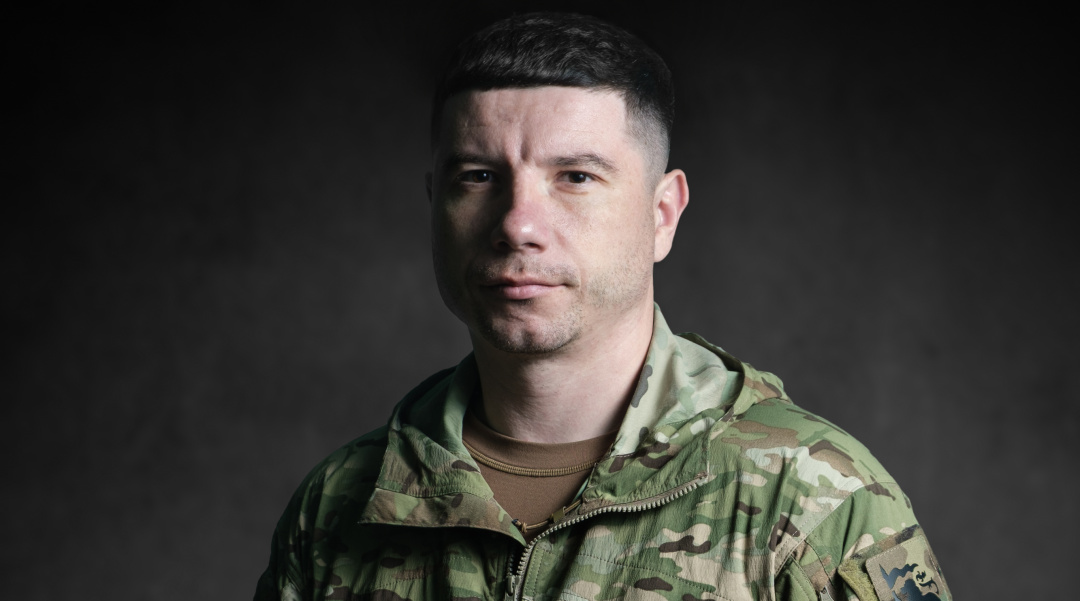
Photo via Dmytro Rohoziuk’s personal archive