
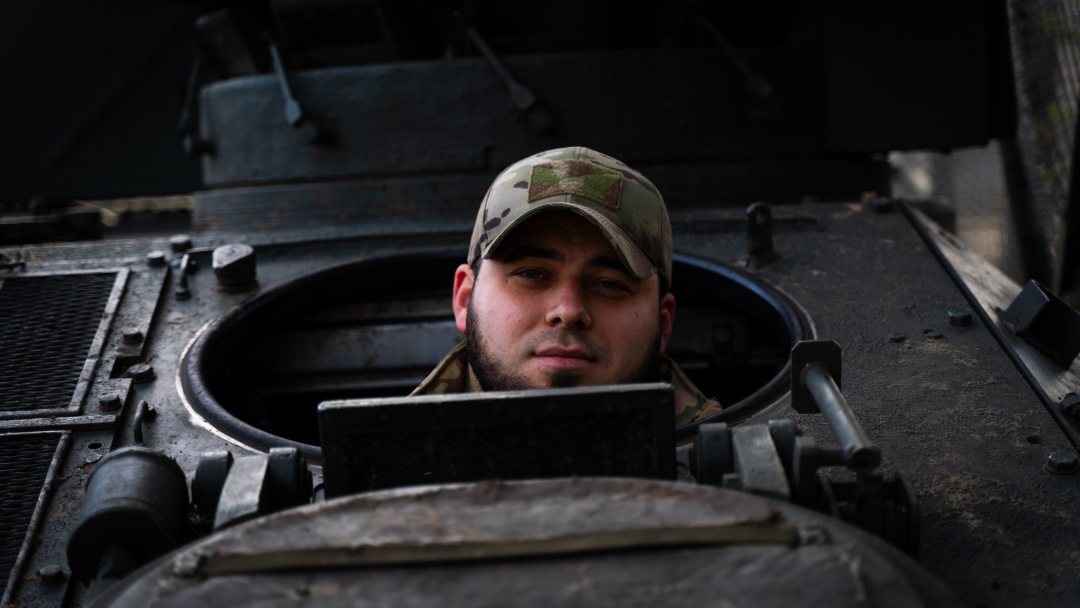
Denis "Rocky", commander of a gun-launched missile division within the 3rd Separate Assault Brigade, belongs to those military men who embarked on their combat carrier long before the full-fledged invasion. A native of a small village outside Vinnytsia, he passed a path from member of patriotic youth movements and the OUN*** [Organization of Ukrainian Nationalists] volunteer battalion to an officer at the 3rd Assault Brigade. He met February 24, 2022 wearing a police uniform, but soon returned to the war zone. Today, Rocky is in command of a team of the artillerymen who were fighting near Bakhmut, Avdiivka, and are currently holding the defense in the Kharkiv region.
- Could you tell us about yourself: where are you from, who were you in civilian life, what was your February 24 like?
- I come from the Vinnytsia Oblast, from the small village of Stara Huta. Around the age of 16, I began to join patriotic youth organizations. And at 19, I joined up as a frontline soldier for the first time – I volunteered for a battalion, served as a rifleman. Therefore, before the full-scale invasion, I already had some minimal amount of combat experience, and I understood that a “big” war was inevitable.
I am 28 now…
I met February 24 while working as a police investigator. We used to often get together with the guys – we had a nice group of guys in Vinnytsia, it still exists, it’s just that currently they are all scattered across different branches of the military. Some are serving in artillery, other in the 3rd Brigade, yet others in the Air Assault Force. The guys from Molot*… It was our Vinnytsia hangout, where we constantly trained in military affairs, tactics, worked a lot on ourselves. At the same time, we provided training to those who wanted it.
Our organization “Molot” never had official status. Rather, it was a group of people who lived a lifestyle of military vibe. These were mostly guys from the Right Sector**, OUN, Azov****… That’s how we stuck together until the full-scale war broke out…
- Where did the call sign Rocky come from? Did you choose it yourself or did you “get it” from your comrades?
- I used to have several different call signs – at least three or so. Why has Rocky ultimately stuck to me? At the time I belonged to the Molot organization, we often had training sessions in Vinnytsia. And that’s the nickname our coach gave me. Training was different: there were moments when you had to fight five opponents at once, who were simply “knocking” you down from all sides, and you had to stand your ground. I always tried to stand my ground until the end, like in the legendary Rocky Balboa movie, where the main character, played by Sylvester Stallone, said that it’s not how you hit that matters, but how you withstand the blow, that is, how you overcome difficulties and blows of fate. I think that's why the coach nicknamed me Rocky. And so it went; since 2015, this call sign has been with me.
- Your first experience – the one you gained at the age of 19… Was it in Azov?
- No, it was an OUN volunteer battalion at that time. It operated in the Luhansk region, near the village of Krymske, was holding positions alongside the 93rd “Kholodny Yar” Brigade.
And February 24… I met that day while in Vinnytsia. Around two in the morning, I got a call from the duty unit: Emergency with enemy! Everyone urgently needs to get to work. Of course, there was no particular enthusiasm, but service is service. I got up and called a taxi. While I was waiting, I scrolled the news: explosions in Kharkiv, Kyiv, Mykolaiv, Kherson… And I understood that what we anticipated had actually begun, although somewhere deep down it was still difficult to accept it.
Weapons are ready for delivery, everybody stand ready. Anxiety arises, because you don’t fully understand what is happening. There is a full information gap between agencies: the National Police, the Armed Forces, the National Guard – zero coordination. The only thing you can trust is the news coming from acquaintances on the front line: there is a Russian convoy here and a breakthrough of our defenses there… And we are in Vinnytsia, Transnistria is nearby – everyone was waiting for something to break out from there.
- Well, it was like this…
- With my experience of fighting in Luhansk, I understood: the district police station is the first potential target. Some pro-Russian “activists”, saboteurs, gangs could get out. First of all, they would attack the police, the office of the Security Service, other security organizations – that is, where weapons are stored.
Good that we had several people with combat experience among us. We quickly rallied the team and built an echeloned defense of the district police station. We were prepared that, if we are under assault, no one would give up their weapons, their station, or the city just for nothing.
But the hardest part, I reiterate it, was the complete lack of verified information. There was a wave of misinformation: there is a sabotage and reconnaissance group (SRG) purportedly operating in the city, an air assault squad purportedly landed somewhere outside Vinnytsia, a convoy is moving in from Transnistria… And you as a police officer have to be the first to respond to all this, to go out and verify.
Over time we gradually established coordination with the Armed Forces, created two rapid response groups. We borrowed, one might say, bulletproof vests and helmets from the nearest military unit. We had our own automatic weapons. And we started working in a more organized way.
February 24 came as huge stress, with emotions that I will never forget. People were not ready for war: female colleagues were crying, some were simply falling into a stupor. Panic was growing. I took the situation into my own hands, I told my colleagues that, if there is a shooting contact, we must be prepared. We swore an oath of allegiance to the people of Ukraine. That was how we survived February the 24th. We held out.
- Your second return to the war zone: how and when did it happen? And why artillery?
- That was simple. A friend of mine and I served in the police at the time, in different departments. He was already an Azov veteran, and I once volunteered for the OUN battalion. We both had our own experience. Many of our acquaintances were defending Mariupol at that time, and we were very worried about them. As long as there was connectivity, we maintained contact.
We even tried several times to get to Mariupol to help de-blockade the city together with the volunteers who got there on helicopters. Everyone who wished so was promised a free transfer - from any organization, be it the Ministry of Internal Affairs, the Armed Forces, or the National Guard. And for us it was a call of honor. Especially knowing that our comrades were in encirclement.
I remember how we were encouraging one of the youngest guys named Dima. He is still in Russian captivity. We said to him: "Dima, we signed up, as soon as there is a chance, we will fly and take you out first." This was a subtle motivation from us to him: we are not sitting idly by, but were trying to break through to them.
But the Ministry of Internal Affairs told us in no uncertain terms that such a transfer was unrealistic, that they are ready to provide moral support, but not to allow the transfer. Then we decided: if they don’t allow us to transfer officially, we will resign at our own will. It turned out not that easy. The superiors were tearing up our resignation reports, saying: “We will not let you go anywhere. Others will go to de-blockade Mariupol, but you are needed here.” We persisted. We wrote to the Main Directorate. And in the end, we were dismissed: first my comrade, then me.
At that time, we were choosing between two units: the Right Sector, which was eventually reorganized into what is now the 67th Brigade, and the Azov Special Operations - because ours were serving there. But, with our experience in infantry, we wished for more. We were purposefully looking towards a mortar battery. We had skills, both as infantrymen and mounted grenade launcher operators. We wanted to operate heavier weapons.
Initially, there were no vacant positions in the Azov Special Operations unit, so we chose the 67th Brigade - they were waiting for us there. But while we were being released from the police, they told us: "Come, but it's not guaranteed we will take you." So, we decided to try and get to serve with ours in the Azov unit. That time around d we were lucky. They said that a new mortar battery was just being organized and they would welcome us.
- What month was it already?
- June, I think it was the fifth or sixth. I remember that day well: at 12:00 a.m. I handed in my certificate, and by 15:00 we arrived in Kyiv. We bought a car then, collected all the gear left over from the [Anti-Terrorist Operation] ATO. We even had our own aiming compass, so that we could immediately start to work on mortars. We were fully charged: “Just give us an automatic rifle and we’ll go. No matter where to.”
But that wasn’t the case. This damn bureaucracy, again. In the first months, it really was a quest to get into the military. The influx of people was huge, everyone wanted to serve. But getting registered not just as a volunteer, but officially was a big deal in itself. At first, we were assigned to a mortar battery, but a little later we found out that there was also a howitzer battery there. And we were like: “Damn, we came to work on big guns, let’s try it.”
The guys who had already had combat experience said: “Don’t even request it, there are no vacant positions there.” But my friend (he is more persistent, knows how to get things done) came in, talked… And they promised to find positions for us. But we didn’t get into Azov right away. We had to wait a little bit before all the paperwork had to be completed again.
…We started working on Soviet-era D-30 howitzers. And again: the Azov Special Operations was being reorganized into what is now the 3rd Assault Brigade. And this is already part of the Armed Forces of Ukraine.
To put it shortly, it wasn’t until September that I officially joined the ranks.
- This bureaucracy did wear out your patience…
- It did it… right! I was angry as a hornet. Because I came to fight for my country – and they won’t let me!
- What was next?
- In September, they told me that I would be leading a platoon within an artillery division. I have a degree from the Odesa Land Forces Academy, but my military specialty is airborne assault platoon commander. It has nothing to do with artillery. The military registration and enlistment office told me: “Your military specialty is completely different.” And I replied, “Yes. But artillery is good for my soul.”
…There was a day that I remember well. I was about to take the position of platoon commander, and I was ready for it. Well, 20 personnel under your command, I can handle it. Well, that was my thought of it. After all, I have experience as an infantryman. What is there to be afraid of? Especially since in the infantry I served with people of very different ages: there were men over 50, there were young guys, there were middle-aged. But mostly older people. And I am really grateful to them for that experience. It was those OUN volunteers who taught me to love Ukraine and to truly fight for it.
And here I come, and they tell me: “The position of platoon commander is gone, you will be in charge of a division.” And I like: “Wow… This is a whole different level. I am even uncertain if I can handle it.”
- Did you handle it actually?
- Well, actually, yes. Although I had to deal with enough difficulties.
- What territories did you have to liberate/defend? Where were the fiercest battles fought? And in which sector are you deployed now? What is the situation there?
- It took several months for me to "assemble" my division. By that time, the division had already participated in the Kherson Liberation Operation. Then "Bakhmut-1" followed. I already got to "Bakhmut-2", when the enemy was bypassing the city from the side of Khromove, when Soledar was already under their control.
And we passed through Bakhmut itself and its surroundings - we were shuttling between different sectors, including the Toretsk area. Then we were redeployed to the Avdiivka direction. And afterwards our brigade ultimately deployed to the Borivka line in the Kharkiv region, where we are holding defense until now.
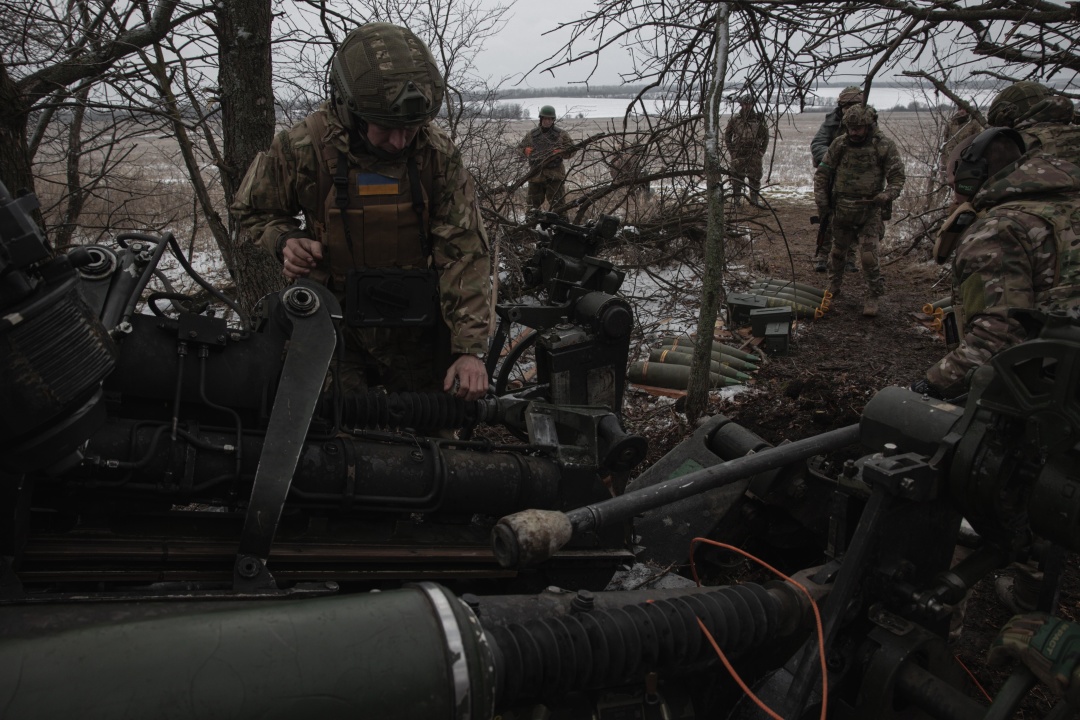
Where it was most difficult? Avdiivka, perhaps. It was real hell there. Work 24/7without a single break. Immediately after we received shells we delivered them to the firing points. We didn’t even have time to think – everything had to be done “here and now”.
In Bakhmut too, I encountered different situations… Departures as part of mixed companies and brigades to which we were temporarily assigned. I was a young commander with zero experience in artillery. So, decisions had to be made at lightning speed – no one had time to train anyone. We had to learn in battle.
But Avdiivka… it surpassed everything that we experienced fighting in Bakhmut. Swamps… Gun vehicles bogged down in muddy terrain. The enemy’s offensive was furious. And you understood: if we don’t have time to put the gun in position on due time, more losses will be inevitable. Our guys. Our brigade. And this is more morally depressing than any shelling.
We ate little, slept even less. Constant movement. We just received ammunition, and at night we are already on the way to an unloading point. From there – to another field depot. The distances were huge. We had to think through the logistic routes so that everything proceeded as quickly as possible. Therefore, all the officers of the division were involved in order to relieve at least part of the load from gun crews, which were constantly on duty or on rotation.
Regarding the drivers… They are worthy of a monument. They used to drive from the firing line to a depot, then from the depot back to the firing line. And so on in a circle. Without breaks. Without days off. It was very difficult there in Avdiivka, not only physically, but also mentally.
- That is, Avdiivka was the most challenging sector during these almost four years…
- Yeah. Our pilots once went on reconnaissance to explore a new observation post. It was ordinary, everyday work. I too got out there, and at lunchtime they told me: a vehicle with our fighters had been hit by an ATGM. The vehicle was destroyed, communication was intermittent. We already knew that there were two soldiers dead and as many wounded. And then silence. Where are they? Are they alive?
I found myself missing until the night. We sat there, thinking over how to do the evacuation. We waited for dusk. There was no information about my orderly. He was the last to get in touch. I called the platoon commander and almost shouted: “What was he doing there? He wasn’t supposed to be there at all!” My nerves were on edge, but there was no solution.
I suggested: “There is an armored Hummer. We will wait – otherwise there will be even greater losses. Let’s break through there and decide on the spot.”
Finally, the division commander ordered that we prepare a vehicle and people and pick him up in the evening.” I breathed a sigh of relief for the first time that day. Before departure, a signal came that the pilot had made contact – he himself had reached the infantry positions and already been provided with first aid. But it was difficult all the same, because I knew that I was going to pick up the dead.
We found them all…
- Denis, you said that you are currently deployed in the Kharkiv region. What is the situation out there?
- I would describe it in words typically used in our TV news releases: the situation is challenging but controllable. We will not give up a single piece of our land to the enemy.
- What kind of commander are you – demanding, humane, tough?
- That’s a difficult question to answer. Many of my close friends with command experience used to tell me: “Rocky, it’s time to switch on commander mode.” And I thought to myself: “Damn, what a true commander should be like?”
To be honest, I am kind by nature. Maybe even too kind. I take everything close to heart – losses, equipment breakdowns, any problems with personnel. But this is not to say that I allow other people to sit on my head. It’s just that each of my subordinates is also my comrade.
But my kindness ends when it’s time to be tough, no choice.
It matters most to understand the people under your command. Each of them is not just a name on a list, but a unique personality. And it is important for them to clearly understand the task: what they are doing and why.
Justice is probably one of the main principles a commander must adhere to. We value this very much. It doesn’t matter who is in front of you – a soldier, a sergeant or an officer. The commander must heed to everyone. Only then will there be trust.
- Would you tell us about your comrades? Who are they? Are they mostly civilians or career military men?
- My comrades are unique people, basically. They come from completely different fields. Most of them are ordinary hard workers. There are a lot of village guys: drivers, mechanics, foresters, those who excel in practical, hand-on jobs. Although there are also IT specialists, businessmen, and doctors... But 90 percent, or maybe even 95 percent are civilians who had no connection with military service until 2022.
- What motivated them to go to war?
- I can't say for the entire unit, because I didn't have close conversations with everyone. But in the division I was assigned to, I knew everyone by name. My personnel are mostly natives of the Sumy region. Russian convoys passed through their cities and villages. They saw with their own eyes what the "Russian world" is like. Those who didn’t have the opportunity to see it personally, heard from their relatives. Everyone wanted to protect their home.
Lots of the guys come from the Ternopil region. Local people have a traditionally strong sense of homeland, and they would rather not see the war reaching their homes. But everyone who came then said the same thing: “Well, we’re here for a year or a year and a half. It’ll end and we’ll go home.”
I replied, “You need to be ready that the war will not end in a year or a year and a half... Because Ukraine has been at war with Russia not since 2014, but for centuries. Even if the guns fall silent in Ukraine, it will be a pause, not the end.”
And now no one says so anymore. Everyone understands why they’re there.
- What keeps you and your unit in good morale during the Great War?
- In artillery, the work is routine, people burn out quickly, so you have to work with them constantly. It helps that in our small family of artillerymen there are always the “sparks” – guys who have been at war from the first days or are simply stronger in spirit. Everything rests on such people. Others look at them and get charged up.
As I noted above, motivation differs among people. Someone has a friend in captivity, someone has lost their home, someone has a family member killed. But the common fire is kept by these small sparks, which do not let the great artillery flame go out.
- When meeting military men, I sometimes hear them saying that war is also life, that there is a way of life there too. Is there any special way of life in your unit?
- War is a special vibe in itself. If you don’t “dive” into it headfirst, you’ll burn out in the first few months. And if you accept this rhythm, it’s easier -- easier to perform tasks, easier to keep up with your comrades.
And there’s no way without black humor. This is perhaps the most effective cure against stress. Constant jokes, pranks – they give emotional relief. In each group there are people who keep the atmosphere going, support others.
Artillery is like a big family. And inside it there are smaller “families” – gun crews, everyone keeps a way of life of their own, following own rules, traditions, own dynamics. This goes from gun crews up to the platoon, battery, division levels.
And in this way we build a big artillery family from smaller families.
- What are the biggest risks and dangers facing artillerymen?
- Two years ago, I would replied thus: the biggest risk comes from hostile artillery spotters. But now FPV and fiber optic-controlled drones have been added to the battlefield and employed extensively by the adversary. This is a new level of danger.
- People from rear areas can be often heard saying they are tired of the war. How do you, your comrades feel about it? How has Great War changed you?
- Talk about fatigue is very demoralizing for the military. Previously, I paid little attention to what they in rear areas say. We are doing all this precisely for their sake, so that the enemy does not reach peaceful cities, towns, villages. But when your work is no longer appreciated in the back, this cannot but affect morale in the field. This affects even people like me, people with combat experience.
But we try not to focus on this too much. Though… Sometimes it happens that you wake up in the morning and think: “How did it all go wrong…” You seem to be completely burned out, are reluctant to do anything. But one comrade comes, then another one, saying, “We have to do this first then that next”. There are a lot of tasks that don’t even let you think about how tired you are of this tempo.
Combat tasks, movements, meetings, jokes – all this keeps you in good morale. And you just work for the good of Ukraine.
- How has the role of artillery changed? Does it retain its status as the “King of the Battle”? How exactly have drones changed the role of artillery in terms of reconnaissance, precision, and the tempo of battle?
- We will not give up our status as the “King of the Battle” to anyone. Indeed, technologies are advancing rapidly, and that is good. Only those win who learn, analyze, adapt. But artillerymen will not give up their place even to UAV pilots.
Indeed, we may lag behind a little bit in some aspects, such as precision, for example. But there are roles that drones will never be able to do instead of artillery. Bad weather, lack of communication, a repeater failure – and that’s it, UAVs are powerless. And we, artillerymen, can work always and everywhere. Just give us “eyes”, a picture, and we will put the shells exactly on target. And it doesn’t have to be a picture from the Mavic drone. We can adjust ourselves even to an infantryman at an observation post. Therefore, you definitely won’t knock us out with drones. Though the future of warfare belongs to UAVs. This is for sure.
As regards coordination … We are trying to combine roles to the maximum degree possible: a strike with FPV drones supported with artillery fire. This synergy yields fantastic results.
- What does Ukrainian artillery require the most today – ammunition, barrels, equipment, manpower?
This is long-range ammunition in the first place, followed by equipment, most particularly armored vehicles for transportation, evacuation, and to support personnel rotations.
And manpower… Though the artilleryman operates further away from the infantry, it is also a very physically demanding job. Not everyone can carry 50+ kilograms of ammunition without stops every day and stay healthy. People are always in need.
In terms of barrels, we are fine with this, more or less. Indeed, they wear out, are damaged somewhere or destroyed by the enemy. But, in my opinion, the most critical thing we require now is long-range shells and people, followed by equipment and barrels.
- How do you assess the Ukrainian [mobile howitzer] "Bohdana"? Can it become the core of Ukraine’s long-range artillery capability?
- Our division currently fields the 2P22 "Bohdana-B" - a trailer modification of the self-propelled 2S22 "Bohdana" howitzer. It provides several advantages, most particularly in terms of availability. Ukraine can currently produce these guns in large quantities, and this is a huge plus. Of course, Bohdana, like any new system, suffers from “childhood diseases”, but we constantly provide user feedback to the manufacturer and immediately work on removing imperfections. So, my conviction is that the Bohdana will be a worthy replacement for the Soviet-era systems currently in our military inventory.
- Photos often appear on social networks showing artillerymen writing messages on shell cases. Do you maintain such a tradition? What messages do you leave, if any?
- Yes, I think this tradition is followed by almost every artilleryman. Most often, they write call signs or real names of fallen comrades - a kind of way of honoring. There may be greetings on someone’s birthday or wedding anniversary - and the guys remember this even during the war. This is our inner vibe. Acquaintances from other units often request that we send greetings to the orcs from Stepan, for example. And we do so.
Will the orcs read these “greetings” or not? I hope not. Because if they read them, it means that the shell didn’t explode. And that’s bad.
- How has Russian artillery changed during the war in terms of tempo, quality, technology, tactics? Does the enemy still fight mostly with old Soviet-built guns?
- The enemy is learning, that’s a fact. Yes, they lag behind us in terms of speed, agility, and modernization, but they don’t stand still. A year and a half ago, I saw their whole batteries working: they would go out, deploy guns “as books instructed” and conduct firing by batteries or even divisions. That doesn’t happen now as they can’t afford it anymore.
We have inflicted severe losses on them using all classes of artillery – rocket, self-propelled, and towed. So, they don’t scatter in systems as they did previously. They would rather dig them into the ground, cover with camouflage nets, hide them from our scouts and FPV drones. They are already operating with single guns, placed at different positions, meaning we have exhausted their gun inventories. We continue to fight them quite successfully, I believe.
- Who has the advantage in artillery duels today? And why? At the beginning of the full-scale invasion, the enemy outnumbered us by a factor of ten in artillery, and even more in the number of shots made. And what are the ratios now?
- In terms of the total number of barrels, the enemy has more and more of them. It is no longer 10 to 1, as it was at the beginning, but about 5 to 1. But this also forces us to work faster and more accurately. We have learned to adapt much more quickly than they do. We must not underestimate the enemy, but we too are growing very quickly.
Therefore, as far as artillery duels are concerned, I believe, the advantage is now on our side: we react faster and “knock out” their systems more effectively than they do ours.
- What do you dream about most?
- My dream is as simple as that: to start a family, to live away from a big noisy city. And to have the opportunity to travel the world. When your eyes see the same picture every day, the same rhythm – you want to break away, see beautiful places, other cultures, other people. Just live a normal life.
- And the last question – what will you do first after the Victory?
- “Victory” is an abstract word, everyone puts their own meaning into it. For me, a true victory is the complete collapse of Russia as a state. So that in its place there are countries that it once absorbed. This would be a real peaceful future.
If there is a temporary truce or a freeze on the war… The first thing I will do is remember every my fallen comrade. There are already a lot of them, starting from 2014. And then… I will try to return to civilian life, no matter how difficult it is.
Myroslav Liskovych, Kyiv
* Bilyi Molot (White Hammer): Historically, this was a radical nationalist group in Ukraine during the 2014 Euromaidan protests. It was a minor group within the coalition known as the Right Sector.
** The Right Sector --a Ukrainian nationalist movement that functions as both a political party and a paramilitary organization with units integrated into the Ukrainian Armed Forces (AFU). It views itself in the tradition of historical Ukrainian partisans like the Ukrainian Insurgent Army (UPA) and advocates for building a strong, independent nationalist state.
*** The OUN was a Ukrainian political organization established in 1929 in Vienna, Austria, by the merger of several radical nationalist groups. Its central objective was the creation of an independent, sovereign Ukrainian state through revolutionary means and armed struggle against the various foreign powers occupying Ukrainian territory at the time (primarily Poland and the Soviet Union).
****Azov – the term refers primarily to the 12th Special Forces Brigade Azov, a professional and highly effective military formation within the National Guard of Ukraine that has gained global recognition for its role in the defense of M